On the “new” Supreme Court

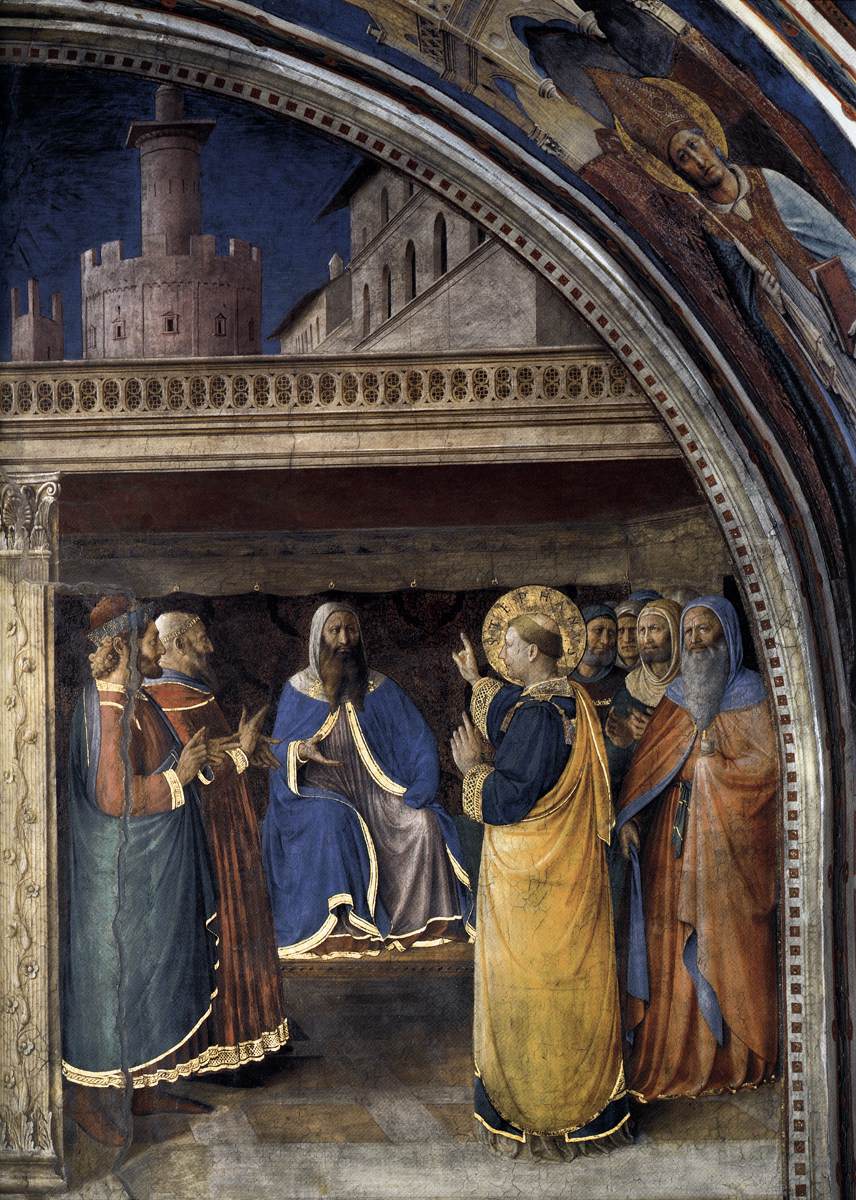
Moses as the original supreme court, on advice and counsel of  his father-in-law Jethro

*   *   *   *

The U.S. Supreme Court is in the news, again…

Last Saturday night I was channel surfing at home.  (Waiting for a ride to The Buddy Holly Story at the Legacy Theatre, Tyrone GA, shown at right.)   One channel had this news flash: “Antonin Scalia, Supreme Court justice, dies at 79…”

I was shocked, to say the least.

Later – at the theater – I mentioned Scalia’s death to a young(er) lady-friend.   (Whose political views are slightly to the right of Attila the Hun.)  She said something to the effect that now “that [expletive deleted] Obama” would be able to name a new Supreme Court justice who would – shall we say – “tilt the balance of power.”

I didn’t expect her vehement response.  (Heck, the poor guy wasn’t even buried yet.)  So – diplomatically – I smiled and changed the subject.  However, after further review I thought her presumed outcome unlikely.  (With Republicans controlling the Senate and all.)

With that in mind – and after more time to review – allow me to prognosticate.

With the presidential election less than nine months away, there’s a pretty good chance Senate Republicans will block any Obama nomination.  Which means the next president will have to pick his – or her – favorite nominee, but possibly with a different Senate.

Which is another way of saying conservatives could settle for a moderate nominee now, or risk seeing a truly liberal nominee confirmed in the foreseeable future.

The thing is, in the recent past the balance of power in the Senate has shifted every two years or so.  And in 2016, 24 Republican senators are up for re-election, compared to only ten Democrats.  (Including “seven in states President Obama” – at right with Mitt Romney – “carried twice.”)

So even if the next president is Republican, he’ll face the same hostile Senate Obama faces now.  (Which could bring more gridlock.)   On the other hand, if the next president is a Democrat, he – or she – will be able to fill the vacancy with anyone he – or she – chooses.

Then of course there’s the fact that newly-elected US senators will take office on January 3, 2017.  On the other hand, President Obama’s replacement won’t take office until January 20.  In other words, if the new Senate is indeed Democratic, Obama will have 17 days in which to name his own replacement.  (And plenty of time to prepare for the Senate’s “nuclear option.”)

Which is one reason I say – if they were smart – Senate Republicans could settle for a moderate nominee now, or risk a true-liberal nominee in the really foreseeable future.

Personally – if somebody held a gun to my head and said, “Make a bet with your total life savings” – I’d have to put my wager on the latter option.

And all of this raises some further interesting questions.  Like, “Have these nominations always been so acrimonious?”  And, “Has the Supreme Court always been this powerful?”  Or possibly, “Just how did this ‘supreme court’ get started in the first place?”

091507-USCNeb-CorsoHerbstreit crop to Corso.jpgFor those who think the Supreme Court was only “invented” as late as 1787’s Constitutional Convention, the answer to that would be, “Not so fast, my friends!”

I noted – in a post in another blog – that the idea of a “supreme court” goes back over 3,000 years ago.  It seems the idea was hatched by Jethro, whose daughter Zipporah married Moses.  (See On Jethro inventing the supreme court.)

That prior post cited Exodus 18:13-27.  Here’s what happened.

Moses grew up a literal “Prince of Egypt.”  But about the time he learned of his Hebrew heritage, he had to run away from Egypt.  (Basically as a fleeing felon.  See Exodus 2:12.)  He fled to Midian, where he met and married the daughter of Jethro, noted above.

Then God made him return to Egypt, to “set my people free.”  While he was doing that, Moses left his wife and two sons with Jethro, in Midian.  Once he accomplished his mission, he came back home and told Jethro all he’d done.  Then he sat down to “judge the people.”

That’s when the trouble started.  (Or more precisely, got worse):

Moses took his seat to serve as judge for the people, and they stood around him from morning till evening.  When [Jethro] saw all that Moses was doing … he said, “What is this you are doing for the people?  Why do you alone[?]  Moses answered him, “Because the people come to me to seek God’s will.   Whenever they have a dispute, it is brought to me, and I decide between the parties and inform them of God’s decrees and instructions.”

Jethro saw right away that the work was way too much for one man.  So he advised Moses – basically – to delegate authority.  He said to “select capable men,” and trustworthy, “and appoint them as officials” – judges – “over thousands, hundreds, fifties and tens.”

These “lower court” judges – illustrated at right – could handle the simple cases, of which there were many.  (After they’d been given the functional equivalent of today’s legal education.)  In turn, with Moses only having to handle difficult cases, “that will make your load lighter:”

Moses listened to his father-in-law…  He chose capable men from all Israel and made them leaders of the people, officials over thousands, hundreds, fifties and tens.  They served as judges for the people at all times.  The difficult cases they brought to Moses, but the simple ones they decided themselves.

And that’s the basic idea behind today’s Supreme Court.  That it will only deal with “hard cases,” leaving minor cases for lower-court judges.  (Like Moses did.)

Of course that was before the idea of the separation of powers.  (Dividing American government into three distinct branches.)  Then too, that was  before today’s nominating process evolved into a true media event.  (If not Media circus.)  

With that in mind I say, “Here’s looking ahead – if not forward – to a fascinating next-nine-months.”

*   *   *   *

In closing, some final notes on Justice Scalia.  Like one from Ethan Bronner (32).  The occasion was Scalia’s first being nominated to the Court in 1986.  (Over Robert Bork, at left, with President Reagan):

Although deeply and somewhat idiosyncratically conservative, Scalia had little real controversy in his record.  Nicknamed Nino, he was also an irrepressibly charming man with a hearty, warm laugh, a weakness for opera, and many friends in both the judiciary and the academy.

And a note that – every once in a while – he could spring a surprise in his opinions.

For example, the 1988 case, Coy v. Iowa.  John Coy was convicted of sexually assaulting two 13-year-old girls.  At trial, the girls testified behind a large screen, so they didn’t have to look at Coy as they testified.  When the case got to the Supreme Court, Justice Scalia wrote the majority opinion reversing the convictions, saying they violated the Confrontation Clause.

In 1989, the Pepperdine Law Review wrote a blistering rebuke of Justice Scalia’s opinion. (And/or his legal reasoning.)  See Coy v. Iowa:  A Constitutional Right of Intimidation:

The Supreme Court’s holding in Coy v. Iowa is infected with faulty reasoning and is inconsistent with contemporary, mainstream confrontation clause analysis…  The new requirement of actual face-to-face confrontation is not supported by logic nor is it founded on legal precedent…  Coy’s addition to this area of the law is not logical, but deviates from a long line of case law and ultimately adds a right that exists solely by itself.  It appears that the Supreme Court has created a constitutional right of intimidation.  [E.A.]

Which leads to a couple more asides.  For one thing, Pepperdine law school isn’t exactly known as a “bastion of liberal thinking.”  For another, Ken Starr – bane of the (Bill) Clinton presidency – served as dean of the law school from 2004 to 2010.  So:

Like I said, sometimes “Nino” could surprise you…

*   *   *   *

A “more conservative” – 1956 – view of Jethro (with Charlton Heston)…

*   *   *   *

The upper image is courtesy of bible-history.com/studybible/exodus/18/2.  See also On Jethro inventing the supreme court.  Or see Exodus 18: Moses and Jethro – Bible Encyclopedia.

Re: Senators up for re-election in 2016.  See United States Senate elections, 2016 – Wikipedia, and 10 senators who could lose in 2016 | The Hill.

The Romney-Obama photo is courtesy of Barack Obama – Wikipedia.  The caption:  “Former Governor Mitt Romney and President Barack Obama shake hands in the Oval Office on November 29, 2012, following their first meeting since President Obama’s re-election.”

Re: Obama’s 23-day window.  See How Obama Could Win Supreme Court Battle — Even If Republicans Take the White House.

The “not so fast” image is courtesy of Lee Corso – Wikipedia.  See also Lee Corso’s ‘Not so fast, my friends’ gets autotuned (Video).

The “lower court judges” image is courtesy of Judge – Wikipedia.  The caption:  “Judges at the International Court of Justice.”

Re: Today’s nominating process as “a true media event:”

…in the modern appointment process, Presidents typically announce their Supreme Court nominations to the nation before broadcast television cameras in carefully staged presidential news events.  In turn, nearly all of the official confirmation process that follows … is conducted in public session, receives intensive news media coverage, and is watched by hundreds of thousands (and sometimes millions) of American television viewers.

See Supreme Court Appointment Process … Foreign Press Center.

The Ethan Bronner quote is from his 1989 book, Battle for Justice[:]  How the Bork Nomination Shook America.  (Anchor Books, published by Doubleday, at page 32.)   Bronner also noted – at pages 117-18 – the prevailing Republican opinion when Richard Nixon was president:

In a publicized letter to Ohio Senator William B. Saxbe, later Attorney General, Nixon accused the Senate of denying him a historic right to see his choices appointed.  That right, he said, had been granted to all previous presidents, and the advice and consent function of the Senate was clearly meant to be no more than pro forma.

Re: Coy v. Iowa.  See also Protection of Child Witnesses and the Right of Confrontation;  A Balancing of Interests.

Re: Pepperdine Law School.  See My daughter’s applying to Law schools – She said Pepperdine?  One person commented that it was extremely conservative and with a “strong Christian bent.”  Another response:  “Is she political?  If so where does she lean?  Pepperdine isn’t exactly a school most liberal leaning [sic] would decide on.”  And finally see The State of LGBT Affairs at Pepperdine University

In 2014, the university was ranked by the Princeton Review as No. 7 on its list of “Top 20 LGBT Unfriendly Schools.”  Pepperdine ranked No. 19 in 2013 and No. 17 in 2011.  College Magazine also ranked Pepperdine as No. 4 on its list of “Top 10 Most Prude Colleges,” in 2012, citing the university’s actions in regard to LGBT students as a factor in its ranking.

Re: Scalia’s opinion in Coy v. Iowa.  He traced the right of Confrontation back to the “Roman Governor Festus, discussing the proper treatment of his prisoner, Paul[:]  ‘It is not the manner of the Romans to deliver any man up to die before the accused has met his accusers face to face.'”   (Not to mention “Richard II, Act 1, sc. 1.”)  He also quoted President Eisenhower,  who “once described face-to-face confrontation as part of the code of his hometown of Abilene, Kansas… ‘In this country, if someone dislikes you, or accuses you, he must come up in front.  He cannot hide behind the shadow.'”

Note also the emphasized phrase, “created a constitutional right of intimidation.”  That seems especially ironic given Scalia’s insistence that judges should not “create new laws,” but must – in the case of the Supreme Court – stick to the Founder’s “original intent.”  See e.g., Scalia Defends Originalism as Best Methodology for Judging Law.

Re: Ken Starr’s tenure as dean of Pepperdine.  See Dean at Pepperdine’s school of law is named president of Baylor University.

The lower image is courtesy of destination-yisrael.biblesearchers.com/destination-yisrael.  Among other things the article  noted, “According to Jewish tradition, Yithro” – Jethro – “did convert to Judaism with his whole family.”  Then too, the image seems to be from the 1956 movie Ten Commandments, with Charlton Heston as Moses.  (And Eduard Franz as Jethro.)


Jesus as a teenager?

James Dean in Rebel Without a Cause.jpg

 James Dean – the quintessential teen “rebel without a cause…”


Did you ever wonder when Jesus came up with the idea that He was Jesus.

Christ, by Heinrich Hofmann.jpgThat He was “special?”  That He was – literally – the Son of God?

That leads to even more questions:  Did Jesus  know the minute He was born that He was “the Son of God?”  Did He – even as a newborn child – have a fully formed adult personality?

Some time ago there was a bracelet trend, “WWJD?”  What would Jesus do?  Turning that question around –  “thinking outside the box” – the question could be put like this:

What would you do – with a fully formed adult personality, able to see and know all around you – yet you were trapped in the body of a baby?

And that in turn raises some more interesting questions.  Like:  What would you do if you could only communicate with those around you, with a smile, a frown, a gurgle or a belch?

To most of us, that would be a living nightmare.  It would be a nightmare to be trapped inside the body of an infant, but have a fully formed adult personality.

Yet many believe that’s just what Jesus went through, from the moment of birth on.

On the other hand, if that isn’t the case, when did Jesus find out?  The only rational alternative is that Jesus did not know who He was at that very minute He was born.  And if that is true, the question becomes:  “At what point in His life journey did Jesus find out?”

Sen. Howard Baker covering mike w. hand as unident. man whispers to Sen. Sam Ervin during Watergate hearings.In modern terms – borrowing a page from yesteryear – the question could be phrased, “What did Jesus know, and when did He know it?

If Jesus didn’t know – the minute He was born – that He was the Son of God, He had to find out later in His life.  And one interpretation of that theory came from the man who wrote Zorba the Greek

Nikos Kazantzakis also wrote The Last Temptation of Christ.  (In 1955.  It became the movie that caused such a stink when it was released in 1988.)  Anyway, in his novel, Kazantzakis theorized that at some point in His life, Jesus started “to hear voices:”

“I fasted for three months. I even whipped myself before I went to sleep. At first it worked. Then the pain came back. And the voices. They call me by the name: Jesus.”

So according to Kazantzakis, Jesus may not have known the minute He was born just how special He was.  He didn’t find out until some time later in His life.

*   *   *   *

Whatever the merits of such a contemplation, it seems pretty clear that throughout the first 30 years of His life, Jesus must have had a world of patience.  And in all likelihood, at no time was that more true than when He was a teenager.

Of course He did have that one chance when he was 12 years old, to impress the elders in Jerusalem.  (See Luke 2:41-50).  But except for that one or two days of “mountaintop experience,” it seems that Jesus still had to endure 30 long years of pure, mundane drudgery.

He had to live quietly and unobtrusively – for 30 long years – before starting His life’s work.  And He had to do this before the people around Him started getting the idea who He really was.  (It must have been something like spending all day in a county tag office, multiplied by 10,950.)

Which brings up another compelling question:  What was Jesus like as a teenager?  Suppose – just for the sake of argument – that by the time He was a teenager, Jesus did know that He was in fact the First-born Son of God.  For one thing, He could see into the future.  And He knew, absolutely knew, everything that ever was or ever had been.

So maybe as a teenager, Jesus did know everything there ever was to know, and everything possible that ever could be known.  Yet there He was, stuck in that backwater, hayseed town of Nazareth, far away from any possible excitement, like what He might find in Jerusalem.

And, probably the worst thing of all for Him was that He had to take orders from older people, people who He knew didn’t know a fraction of what He knew about “real life.”  Of course:

Since every teenager in the history of the world has felt exactly the same way, how could the people in Nazareth know this teenager was any different?

*   *   *   *

The upper image is courtesy of James Dean – Wikipedia.  The caption: “Dean in Rebel Without a Cause.”  The article noted, “Dean’s premature death … cemented his legendary status.”

The image of Jesus is courtesy of Jesus (name) – Wikipedia.  The caption:  “Christ by Heinrich Hofmann.”  The article noted that the name “Jesus” is a “rendition of the Hebrew Yeshua (ישוע), also having the variants Joshua or Jeshua.”  

Re:  “What did Jesus know, and when did He know it?”  One of many phrases – like “Irangate” or “Benghazi-gate” – that can be traced back to the 1972 Watergate scandal.  The phase is credited to Senator Howard Baker, who famously asked, “What did the President know and when did he know it?”  The question was originally written by Senator Baker’s counsel and former campaign manager, future U.S. Senator [and Hollywood star], Fred Thompson.  (See, en.wikipedia.org/wiki/Howard_Baker, and firstthings.com/blogs/evangel/2011/04/what-did-jesus-know-and-when-did-he-know-it.)

The image to the right of the “when did He know it” paragraph is courtesy of 40 Years Since The Watergate Hearings | Getty Images.  Senator Baker is at left, covering the microphone.  Senator Sam Ervin is at the right of the photo, arms folded.

The image to the right of the “contemplation” paragraph is courtesy of that Wikipedia article.  The caption:  “Statue The Spirit of Contemplation by Albert Toft.”  

The lower image is courtesy of krustofsky.deviantart.com/art/Teenagers-Act-Now-261044948.  And an ironic side note:  Harassed has one “r” and two “s’s.”

*   *   *   *

This post was gleaned from earlier posts in my other blog, On Jesus as a teenager, and On Jesus as a teenager – REDUX.

Remember “transcendent” meditation?

Maharishi Mahesh Yogi with the Beatles in India” – in happier times…


Welcome to the “Georgia Wasp…”

This blog is modeled on the Carolina Israelite.  Harry Golden did up that old-time personal newspaper.  And for that he was considered a “voice of sanity amid the braying of jackals.”

That’s now my goal as well.  To be a “voice of sanity amid the braying of jackals.”

For more on the blog-name connection, see the notes below.

In the meantime:

Remember Transcendental Meditation?  In case you missed it, the Maharishi Mahesh Yogi started teaching this method of personal development in 1958.

Prep examples of MadrasIronically, “TM” was said to have launched in Madras, India.  (Now called Chennai.)

In less than a decade after 1958, Madras shirts, shorts and jackets – like those at left – became all the rage.  (“All the rage” for middle school, high school and even college “boys” in the 1960s.)  Getting back to TM:  It also got “more popular in the 1960s and 1970s, as the Maharishi shifted to a more technical presentation and his meditation technique was practiced by celebrities.”

Celebrities like the The Beatles, shown in the top-of-the-page picture

The kicker?  You had to pay through the nose.  (At one point the price for “working folk” was pretty much a full week’s salary.)  For that you got instructed in the technique itself, plus you got your own “personal Sanskrit mantra.”  (Note that a mantra is a word or phrase – said to be of “spiritual power – that you repeat over and over again, for up to 20 minutes.)

One of the goals – of “regular” meditation anyway – is to “bind the mind staff in place.”

File:Picswiss UR-28-18.jpgThat – in a way – brings up that the Maharishi – hereinafter “Mahesh” – did quite well as a result of his teaching.  (The photo at right shows one of his “headquarters;” the one in Seelisberg, Switzerland.)

 On the other hand:  It turns out you could get pretty much the same thing from Lawrence LeShan‘s 1974 book, How to Meditate: A Guide to Self-Discovery.  But of course, that would mean you had to do some actual work, to learn the self-discipline on your own.

(An observation that seems to be “redundant redundant…”)

But we digress!  The point is:  LeShan’s How to Meditate was “one of the first practical guides to meditation.”  And it was a whole lot cheaper than TM.  (My first copy cost $1.95.)

And incidentally, LeShan noted that “anyone who gives (or sells) you a mantra designed just for you … is pulling your leg.”  On the other hand, I remember reading somewhere that Mahesh charged Americans so much – for example – because they don’t value “free stuff.”  They – we – arguably figure that if we don’t pay a high price for something, it must not be worth much.

Which does make a certain amount of sense.  (And a telling comment on the American psyche.)

Be that as it may

We mentioned the Beatles being “converted” to Transcendental Meditation.  As Mikal Gilmore noted, George Harrison’s wife Pattie introduced him to Mahesh in 1967.  Harrison was impressed enough to persuade the other Beatles to “attend a sabbatical in Bangor, Wales.”

Later – in 1968 – the group went to Rishikesh, India, for a longer course.  However:

[T]heir relationship with the teacher soured when they heard rumors that he had attempted unwelcome sexual advances on a female devotee.  Lennon and Harrison confronted the yogi, pronounced their disdain and then left him, despite his pleadings that they reconsider…

On a related note, pretty much the same thing seems to have happened to Rajneesh – born Chandra Mohan Jain – also known as “Osho.”

Osho.jpgOSHO” (1931-1990) was yet another “Indian mystic, guru, and spiritual teacher who garnered an international following.”  In the fullness of time he got nicknamed “the sex guru.”  (But others said he just had “straightforward attitudes about sex.”)  

All of which may prove no more than that men are scum.

(At least from a female view.)

But again we digress.  Getting back to Mahesh and the Beatles, see Maharishi Mahesh Yogi | The Beatles Bible.  As to the group confronting Mahesh about the allegation, Lennon said he had to do the “dirty work … as usual.”  When he said they were leaving, Mahesh ostensibly said, “‘Why?’  Hee-hee, all that shit.  And I said, ‘Well if you’re so cosmic, you’ll know why.'”

The article noted as well that despite “the harshness of Lennon’s words about Maharishi, McCartney and Harrison, in particular, remained believers in the power of meditation.”

Which could be another way of saying that the underlying discipline itself was good and valid. (Even if one greedy individual did use it for his own personal gain.)

And the article noted a positive result:  The song “Sexy Sadie,” which Lennon originally wanted to title “Maharishi.”  But again, none of that means the underlying discipline is worthless.  It simply means that – at worst – one or more unscrupulous, misguided or overzealous individuals used a valid spiritual discipline for person gain.

Henny Youngman.jpgWhich is “nothing new under the sun.”  Take martial arts…  Please!

Many people these days come to the martial arts as if to a sport or, worse, as if seeking an effective instrument of aggression and domination.  And, unhappily, there are studios that cater to this clientele.  Violent and exploitative martial arts movies contribute to the corruption…  (E.A.)

And incidentally, that Henny Youngman one-liner – “Take my wife, please!” – is based on a fundamental principle of both martial arts and magic.  (The principle of dislocation.)

But for a third time, we digress…

Plain old meditation – the kind you don’t pay an arm and a leg for – is a “practice where an individual trains the mind or induces a mode of consciousness.”  It’s done for any number of reasons, including to “promote relaxation, build internal energy or life force (qi, ki, prana, etc.) and develop compassion, love, patience, generosity and forgiveness.”

Among the benefits of meditation:  better focus, less anxiety, more creativity, more compassion, better memory, less stress and “more gray matter.”   Or as LeShan said, the real goal is “to help you grow and develop as a total human being.”

The kicker?  You actually have to put in a lot of work.  Or as LeShan said, in its ideal form the “long hard practice” of true meditation “disciplines and strengthens the personality.”  See also Discipline – Wikipedia, with an image captioned:  “To think good thoughts requires effort. This is one of the things that discipline – training – is about.”

All of which may be another way of saying that – when it comes to personal development (a heavy-duty industry in this country) – some people prefer that kind of thing pre-digested:


*   *   *   *

The upper image is courtesy of www.vintag.es/2013/06/maharishi-mahesh-yogi-with-beatles.  

*   *   *   *

Re:  The Carolina Israelite.  Harry Golden‘s personal newspaper, which he wrote and published back in the 1940s through the 60s.  Harry was a “cigar-smoking, bourbon-loving raconteur.”  (Which is another way of saying he told good stories.)  That also means if he was around today, the “Israelite would be done as a blog.”  (For more on the blog-name connection, see “Wasp” and/or The blog.)  But what made Harry special was his positive outlook on life.  He got older but didn’t turn sour, as so many seem to do today.  He still got a kick out of life.

*   *   *   *

Note that personal development has “developed” into an industry, with “several business relationship formats of operating.”

The “Madras” image is courtesy of  Madras Guide – How the Shirt, Pants & Jackets Became Popular.

References to LeShan‘s book, How to Meditate, are from the 1975 Bantam Books edition.  The “bind the mind staff” quote is from page 55.  (Along with a note that “we” should “bind ourselves gently and with humor and compassion at our own lack of discipline.”)

On that note too, see page 14, featuring a quote from Teresa of Ávila, describing the mind of man – in the attempt to meditate for example – as an “unbroken horse that would go anywhere except where you wanted it to.”

The quote about “anyone who gives (or sells) you a mantra” is from page 67.

The “Switzerland headquartersphoto is courtesy of Transcendental Meditation – Wikipedia.

Re:  The high price of TM.  For another view, see Why does the Transcendental Meditation course cost so much?  One theory has it that Mahesh wanted TM to be “primarily taught to the wealthy leaders of society in order to enact maximum change in society,” and further that he “made a public address to that effect in the mid 1990’s and immediately T.M centers worldwide raised their prices.”

Re: Mikal Gilmore.  Gilmore – a writer for Rolling Stone magazine – described Mahesh and the Beatles in his 2009 book, Stories Done: Writings on the 1960s and Its Discontents, at pages 124, 156, and 164-65 in the 2009 Free Press paperback edition.

As to the Beatles and Mahesh, Gilmore noted that later in their lives, “Harrison and McCartney reconciled with Maharishi, though Lennon never did.”  (124)

The Henny Youngman image is courtesy of Wikipedia.  His classic one-liner – “Take my wife… please  – relied on dislocation.  That principle is used in comedy, and also in magic and the martial arts in general. See, Shinogi – Budotheory.ca, which mentioned three types of dislocation: positional, temporal, and functional.  See also Magic (illusion) – Wikipedia.  Finally, see The Internet Classics Archive | The Art of War by Sun Tzu, which noted the Chinese philosopher who said, “The fundamental principle of the Art of War is deception.”  (In other words, dislocating an opponent.)

So anyway, in the classic one-liner – literally “a century ago” – the audience was led to expect Youngman to say “for example” when he began.  (As in, “Take my wife… for example.”)  But instead of saying that, Youngman dislocated his audience with, “Take my wife…  Please!

The quote on martial arts as used for “aggression and domination” is from Taisen Deshimaru’s The Zen Way to Martial Arts, translated by Nancy Amphoux, Arkana Books (1991), at page 3.

Re: “Benefits of meditation:”  The actual article-title is What Happens to the Brain When You Meditate (And How it Benefits You.  As to “more gray matter,” the article said that meditation has been shown “to diminish age-related effects on gray matter and reduce the decline of our cognitive functioning.

Other benefits of meditation came from LeShan‘s How to Meditate, in the 1975 Bantam Books edition.  (The quote “develop as a total human being” is from page 38.)  LeShan pointed out that true meditation is much like physical exercise.  Both require “repeated hard work,” most of it “basically pretty silly” in appearance.  “What could be more foolish than to repeatedly lift twenty pounds of lead up and down?”  But both forms of exercise aim for “the effect on the person doing it.”  (Page 3.)

LeShan cited two main effects.  The first is greater personal efficiency in everyday life.  The second is “the comprehension of a different view of reality than the one we ordinarily use.”  (Pages 6-7.)  Other effects?  The capacity to transcend the painful, negative aspects of life, and develop a serene “inner peace.”  (Id.)  He said it’s characteristic of a practiced meditator to live with joy and love; “a zest, a fervor and gusto in life.”  And one final effect – for the practiced meditator – “a very deep sense of the union of himself and the All.” (Page 7)

The quote about “long hard practice” is from page 38.

The lower image is courtesy of mydailyminefield.com/2012/03/20/spring-has-sprung.  Another good image is at animalstime.com/what-feed-baby-bird-what-feed-baby-birds, along with good advice on “What To Feed A Baby Bird [Who] Fell Out Of A Nest.”

I originally planned to use the image below, an illustrated quote from “that great Philosopher, Charlie Chan.”  But then I had a brainstorm, figuring an image like that of baby birds – eager mouths wide open – would get the point across better.  

“So anyway,” the image below is courtesy of izquotes.com/quote/217824.  See also Charlie Chan (Wikipedia).  The quote is said to have come from Charlie Chan at the Circus, and in the form given.  See Charlie Chan – Wikiquote and Reel Life Wisdom – The Top 10 Wisest Quotes from Charlie Chan.  But I could have sworn that the actual quote was, “Mind like parachute;  work best when open.”


A final note:  This post is a substantially altered update of a post originally published as On the Bible as “transcendent” meditation, at DOR Scribe – Expand your horizons

On spam, today’s “thorn in the side”

 The “Endless Knot,” a great metaphor for spam


I’ve written before about the advantages of blogging.  Advantages over the kind of “delightfully retro” format that Harry Golden had to use in his Carolina Israelite.  (See ABOUT THE BLOG.)

Things like links, along with full-color pictures and “flashy graphics.”

But now it’s time to write about some of the disadvantages.  One of the biggest disadvantages of blogging is spam, masquerading as “comments.” (Along with the possibility of being hacked.)

*   *   *   *

It’s a rainy, blustery Friday afternoon here “in the ATL – also known as ‘God’s Country.'”

For one thing, the Metro Area is all in a hubbub about “icy Arctic blasts,” courtesy of the winter storms threatening most of the Eastern seaboard.  On a more personal note, I just tried to log in to my other blog.  But I couldn’t, because it was “temporarily disabled.”

It was temporarily disabled, because someone tried to hack into it.

That led me to work on this blog.  Unfortunately, my personal Muse – exemplified by the one at right – was no help whatsoever.

That led me to this blog’s “comments” link.  (In the “Dashboard.”)

I found 427 comments.  Unfortunately, most of them were spam.

*   *   *   *

When I first started my other blog, the first thing I did each day was go to the “Comments” section there.  And there I’d mass-delete the latest batch of spam, most of it having to do with “Babyliss.”

Just as an aside, “Babyliss” is apparently a division of the Conair Corporation.  (See Wikipedia.)

That led me to web articles including We Can’t Get Rid Of Spam – Forbes.  That in turn led me to remember the Apostle Paul’s experience with his own particular “thorn in the side.”

(In the alternative, his “thorn in the flesh.”)

The article thorn in the flesh explained that today the phrase “is a colloquialism used to describe a chronic infirmity, annoyance, or trouble in one’s life.”

The article also noted the phrase is “commonly used by Christians,” and refers to 2 Corinthians 12:7.  This was right after Paul wrote about some his visions and revelations, which led him in turn to talk about his “boasting.”  (“I have plenty to boast about … but I don’t want anyone to think more highly of me than he should.”)  Which led to this passage:

To keep me from becoming conceited because of the exceptional nature of these revelations, a thorn was given to me and placed in my body.  It was Satan’s messenger to keep on tormenting me so that I would not become conceited. (E.A.)

Wikipedia noted that Paul – at left – didn’t specify the nature of his physical “thorn in the flesh.”  It also noted that through the centuries, “Christians have speculated about what Paul referred to.”

On the other hand, if Paul had lived in modern times and tried to advance his message through a blog like this, he may very well have been referring to that *&%*@% spam that keeps coming back like a bad case of [fill in the blank with the expletive of your choice]!!!

See also Paul’s Thorn In The Flesh – Article – Andrew Wommack Ministries, which began:

This thorn in the flesh that Paul mentioned has been used and misused by Christians to justify submitting to nearly any problem that comes along.  Satan has twisted this passage of Scripture to deceive many, many people into believing that God would not heal Paul, so how can they expect to be healed?  Let us examine this closely and find out exactly what Paul’s thorn in the flesh was.

That phrase – “Satan has twisted this passage of Scripture” – brought up the subject of how “the Devil can cite Scripture for his use.”  (See The devil can cite Scripture for his purpose | EnglishClub, quoting Shakespeare’s Merchant of Venice, Act 1, scene 3.)

But that’s a whole ‘nother subject entirely.

More to the point is the concept of Karma.  See Wikipedia, which defined it as the action, work or deed of an individual, or “the principle of causality where intent and actions of an individual influence the future of that individual.”  (In the alternative, “the sum of a person’s actions in this and previous states of existence, viewed as deciding their fate in future existences.”)

All that led me to think maybe all that spam was some strange punishment for my past sins.  In the alternative I had the good Christian thought that  maybe some of this spam presented an opportunity to “entertain angels unaware.”  But these days – having been victimized by thousands upon thousands of unsolicited “spams” – my attitude has hardened.

I now I fully agree with the words of Mister Kurtz, in the novel Heart of Darkness:

“The horror, the horror…   Exterminate all the brutes!!”


http://www.studentpulse.com/article-images/uploaded/348_1.jpg


The upper image is courtesy of Endless knot – Wikipedia.  The caption:  “One common form of the Endless Knot.”  On the matter of spam, see also Unsolicited Bulk Email: Definitions and Problems.  

Re: “God’s Country.”  See Introduction to “Ashley Wilkes.”

The “muse” image is courtesy of Muse – Wikipedia.  The caption:  “Polyhymnia, the Muse of sacred poetry, sacred hymn and eloquence as well as agriculture and pantomime.”

Re: “Angels unaware.”  That’s from the King James translation of Hebrews 13:2.

The “Paul” image is courtesy of the Paul the Apostle link in the “thorn” article.  The caption:  “Paul the Apostle, by Rembrandt Harmensz van Rijn c. 1657.”

The lower image is courtesy of “www.studentpulse.com/article-images/uploaded/348_1.jpg.”  See also Kurtz (Heart of Darkness) – Wikipedia, and In Heart of Darkness, what does Kurtz mean by his final words …    (Mister Kurtz was a central character in Joseph Conrad’s novel.)

*   *   *   *

Note that this post is an updated version of one originally published on my other blog, in September 2014, On “babyliss,” a thorn in the side – and maybe karma.

On “THE Revenant”

Man [against] the Wilderness…”   That’s pretty much the theme of The Revenant


Here’s a review of The Revenant, the 2015 “frontier revenge film.”  It’s set in 1823, in what later became the states of Montana and South Dakota.  The film – with Leonardo DiCaprio in the lead role – was “inspired by the experiences of frontiersman and fur trapper Hugh Glass.”

Revenant reviewIn a word, the film is intense.  But perhaps the best summary came from the first line of the Rolling Stone review.  (Which you’ll have to look up, on account of “we” are trying to be a class act here.  And a BTW:  “Brutal” is another good one-word description.)

Suffice it to say the film features breath-taking winter photography of the American West, “before the coming of the White Man.”  (In the words of The Hollywood Reporter, “brutal realism and extravagant visual poetry.”)  But that Ode To Beauty is interspersed with graphic images of the savagery it took to actually survive in that wilderness.  

And in what could be a related note:  “In European folklore, a revenant is a corpse that has returned from the grave to terrorize the living.” (See Revenant (disambiguation) – Wikipedia.)

That’s another good way to sum up the movie.

More to the point, the real-life Hugh Glass was called the revenant “from the 19th century French verb revenant, meaning someone who returns from a long absence, or a person or thing reborn.”  The nickname came after his epic 200-mile journey – in the dead of winter, down the Cheyenne River to Ft. Kiowa, shown at left – after being mauied by a momma Grizzly.

And speaking of a Man in the Wilderness, that was the 1971 film with a variation on the theme of basically the same story.

That film too was “loosely based on the life of Hugh Glass.”  It featured Richard Harris as “Zachary Bass” – not “Hugh Glass” – and John Huston as Captain Henry.  (See also Man in the Wilderness – Wikipedia.)  Captain Henry – the “hunting party leader” – showed up in both films. But Huston’s portrayal – of Henry as demented nemesis – was more like his role as Noah Cross in Chinatown.  In Revenant, the Captain is good-hearted but much too willing to trust…

Which is another way of saying the bad guys in Revenant are “Thomas Fitzgerald” and a youthful Jim Bridger.  Bridger went on to become one of the “foremost mountain men, trappers, scouts and guides who explored and trapped the Western United States.”  But in the 1823 expedition he was an “unwitting dupe” to Fitzgerald’s scheming and treachery.

Tom Hardy was admirable as Fitzgerald. (Shown at right.)  He’s the type of loudmouth, self-seeking blowhard who seems to plague every all-male gathering. (Or “hunting party” for that matter.)

Another note:  In various reviews there seemed to be some confusion between Thomas Fitzgerald and Thomas Fitzpatrick.  (The latter was known as (the) “Broken Hand,” from a firearms accident that mangled his left hand.)

So anyway, throughout the movie Fitzgerald constantly complains, badmouths, and is a general – and genuine – “PITA.”  For example, he’s the first to suggest killing Glass outright.  (After Glass was graphically mauled by a mother Grizzly Bear protecting her cubs.)

That’s because the company of hunter-trappers got ambushed by Arikara warriors to start the film.  As a result, some 16 of the 24 men in the hunting party got killed and/or scalped.  (Also shown graphically in the film.  The survivors’ escape is shown below left.)  

In turn, Glass’s injuries threatened to slow down the whole group, trying to escape further death at the hands of the Arikara.  And by the way, the film-Fitzgerald wore that bandana-like thing on his head because he’d been partially scalped.  (In an earlier run-in with another band of Indians.  And in an ode to karma, the job gets finished at the end of the film, “and deservedly so.”)  

 And speaking of gore, the film goes to great lengths to illustrate what Glass actually had to put himself through in order to survive.  (From both the harsh winter conditions and his injuries.)

For example, in one scene, “Glass” slits open a just-dead Indian pony, pulls out the entrails and crawls inside – naked – to keep from freezing.  (After yet another near-escape from death.)  In another sequence, Glass has to cauterize a still-open bleeding wound in his throat.  He applied gunpowder to the wound, then lit-it-to-explosion with some burning brush.  Which brings up the fact that for much of the movie, DiCaprio‘s dialog consisted of grunts and screams.  (And deservedly so…)

And aside from having to deal with:  1) the “Momma Grizzly,”  2) the Arikara,  3) big-mouth Tom Fitzgerald, and of course  4) the brutal winter conditions, Glass has another set of “villains” to deal with:  A party of horny French hunters and trappers.  But they’re not just direct competitors of the American fur trappers.  They also instigated the Arikara ambush in the first place.  (As a way of “stealing business away from [their] competition.”)

And aside from all that, they kidnapped the daughter of the Arikara chief.

Which brings up another gory scene.  Glass sneaks up behind one of the Frenchmen – raping the Ree maiden from behind – and slits his throat.  (“And deservedly so.”)  The girl ran one way through the snow, and Glass – on a stolen horse – galloped away in another direction.  But of course “we” knew she’d reappear in a later scene, and so she did.  (At the end of the movie, on variations of:  1) The enemy of my enemy is my friend;  2) Karma; and  3) Poetic justice.)

The long and short of it is that the story of Hugh Glass is a timeless classic, as shown by the 1922 newspaper feature shown below.  (Illustrated by Charles M. Russell.)  But unfortunately it’s not for everyone.  On the other hand, it provides a much-needed message to all the whiners, complainers, back-stabbers, badmouths, and blowhards who seem so prevalent today:

Walk it offNancy!”


A 1922 Milwaukee Journal article on “Hugh Glass’ exploits,” illustrated by Charles M. Russell… 

*   *   *   *

The upper image is courtesy of The Revenant (2015) Movie Photos and Stills – Fandango.  (As are the images of Tom Fitzgerald – Tom Hardy – and the hunter-trappers escaping across a creek, with DiCaprio in the middle, carrying a wounded man in a Fireman’s carry.)

The second-down (DeCaprio) image is courtesy of  ‘The Revenant’ Movie Review | Rolling Stone.  The caption:  “Leonardo DiCaprio in ‘The Revenant.’ (Kimberly French).”

Re: “Coming of the White Men.”  See Coming of the White Man – Wikipedia, about a sculpture in Portland, Oregon, depicting “two Native American men, including Chief Multnomah, looking towards the Columbia River upon the arrival of Lewis and Clark.”  See also, Coming of the White Men[:]  Geronimo His own story, for a Native American point of view.

Re:  “Brutal realism and extravagant visual poetry.”  Those were Todd McCarthy’s words, in his Hollywood Reporter review.  See The Revenant Reviews | Movies.com.

Re:  Jim Bridger.  As noted, Hugh Glass ultimately forgave Bridger for his part in the 1823 matter, largely because he was so young.   In the winter of 1824-1825, Bridger went on to gain fame as the first European American to see the Great Salt Lake.  He was also “among the first white men to see the geysers and other natural wonders of the Yellowstone region.”  And in 1830, Bridger and some other trappers “established the Rocky Mountain Fur Company, competing with the Hudson’s Bay Company and John Jacob Astor‘s American Fur Company for the lucrative beaver pelt trade.”  He remained active – serving as Army scout and guide – until 1865.

Re: The estimate of men killed in the initial film-ambush.  The sentence as originally written said “some two-thirds of the ‘white men’ were killed and/or scalped.”  But I felt that “neutral” phrasing didn’t do justice to the actual situation.  (Of a great number of American men killed.)  So I searched the Internet for the actual number of men in the hunting party, to no avail.  As an alternative, I counted the number of men in the “survivors’ escape” photo, added two, and multiplied by three.

 Re: “Walk it offNancy!”  A variation on that theme is “Get off your pity potNancy!”  Walk it off generally means to deal with a “negative emotional event without complaint; to take it like a man.” According to the Urban Dictionary, “pity potis a euphemism for generally “feeling really sorry for oneself.”  As to “Nancy,” that term is used “as a disparaging term for an effeminate man.”  (In other words, a man who couldn’t have done what Hugh Glass did.)  See also “nancy boy,” and “negative Nancy,” for similar disparaging terms apropos to a review of The Revenant.

The lower image is courtesy of the Hugh Glass link in the article, The Revenant (2015 film) – Wikipedia.

Charles M. Russell (1864-1926) was a noted “artist of the Old American West.”  Known as “the cowboy artist,”  he created “more than 2,000 paintings of cowboys, Indians, and landscapes set in the Western United States.”  An example:  The 1908 oil-on-canvas painting at right, “Smoke of a .45.” 

And incidentally, the director of The Revenant – Alejandro González Iñárritu  – won three Oscars in 2014, for directing, writing, and producing “Birdman.”  See my review at On “Birdman,” the movie.

*   *   *   *

For another good review see Hugh Glass, the Real Man of “The Revenant” Movie.  It identified Glass’s nemesis as “John Fitzgerald,” but also asked the rhetorical question, “Have we become a nation of wusses?”  I.e., some of the film crew walked off the set because of the difficult conditions: 

Behind the scenes, DiCaprio has told media outlets the remote locations and frigid temperatures – the movie was film only in natural light during winter – was one of the most difficult films he has done.  Those same factors led some crewmembers to walk off the set. Which begs the questions: have we modern-day Americans lost our ability to rough it in the wild?

I took the liberty of translating “our ability to rough it in the wild” to the more-direct question: “Have we become a nation of wusses?”  For one answer see Canoeing 12 miles offshore.

A look back at 2015

Baby New Year 1905 chases old 1904 into the history books…”


The image above shows Baby New Year 1905 as “personification of the start of the New Year.”

(Personification is giving “human form and characteristics to abstract concepts such as nations and natural forces likes seasons and the weather.”  Or of a whole new blank slate.)

So this personification of New-Year-as-baby symbolizes a rebirth.  (Spiritual or otherwise.)  In turn the birth of that New Year can only come with the passing – the “dying” – of the Old Year.

But before thinking too much on the possibilities presented by “Baby 2016” – like the personified Baby 1908 at right – it helps to look back at the year just past.  (I.e., 2015.)

That is, the end of an old year – and birth of a new year – is a time to “take stock and review the outgoing year.”  It’s a time to look back at the “wins, the challenges, the mistakes” of the old year.  And it’s a time to identify areas for improvement.

So for starters, I did my first post here last March 12.

On “Birdman,” the movie reviewed the “2014 American black comedydrama film” starring Michael Keaton.  (An actor playing a “faded Hollywood actor.”)

And just as an aside, I started this blog as a spin-off of my first blog, DOR Scribe.  (This one let me work on more “secular” issues, like weird movies with “farce and morbid humor … on subject matter usually considered taboo.”)   But unfortunately, it took awhile to translate the lessons learned from that other blog.  As a result, Birdman looks a bit “blog-primitive…”

At least to me and in hindsight.

But Birdman also reminded me why I started this blog.  In large part it was and is an homage to Harry Golden and his style of writing.  For years he published and wrote the Israelite, “a pre-Internet blog of sorts.”  And eventually – in 1958 – his book Only in America came out.  A collection of what today would be called his “blog posts.”

Harry’s book Only in America has been “an inspiration [to me] ever since…”

Birdman also explained the blog’s nom de plume, “Georgia Wasp.”  Then there was this:

Apparently there’s a website, “dating psychos…”  One of the bulletins tells of a crazy guy – “Alias ‘Georgia Wasp’” – who is said to be a “pathological liar” who’s been “married many times and has cheated on each wife with multiple partners!”

So here’s a heads up:  I’m not that guy!!!

Exodus: Of Gods and Kings, out on December 12 in U.S. theaters tells the story of Moses (played by Christian Bale, left) rising up against the Egyptian pharaoh Rhamses (played by Joel Edgerton, right)So anyway, on March 28 I moved on to review “Exodus: Gods and Kings.”  (Complete with images of Moses – Christian Bale, at left – and Ramses – Joel Edgerton, at right.)  

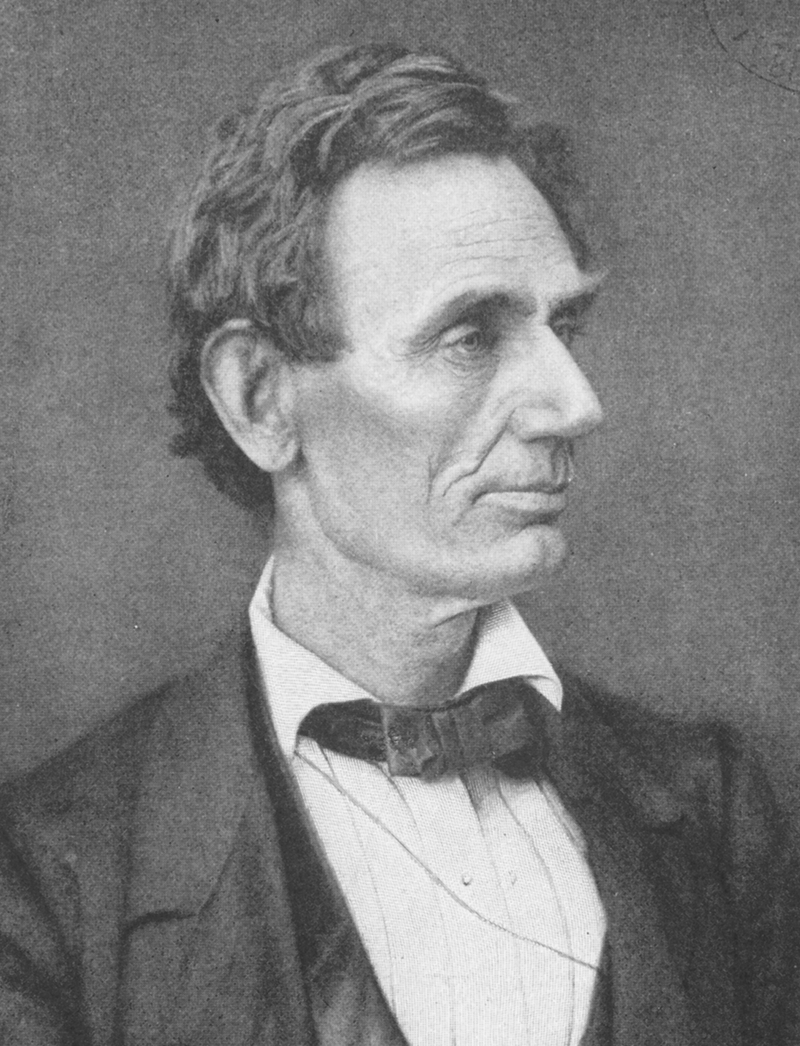
One thing I liked about the movie was how it showed Moses growing ever more senescent.  (Thanks largely to his having to metaphorically herd cats or “shovel fleas.”)  I noted that something like that happened to Abraham Lincoln, after four years as president:

He arrived at the White House as a sinewy 6-foot-4, 180-pound strongman.  In the course of four years, he dropped 30 pounds.  “He was sunken-eyed and grizzled, nothing like that bright-eyed lawyer of Springfield [and] looks 75 years old, but he’s 56.”

That led to some lessons including this:  To “the icons that we choose to throw our cares and responsibilities on – like Moses – we followers are pretty much a pain in the neck.”

Which seems especially apropos as the 2016 election season heats up.

SwampWaterPoster.jpgOther post-highlights from 2015 included Operation Pogo – “Into the Okefenokee,” and The mysterious death of Ashley Wilkes.

Pogo” – told in three parts – was about fulfilling a life-long dream. The dream involved and led to an overnight camping trip deep into the sinister and mysterious “Swamp Water” locale.  (The Okefenokee Swamp, as illustrated by the 1941 movie poster at left.)

Ashley Wilkes detailed the circumstances surrounding the mysterious death of Leslie Howard.  (Best known for playing Wilkes in 1939’s Gone with the Wind.)  

Briefly, the commercial airliner in which he was flying got shot down by eight German fighter-bombers in 1943.  It happened over the Bay of Biscay – west of France – on a flight from ostensibly-neutral Lisbon and London.

The shoot-down spawned a number of conspiracy theories.  One said German spies mistook Howard’s friend and bodyguard for Winston Churchill.  Another noted Nazi propaganda chief Joseph Goebbels calling Howard “Britain’s most dangerous propagandist.”  A third said Howard really was a British spy, on a secret mission with the help of the beautiful Conchita Montenegro.  (One of many women with whom he’d ostensibly had a “torrid love affair.”)

That post ended:  “And some people think those were better and simpler times…”

And speaking of politics…  On April 2, I posted On Blue Dogs and the “Via Media.”  It addressed the dearth of moderate Republicans and conservative Democrats.  One point the post made was that the Political Middle [Seems To Have] Disappeared.  But the good news seems to that our political system was “specifically designed to keep moving back to the middle, even though it’s clumsy at times.”

In other words, “Don’t Forget That Politics is Cyclical.”  That – I wrote – could be “the best political news ‘we’ve’ heard in a long time…”

http://inapcache.boston.com/universal/site_graphics/blogs/bigpicture/kennedy_08_31/k15_20120853.jpgThen came “Great politicians sell hope” on June 12.  (Featuring the shot at right, of Ronald Reagan and Ted Kennedy “supping” with a political enemy.)  That post led off with the Peanuts cartoon below.  That in turn was a kind of spin-off from a quote from Chris Matthew’s 2007 book, Life’s a Campaign.  I then wrote:  “When I [first] heard that a few days ago I thought, ‘What rock have you  been living under?‘”

But then I noted that Matthews’ book – after actually reading it – gave me a sense that our presidents have been mostly “decent, honorable and capable.”  And it gave me a sense “that the same applies to politicians in general.  (Gasp!)”  Then a third thought: Maybe politicians today are especially nasty because too many voters they’re trying to woo are just plain nasty.

But the 1950s and ’60s – when Harry Golden did most of his writing – weren’t any bed of roses either.  (They featured McCarthyism Vietnam War protests, and the Civil Rights Movement.)   Yet through all those dark years, Harry Golden exuded hope.

All of which brings us back to the old saying noted in the Peanuts cartoon [below], that in “bad times or hopelessness, it is more worthwhile to do some good, however small … than to [just] complain about the situation.”  See also Better to light a single candle.  And that great bloggers – like great politicians – should work harder on “selling hope.”

Which is exactly what this blog will try to do.  In 2016 … and Beyond!

*   *   *   *

 *   *   *   *

The upper image is courtesy of New Year – Wikipedia, the free encyclopedia.  The full caption:  “Baby New Year 1905 chases old 1904 into the history books in this cartoon by John T. McCutcheon.”  See also ‘Ringing’ Or ‘Bringing In The New Year:’ A History.

 The full “take stock” quote is courtesy of The Year in Review (Huffington Post):

Before we start to talk about the plans, goals and resolutions for the new year.  It is important to take stock and review the outgoing year.  This includes looking at the wins, the challenges, the mistakes, the areas for improvement and just appreciate how are you feeling at this time of the year.  When you take the time to take stock of the past year’s experiences you will achieve 2 things[:]   1) Ability to count your blessings[; and]  2) Identify the areas for improvement.

Re:  “Life’s a Campaign.”  (“What Politics Has Taught Me about Friendship, Rivalry, Reputation, and Success.”)  My first exposure to the book was listening to the six hour book-on-CD version.  

The Reagan-Kennedy image is courtesy of www.boston.com/bigpicture/2009/08/senator_ted_kennedy.

The lower “stupid darkness” cartoon is courtesy of You Stupid Darkness! | Kurtis Scaletta’s Site, which in turn links to comics.com/peanuts, “one of the most amazing but little-known Internet resources.”  See also lightasinglecandle.wordpress, and The 5 Greatest (newspaper) Comic Strips Of All Time.

*   *   *   *

Other notable 2015 posts included On American History, “patched and piebald,” the Mid-summer Travelog series, and On RABBIT – and “60 is the new 30,” Parts I and Part II.

“Piebald” talked about history as it actually happens – and is lived through – compared to how we learned in schools.  In “school-taught” history, the Founding Fathers – for example – knew exactly what they were doing.  They were “carried [on] by a sure and steady tide.”  But the more-real version – history actually lived through – was “improvised, patched together, made up from one moment to the next.”  That thought was exemplified by John Adams, a Founding Father himself:

I’ll not be in the history books.  Only Franklin.  Franklin did this, and Franklin did that, and Franklin did some other damn thing.  Franklin smote the ground, and out sprang General Washington, fully grown and on his horse…

The Mid-summer Travelogs were on a two-week early-July road trip to Atlantic City and New York City. Modeled on Steinbeck’s Travels with Charley, they spoke of pilgrimages in general, driving pilgrimages especially, and had a nod to a canoe trip 12 miles offshore.  Part II added this:

Maybe understanding is only possible after.  Years ago when I used to work in the woods it was said of lumber men that they did their logging in the whorehouse and their sex in the woods.  (E.A.)

Which was another way of saying it seems we can’t truly enjoy our “road trips” until they’re over; “Now that my trip is over … I can look back and relish the memories just lived through.”

And finally, RABBIT [and] “the new 30” talked about the series of books by John Updike centered on Harry “Rabbit” Angstrom.  They started with Rabbit as a new father in 1960.  Then:

Updike revisited his hero toward the end of each of the following decades in the second half of this American century; and in each of the subsequent novels … Updike has chronicled the frustrations and ambiguous triumphs … the loves and frenzies, the betrayals and reconciliations of our era.

Part II led off remembering when you could buy a beer at a bar for 40 cents and leave a dime tip.  But at the same time, turning 65 back then meant you looked and felt old, with “liverish scoops” below your eyes and broken veins on the sides of your nose.  But these days a 60-year-old looks like this: 

http://img2-2.timeinc.net/people/i/2014/news/140210/christie-brinkley-300.jpg

“Here’s to Plough Monday!”

January 6 – last of the 12 Days of Christmas – leads to “Plough Monday…”


Christmas Day has come and gone.  But that doesn’t mean the Christmas season is over.  As noted last year here, the Twelve Days of Christmas are “both a festive Christmas season” and the title of a “host of songs and spin-offs (including one on a Mustang GT):”

The Twelve Days of Christmas [begin] on Christmas Day (25 December)[, they celebrate] the birth of Jesus [and are] also known as Christmastide…   The Feast of the Epiphany is on 6 January [and] celebrates the visit of the Wise Men (Magi) and their bringing of gifts to the child Jesus.  In some traditions, the feast of Epiphany and Twelfth Day overlap.

The post also said that technically this holiday season really started back on Halloween.

The thing is, winters back in the really old days – when life was nasty, brutish and short – were really long and really boring.  So folks back then looked for any good reason to throw a party and get sloshed.  (Which explains why the “party season” started on Halloween.)

So in one sense you could say the end of that extended holiday season comes on January 6.

But in another sense you could say the season extends to the Monday following January.  That’s the Monday known as Plough Monday.  (Which is another way of saying some of the post-Christmas holidays and/or Feast Days can be extremely confusing.)  So the end of that extended holiday season – this year, on January 11 – was also known as Plough Monday.

Getting back to January 6, another name for it was Twelfth Night.  That in turn was the name of famous play by William Shakespeare.  The play “expanded on the musical interludes and riotous disorder expected of the occasion,” to wit: the “occasion of the ‘drunken revelry’ of 12th Night.”

And finally, January 6th has yet another name.  It is perhaps best known as the Epiphany.

But getting back to Plough Monday:  In England it marks the start of the new Agricultural Year.  The Church of England had a long church service to mark the occasion, with prayers for a bountiful harvest.  And that service included both a blessing of the seed to be planted and a “blessing of the plough” – as illustrated at right:

Blessed are you, Lord God of all creation:  for in your abundant care you have given us fertile land, rich soil, the seasons in their courses…  By your blessing, let this plough be a sign of all that you promise to us.  Prosper the work of our hands, and provide abundant crops for your people to share.

In turn, Plough Monday was preceded by Plough Sunday.  Plough Sunday was seen as a way of celebrating farming and the work of farmers, in church.  But since you weren’t supposed to work on Sundays – back in the good old days – the new agricultural year didn’t really start until the next work day:  “work in the fields did not begin until the day after Plough Sunday.”

Put another way:  Since Epiphany always came on January 6, Plough Sunday came on the Sunday after the Epiphany.  (The Sunday between January 7 and January 13.)  Thus Plough Monday is usually the first Monday after Twelfth Day (Epiphany), 6 January.

The point of all this – January 6, Plough Monday, etc. – was to have one more big blast before getting back to work.  (Resuming farm-work after the extended Christmas holiday season.)  As such it was one more occasion for general tomfoolery, as shown in the top picture:

In some areas, particularly in northern England and East England, a plough was hauled from house to house in a procession, collecting money.  They were often accompanied by musicians, an old woman or a boy dressed as an old woman, called the “Bessy,” and a man in the role of the “fool.”

In turn it may  help to remember that one big reason for all this general tomfoolery was that – otherwise – life back then was indeed “nasty, brutish and short.”

And finally, people usually celebrated Plough Monday by eating Plough Pudding, as seen at left:  A “boiled suet pudding, containing meat and onions.  It is from Norfolk and is eaten on Plough Monday.”

*   *   *   *

All of which brings up the topic of Ringing In The New YearThat web article noted that bells – as in the ringing of bells – are “a deeply spiritual part of ushering in both life and death for ancient cultures.  (In a practice that serves as an “apt metaphor for the changing of the New Year.”

Or see New Year – Wikipedia, which noted that New Year’s Day wasn’t always January 1:

During the Middle Ages in western Europe … authorities moved New Year’s Day variously, depending upon locale, to one of several other days, among them: March 1, March 25, Easter, September 1, and December 25.  These New Year’s Day changes generally reverted to using January 1 [with] local adoptions of the Gregorian calendar, beginning in 1582…

Note also that the ancient Hebrews celebrated a type of New Year with Rosh Hashanah.  (Hebrew for “head of the year.”)  Rosh Hashanah is a two day holiday “commemorating the culmination of the seven days of Creation, and marking God’s yearly renewal of His world.”

As for January 1, that started in Rome:  “During the Roman Republic and the Roman Empire years began on the date on which each consul first entered office.”  But then in 45 BC – and the new “Julian calendar” – the Roman Senate fixed January 1 as the first day of the year.

At that time, this was the date on which those who were to hold civil office assumed their official position, and it was also the traditional annual date for the convening of the Roman Senate. This civil new year remained in effect throughout the Roman Empire, east and west, during its lifetime and well after, wherever the Julian calendar continued in use.

So here’s wishing you a happy, healthy and prosperous 2016 in advance!


Baby New Year 1905 chases old 1904 into the history books…”

*   *   *   *

Note that this post was modeled on a similar one at DOR Scribe, my other blog.

Re: Mustang GT.  See also Jeff Foxworthy – Redneck 12 Days Of Christmas lyrics.

Re: “Nasty, brutish and short.”  That’s a quote from the book Leviathan, written by Thomas Hobbes and published in 1651.  Hobbes described the natural state of mankind as a “warre of every man against every man,” a life which was in turn “solitary, poor, nasty, brutish, and short. See Wikipedia, and also Nasty, brutish and short – meaning and origin.

The lower image is courtesy of New Year – Wikipedia, the free encyclopedia.  The full caption:  “Baby New Year 1905 chases old 1904 into the history books in this cartoon by John T. McCutcheon.”  See also ‘Ringing’ Or ‘Bringing In The New Year:’ A History.


“In the Heart of the Sea”

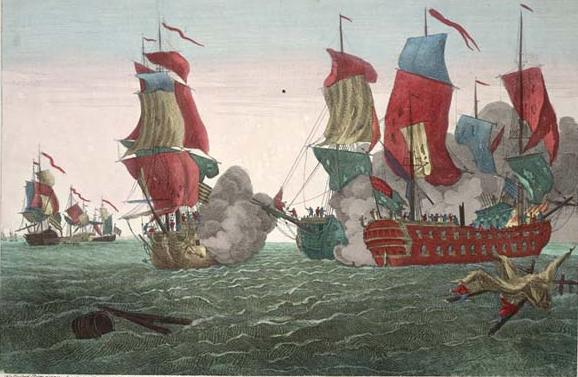
image: Sperm Whaling:  The Chase

“Sperm Whales – The Chase…”


 I first read about the Essex 54 years ago.  (I was 10 or so.)

My aunt gave me a set of American Heritage Junior Books.  The one I liked best was The Story of Yankee Whaling.  (Published in 1959.)

But that book didn’t just include the story of the Wreck of the Essex. (With a POW – loosely translated as “angry whale” – ramming and sinking a ship, as shown in Ron Howard’s new In the Heart of the Sea.)

 Yankee Whaling also included the gory tale of Samuel Comstock, star of the “bloodiest mutiny in the history of American whaling,” on the whale-ship Globe:

The mutineers [in 1815] killed Captain Worth and three other officers.  Soon after William Humphries, one of the mutineers, was accused of plotting to take the ship; a kangaroo court of the mutineers tried him and, finding him guilty, hanged him.

Yankee Whaling had vivid descriptions of the mutineers hacking up some victims – mostly officers – and throwing others to the sharks.  (Just the stuff 10-year-old boys love to read.)

Which could mean the Globe mutiny will soon be “coming to a theater near you.”  In the meantime we have Heart of the Sea.  That movie shows a whale sinking a ship, then “stalking” the survivors 2,000 miles across the vast Pacific.  (In a bit of Hollywood hyperbole.)

In the Heart of the Sea poster.jpgOn the other hand – in 90 days at sea, in small leaky boats and without enough food or water – the eight survivors of the Essex did things that the Globe mutineers would likely have found revolting.  (See the classic joke, re:  “the peasants are revolting.”)

There’s more on that later, but first note Garry Wills‘ version of the Lord’s prayer.  His version reads, “and bring us not to the Breaking Point.”  (Instead of the usual “lead us not into temptation.”)

Briefly, Heart of the Sea tells the story of eight men – survivors of the original crew of 21 – who got forcibly taken to their breaking point, then well beyond that.

Which is another way of saying the original – true – story was bad enough.

The problem?  The true story of eight men surviving 90 days of living hell – on the vast Pacific – is both incredibly long and incredibly boring.  (On film anyway.)  Which is another way of saying that amount of living hell doesn’t translate well to film.  So in making the movie, Howard had to take liberties with some facts and make up others out of whole cloth.

Despite all that, the film earned my highest compliment.  I paid three times more than usual – to see the IMAX version – and still felt like I got my money’s worth.

Getting back to the Essex:  I read the American Heritage version 50 years ago.  Then five or six years ago I came across the book version of Heart of the Sea, by Daniel Philbrick.

The heart of the story – what made Philbrick’s book different – was that tale of eight men in small boats, undergoing 90 days of heat, hunger and thirst.  And the book version gave that long, boring ordeal its full scope.  But a film is like a shark.  It has to move – visibly – or it will “die.”  (Lose its audience.  Or to paraphrase McLuhan, “the format shapes the message.”)

Accordingly, in making a film of Heart of the Sea, Ron Howard came up with a workable yet eminently appealing mix of fact and fiction.  For starters, he used the classic seafaring style, focusing on “two quarrelling men in charge of a big ship, like Mutiny on the Bounty” – as shown at left – “or Jaws.”  (See “scurvy and beards.”)

Another twist was the flashback:  One remaining survivor – Thomas Nickerson – interviewed by Herman Melville (“Moby Dick“) some 30 years after Nickerson served as cabin boy on the Essex.

And “young cabin boys” raise an historical anomaly:

In 1822 … New England mothers sent their sons to kill whales in the Pacific Ocean at an age when modern parents would think twice about letting them have the car for a weekend.

Which brings up an early departure of fact in the film.  Melville actually interviewed Pollard, long after he’d lost his “captaincy.”  Some three years after the Essex sank, Pollard commanded the whale-ship Two Brothers when it sank.  (Off the Frigate Shoals.)  So by the time he got interviewed by Melville, Pollard had been demoted to “night-watchman” on Nantucket Island.  (And as such considered a “nobody” to the islanders.)

And speaking of anomalies:  The film showed First Mate Owen Chase as the real hero.  It also showed Pollard as both a man who owed his captaincy to nepotism – connections – and a lesser sailor than Chase.  But once the ramming happened, Pollard recommended a shorter course to a closer set of islands.  (A course that would take advantage of prevailing “tail winds.”)

But unlike the cliche “Captain Bligh,” Pollard let himself be persuaded by Chase.  So the three small boats set sail for South America – 2,000 miles away – against the prevailing winds.  But as Wikipedia noted:  “Herman Melville later speculated that all would have survived had they followed Captain Pollard’s recommendation and sailed west.”

(It seems Chase and the crew feared the closer islands – the Marquesas – were inhabited by cannibals.  Which seems highly ironic, given what actually happened later...)

In yet another departure from fact, the real whale didn’t stalk the boats 2,000 miles across the Pacific.  Nor did the whale “have a moment” with Chase, near the end of 90 days adrift.  (When Chase refused to harpoon the whale-stalker, despite Pollard’s goading to do so.)

The film did feature an accurate translation of a “Nantucket sleighride“,” as seen at right.   It also showed a “flurry:”  The dying whale spraying his tormentors with a mixture of blood from his pierced lungs, along with mucus and seawater.  (In some manner of Freudian anointing.)

Then there were the “chockpins” worn by experienced whalers.  What the film didn’t show: They were apparently worn to “get babes.”

Then there was the matter of the boats landing on Henderson Island.  (Not Ducie Island, as in the film.)  Years after the wreck three skeletons were found on Ducie Island.  They were believed to be from the lost third-of-three boats “never to be seen again,” but that was never confirmed.

And finally, the film ended with two popular tropes.   One was that of corrupt businessmen, in the form of a “board of inquiry.”  The money-grubbing businessmen on the Nantucket board were shown arm-twisting Chase and Pollard to say the Essex ran aground, and that the missing crew-members drowned.  (They were afraid of higher insurance rates.)

A “board of inquiry” that apparently never took place, or at least not in that way.

The other was the look into the future trope.  The film ended with Nickerson and Melville parting ways after the all-night session of drinking, recalling and writing.  Nickerson told Melville – with faint disbelief – of a “new” discovery of oil, in the ground, somewhere in Pennsylvania…

Which led to the cartoon “whale celebration” below..

*   *   *   *

All in all, Heart of the Sea is a film well worth seeing.  For those who’d love to get a feel for the pure adventure, “such as befell early and heroic voyagers…”  And especially for those who’d love to get a feel for being “alone, alone, all all alone, alone on the wide, wide sea…”

*   *   *   *

Whales “celebrating the discovery” of oil in Pennsylvania…

*   *   *   *

The upper image is courtesy of Artifact Article: Sperm Whaling: The Chase:

Three whale ships can be seen in the background, while two whaleboats are in the foreground.  In the whaleboats, boatsteerers are seen with their harpoons raised.  As they chase the whale, one can image that the call “thar She blows!” was sounded, as several whales can be seen spouting as they surface.

The illustration was by Benjamin Russell, born into a family of whaling merchants.  He started work in the office of a whaling agent in New Bedford, MA, but “showed more aptitude for drawing than business, often to the displeasure of his superiors.”  He later spent four years on the whale ship Kutusoff.  There his “acute observational sensitivity” resulted in sketches with “impeccable detail…  Russell’s images were rendered with mastered accuracy rather than artistic intention.” 

See also Benjamin Russell: Whaleman-Artist, Entrepreneur | New Bedford.

For more on the sources used in this post, see the notes below.

The “Story of Yankee Whaling” image is courtesy of American Heritage Junior Library | Series | LibraryThing.  See also American Heritage Junior Library | eBaywhere the book is available individually for $1.95, or as part of a set of seven, for $21.00.  For more on the author, see below.

Re: Samuel Comstock.  See also Globe (1815 whaleship) – Wikipedia, and Helter-Skelter on the High Seas – NYTimes.com.  The latter was a review of two books said to “unravel the saga of the bloodiest mutiny in the history of American whaling.”  Comstock was said to be “a keen ladies’ man,” to wit:  He possessed a “superabundance of something which the fair sex seemed to consider a very agreeable substitute.”  (For affection.)  Also this note, as previously noted:

In 1822 … New England mothers sent their sons to kill whales in the Pacific Ocean at an age when modern parents would think twice about letting them have the car for a weekend.

Re: “coming to a theater near you.”  See also In a World – TV Tropes.

Re: “Your majesty, the peasants are revolting!”  “They certainly are!”  See also Count de Money / “The People Are Revolting” – YouTube, and/or Ambiguity – Simple English Wikipedia, which noted the “British comedian Ronnie Barker said that he loved the English language because there are so many jokes you can make using ambiguity.”

Re: “breaking point.”  See Garry Wills’  What the Gospels Meant, Viking Press (2008), at page 87; found in Part II, “Matthew,” Chapter 5, “Sermon on the Mount:”

Our Father of the heavens, your title be honored … and bring us not to the Breaking Point, but wrest us from the Evil One.    

The usual translation in the Lord’s Prayer is – as noted – “And lead us not into temptation, but deliver us from evil.”  See Wikipedia.  My life experience tells me the term “breaking point” is more accurate and appropriate.  See also The True Test of Faith, in my other blog.

The “whale’s eye” image is courtesy of In the Heart of the Sea (film) – Wikipedia.  See also In the Heart of the Sea (book) – Wikipedia, which included this on the author’s sources:

Philbrick utilizes an account written by Thomas Nickerson, who was a teenage cabin boy on board the Essex and wrote about the experience in his old age;  his account was lost until 1960 but was not authenticated until 1980 before being published, abridged, in 1984.  The book also utilizes the better known account of Owen Chase, the ship’s first mate, which was published soon after the ordeal.

Re: Marshall McLuhan andthe format shapes the message.”  The Rotten Tomatoes review said the “admirably old-fashioned” film-story boasted “thoughtful storytelling to match its visual panache, even if it can’t claim the depth or epic sweep to which it so clearly aspires.”  My theory is that neither the depth nor epic sweep of the true story could have been adequately translated to film. 

The “Bounty” image is courtesy of Mutiny on the Bounty – Wikipedia.  The caption: “Fletcher Christian and the mutineers seize HMS Bounty on 28 April 1789. Engraving by Hablot Knight Browne, 1841.”

Re: The “whale-stalking.”  Wikipedia said that after ramming the Essex – twice – the whale “finally disengaged its head from the shattered timbers and swam off, never to be seen again.”  

Re: “have a moment.”  An allusion to the 1984 film, Moscow on the Hudson (1984)

Vladimir Ivanoff: [confronting a stranger following him down the street]  FBI?   Gay Man on Street:  FBI?  No.   Vladimir Ivanoff:  KGB?   Gay Man on Street:  No.  G-A-Y.   Vladimir Ivanoff: Gay?  Oh, no, no.   Gay Man on Street:  Sorry.  You have a nice face.  I thought we had a “moment” back there.

The “Nantucket sleigh ride” image is courtesy of jrusselljinishiangallery.com/pages/sticker-pages.

Re: the number of survivors and their length of time at sea.  It took 90 days for the Owen Chase boat to be rescued, with three survivors.  It took 95 days for the Pollard boat to be rescued, at a different location, with two survivors.  The three original boats were separated in a storm, and the boat headed by Obed Hendricks – “boatsteerer” – was never seen again.  Wikipedia: “A whaleboat was later found washed up on Ducie Island, just east of Henderson Island, with the skeletons of three people inside…  [S]uspected to be Obed Hendricks’ missing boat, the remains were never positively identified.”  Thus the eight survivors, including the three who stayed on Henderson Island.

Re:  “Look into the future” trope.  It’s actually known as Externally Validated Prophecy:  “When a character makes a prediction about the future which is not fulfilled in the work, yet an audience aware of history knows will be fulfilled.”

Re: “pure dispassionate adventure.”   The quote is from Robert Louis Stevenson’s Travels with a Donkey in the Cévennes.  See also Donkey travel – and sluts and “Pity the fool” from my other blog.

The lower image is courtesy of Sperm whaling – Wikipedia, including the caption: “An 1861 cartoon showing sperm whales celebrating the discovery of new petroleum wells in Pennsylvania.  The proliferation of mineral oils reduced demand for their species’ oil.”   The caption in the cartoon itself:  “Grand ball given by the whales in honor of the discovery of the oil wells in Pennsylvania.”

*   *   *   *

Sources used for this post – or worth more reading:  Heart of the Sea (film) – WikipediaEssex (whaleship) – WikipediaHistory of whaling – WikipediaGirl on a Whaleship – ImagesEssex explainedand a review:  “Heart of the Sea” – Apollo 13 with scurvy and beards:

There was rumored to exist a secret society of young women on the island whose members vowed to wed only men who had already killed a whale.  To help these young women identify them as hunters, boatsteerers wore chockpins (small oak pins used to secure the harpoon line in the bow groove of a whaleboat) on their lapels.

See The Real Story Behind “In the Heart of the Sea,” which also included this:

The harpoon did not kill the whale. It was the equivalent of a fishhook.  After letting the whale exhaust itself, the men began to haul themselves, inch by inch, to within stabbing distance of the whale.  Taking up the 12-foot-long killing lance, the man at the bow probed for a group of coiled arteries near the whale’s lungs with a violent churning motion.  When the lance finally plunged into its target, the whale would begin to choke on its own blood, its spout transformed into a 15-foot geyser of gore that prompted the men to shout, “Chimney’s afire!” As the blood rained down on them, they took up the oars and backed furiously away, then paused to observe as the whale went into what was known as its “flurry.”

The site also noted that Melville interviewed Captain Pollard for his later book, Moby Dick, not Nickerson.  After a second failed whaling voyage, Pollard became the town’s night watchman; “To the islanders he was a nobody…”  For a lengthy account and history see the New York Times review.

A final note:  The American Heritage Yankee Whaling was written by Irwin Shapiro (1911–1981), an “American writer and translator of over 40 books, mostly for children and about Americana:”

After an initial foray into writing radical literature that encompassed his last year as a communist, Shapiro turned to children’s books…  He published many titles for Golden Books[, including one thought to be] a coded message about the imprisonment of American spy Isaiah Oggins in the GULAG…  The Library of Congress holds 44 titles in his name.

See Wikipedia, and also Irony … Literary Devices.

A late-fall mountain trek…

Wayah Bald Lookout Tower

The Wayah Bald Tower, a highlight from my recent trek on the Appalachian Trail


I’ve now officially hung it up for the winter.  “Which is being interpreted:”

“No more outdoor adventures … at least not ’til next spring.”  Which means the two adventures I had this (late) fall pretty does it for this year.

SwampWaterPoster.jpgTo explain:  Last October I fulfilled a life-long dream.  A two-day overnight kayak into the Okefenokee.  (As told in Operation Pogo.)

Then last November – 20 and 21 – I fulfilled another life-long dream: At least one overnight trek on the Appalachian Trail.

I touched on this dream in “A Walk in the Woods.”  (Parts I and II.)

Back in 1967 – when I was 16 – my next-older brother and I hatched the idea of hiking the Trail from Springer Mountain to Gettysburg, where our aunt and uncle lived.  (Some 623 miles…)  But for some reason my parents didn’t bust out laughing [or] slap their knees while wiping away tears of laughter…

Needless to say we didn’t make it.  Ever since then it’s bugged me that we didn’t make it.  And that’s why hiking the A.T. has been on my bucket list.  (Long before the term was coined.)

Among the highlights:  The temp dropped to 31 degrees that Friday night. (11/20.)  Another thing:  Hiking in the late fall – when the leaves have fallen – means the Trail is really slippery.

A related note:  Even now – three weeks later – my left big toenail is still purple-bruised.  (From the Saturday-afternoon slip-and-slide down toward Tellico Gap.)

I’ll get to the details later, but first a word about those “balds.”  There’s a lot of ’em on the A.T., but they’re not meant as an insult to the “follicly challenged.”

The term Bald in the Appalachians means a summit or crest, covered mostly by thick vegetation; “native grasses or shrubs occurring in areas where heavy forest growth would be expected.”

Grassy-bald-roan-mountain.jpgThus the towers at Wayah Bald and Wesser Bald.  (Of which more below.)  Then of course there’s Roan Mountain, seen from Grassy Ridge Bald, at right.

Getting back to the hike itself:  I originally planned to go from Winding Stair Gap to the Nantahala Outdoor Center, near Bryson City.

That’s a hike of about 27 miles.

Fortunately, I found an old high-school friend who lives in Franklin, North Carolina. (Right on the Trail.)  So in September I arranged to drive up to his place on Thursday afternoon, the 24th. From there he agreed to drop me off Friday morning, the 25th.  (And hopefully pick me up on Saturday afternoon, the 26th.)

Under that original plan I might have made 27 miles.  (If I’d been able to hike before the time change.  See Spring Forward – Fall Back.)  Unfortunately, that September try got rained out. Which meant by late November, I had an hour or two less hiking time per day.

Be that as it may…  I made new arrangements.  (Before the weather got too cold.)  My friend dropped me off at 8:35, Friday morning, November 20.  (At the parking lot at Winding Stair Gap, where the Trail crosses U.S. 64, known locally as Murphy Road.)

And now a word about hiking speed.  A good ambling-speed on level ground is a mile every 20 minutes.  (Three miles an hour.)  But a friend at church hikes the Trail regularly, and she says on a good day she and her husband can cover eight miles.  Other sources indicate a good speed – with full pack and up and down mountain trails – is about two miles an hour.

AT 022That’s what threw me off.  Like my paddling in the Okefenokee, I overestimated my ability to trek. (With less daylight, and slipping and sliding on fallen leaves.  Not to mention the recent rains that put much of the Trail under water, as seen at left…)

So anyway, that Friday afternoon I reached Wayah Bald about 4:40.  See also Wayah Bald Tower.

My slightly used handbook – published in 1994 – said there was a camping area a mile and a half further on.  But the sun was setting, it was getting cold and the ground was flat and grassy there.  So I pitched my tent.  (Expecting a ranger to come by and say “You can’t camp there!”) 

But then three young folk came by.  (A young man and two young ladies, all college age.)  We’d been passing each other all afternoon, and after stopping for a bit, they started to head off to the farther-up camping place.  But then they came back and camped on the other side of the tower.  (Which was some comfort.  You never know about those “Dueling banjos…”)

So anyway, I pitched my “Eureka” one-person tent just to the left of where the stone wall at the bottom of the picture turns down.  (As seen in the photo below right.)

Wayah Bald Lookout TowerI’d packed five layers of sweaters and down vests, plus Gore-tex gloves.  (Not to mention a small mouthwash bottle filled with rum.)  And like I said, that night it got down to 31 degrees or so.

I shivered some during the night, and could have used some extra padding for my side hip-bones.  Still, I got a fairly good night’s sleep.  (And there was a nice view of the lights of Franklin, shimmering in the distance, when I got up to answer nature’s call.)

Next morning it took a while to pack up.  It was so cold I had to keep warming my fingers to untie things, then tie them in or to the pack, etc.  But I eventually hit the trail at 8:21.

Like I said, my original plan was to reach the “NOC,” some 27 miles away.  But as I hiked along Saturday afternoon, I formulated a secondary objective: The Wesser Bald Lookout Tower.

But finally – as the sun got lower and lower on Saturday afternoon – I found a rare place with cell-phone reception.  (And they are pretty rare.)  I called my buddy and negotiated a pick-up at Tellico Gap.  (See Wayah Bald to Tellico Gap.)

Over the phone I read the directions – from the 1994 guidebook – to my friend.  They told of an 8-mile drive (for him), west from Highway 28.  Then a 4-mile gravel road up to Tellico Gap.

By some miracle he actually found the place, on the Trail, and with a place to park.  And he got there about 10 minutes before I did.  (Slipping and sliding downhill.)

Boy was I glad to finally sit down in his pickup truck!  

One lesson I learned was that hiking in the Trail in late fall means most of the leaves have fallen. That means much of the Trail is  covered by leaves.  The leaves in turn cover up many if not most of the rocks and tree roots that can trip you up.  (As shown below left.)

AT 037Then there’d been the recent rains, making parts of the trail more like streams than trail, as noted above.

Aside from all that, I deliberately chose to go slow, knowing one wrong move could mean a twisted knee or ankle.  (Which speaks to the wisdom of not traveling alone.)  And finally, my main objective was to see how fast I could travel comfortably.

As I alluded in “Okefenokee – Part II:”  Not only did my Utah brother propose a 16-day, 500-mile, “primitive-camping canoe trip down the Yukon River.”  Also for the Summer of 2016, he’s proposed a four-day hike along the Chilkoot Trail.  (In Alaska.)  So this overnight A.T. hike served as a kind of “shakedown cruise.”

Which leads to the specifics:  It was 5.9 miles from Winding Stair Gap to Wayah Gap.  (Before Wayah Bald.)  It was another 13.5 miles from Wayah Gap to Tellico Gap.  That made a grand total of 19.4 miles.  I covered that 19.4 miles in some 11 hours, 29 minutes of actual hiking.

That averaged out to 9.7 miles a day.  (Or 1.68 miles per hour, over rough ground.  It was actually 1.689895 miles per hour, but who’s counting?)  Still, despite my doing better than the eight-mile-a-day average noted above, it was a learning experience…

And a pretty humbling one at that.  But I’m glad I did it.  For one thing, that first beer and that nice soft bed Saturday night felt really, really good!

And incidentally, the word “trek” – as used in the headline and text – comes from Trekboer.  (A term later shortened to just “Boer.”  See also “kommando,” from Afrikaans as well.)

The point being:  The image below gives an accurate feel for some of the conditions on the A.T. – in late fall, this past November 2015.  (Though without the oxen, whips and wagons.)


The original Trekboers, “Passing Cradock Pass…”


Re: The Appalachian “balds.”  See Bald Mountains – Wikipedia, the free encyclopedia:

The Bald Mountains are a mountain range [bordering] Tennessee and North Carolina in the southeastern United States.  They are part of the Blue Ridge Mountain Province of the Southern Appalachian Mountains.  The range gets its name from the relatively frequent occurrence of grassy balds atop the more prominent summits.

See also Appalachian balds – Wikipedia.

Re: Hiking the whole Trail.  At 64, I realize I’ll probably never do that.  (Or want to, for that matter.) But my bucket list does include hiking at least one portion of the Trail in every state that it passes through.  (So far I’ve done Georgia and North Carolina.)

Re: “Dueling banjos.”  As the link noted, “If you ever see the film [Deliverance,]  you will never be able to enjoy banjos again.  Or go canoeing.  Or visit rural Georgia.  Or, you know, sleep.”  And I must admit to a certain trepidation even kayaking in the remote Okefenokee. Still, there is a certain dark humor in the trope illustrated at right…

The lower image is courtesy of the Boer link in the article, Trekboer – Wikipedia. The caption:  “Passing Cradock Pass, Outeniqua Mountains, by Charles Collier Michell.”  Note that “Boer is a Dutch and Afrikaans word for ‘farmer.'”

Re: “Kommando.”  Another word of Dutch/Afrikaans origin, later spelling-changed to Commando: “The word stems from the Afrikaans word kommando, which translates roughly to ‘mobile infantry regiment.’  This term originally referred to mounted infantry regiments, who fought against the British Army in the first and second Boer Wars.”


“If you’re here from the art show…”


“If you’re from the art show,” you’ll probably want to find out if Ashley Wilkes was really a British spy, working with the likes of Conchita Montenegro? (She’s the one at left…) 

*   *  *

Welcome to the “Georgia Wasp…”

If you’re from the art show, you’ll probably want to check out The mysterious death of Ashley Wilkes.

There’s more on that post below, but first note that I modeled this blog on the Carolina Israelite.

That was a personal newspaper, done up by Harry Golden back in the 1940s and ’50s.  Harry was a “cigar-smoking, bourbon-loving raconteur.”  (That’s another way of saying he told good stories.)

Which means if Harry was around today, “the Carolina Israelite would be done as a blog.”

For more on the blog-name connection, see “Wasp” and/or The blog.  But what made Harry special was his positive outlook on life.  He got older but didn’t turn sour, as so many seem to do these days.  He still got a kick out of life.

For that and more, he was considered a “voice of sanity amid the braying of jackals…”

Which is now my goal as well.

In the meantime:

Like I said, “if you’re here from the art show,” you’ll probably want to check out The mysterious death of Ashley Wilkes.  Which is being interpreted:

I just published a collection of posts from this blog.  The title comes from the [post] I did on September 1, The mysterious death of Ashley Wilkes … but first an explanation.  I’m an artist as well as a blogger, and there’s a big art show coming up in December.  But aside from showing off my works of art – mostly oil paintings – the show also presents a chance for me to get the word out on my two blogs, including this one.

See Introduction to “Ashley Wilkes.”  That’s another way of saying December 5 has come and gone.  (Or will have come and gone by the time most readers see this.)  That means my church’s December 5 Combination Art Show and Christmas Bazaar has come and gone as well.

art show 110This annual “Christmasy” event gave me a chance strut my stuff.  (In more than one sense of the word.)  Not only did it let me show some progress in my oil paintings – like the one at right – it also gave me the chance to “let the public know” about my blogs.

But getting back to Leslie Howard.  He played Ashley Wilkes in 1939’s Gone with the Wind.  Less than four years later his commercial airliner got shot down by eight Luftwaffe Junkers Ju 88C6 fighters.

Under suspicious circumstances.  And 500 miles west of Bordeaux, over the Bay of Biscay, on a flight over supposedly-neutral waters from Lisbon to London.

Some said it was an accident of war.  Others said it was deliberate.  That German spies in Lisbon mistook Howard’s companion for Winston Churchill.  Or that Nazi propaganda chief Joseph Goebbels personally ordered the shoot-down.  (He called Howard “Britain’s most dangerous propagandist.”)  Yet another theory was that Howard was a British spy.

I wrote over 3,000 words on the mysterious death, many of them in footnotes and/or end-notes.  So for the full set of answers your best bet is to check the post yourself.

But note also that that post is just one of the “collection of posts from this blog.”

Others include “Johnny YUMA was a rebel,” and “When adultery was proof of loyalty.”  The first was about Nick Adams – who played Johhny Yuma – and how he too died mysteriously.  (At age 36, a mere seven years after the show ended.)  The other one led off with a painting of “Nell Gwynn, ‘the Protestant Whore,’ a favorite mistress of Charles II…”

art show 112So anyway, the main text of mysterious death ended with this:  “And some people think those were better and simpler times…”

That was pretty much the theme of Alice’s Restaurant – Revisited.  (That people “who ‘wax poetic’ on the Good Old Days usually forget what it was like actually living then.”)  But that post too ended on a positive note, “in the spirit of Harry Golden.”

The positive note was that: “Maybe these days today aren’t so bad after all…” 

So in that spirit of “accentuating the positive,” I’ll close this post by noting the oil painting above left, showing my “favorite grand-niece.”  (Or one of them anyway.)

And of course Ashley Wilkes, as shown below:


Leslie Howard as Ashley Wilkes in Gone With the Wind trailer cropped.jpg

(“Ashley Wilkes,” anti-Nazi agitator?)

The upper image is courtesy of www.flickriver.com/photos.  Wikipedia added this:

Following a rare interview with [Conchita] Montenegro shortly before her death, Spanish author José Rey-Ximena claims that British actor Leslie Howard used her to get close to Spanish dictator Franco after being given the special mission by Winston Churchill.  She claimed that she used her husband’s influence to secure [the meeting with Franco]. “Thanks to him … Spain was persuaded to stay out of the war.”  (E.A.)

Re: “two blogs.”  My other blog is DOR Scribe – Expand your horizons – Read the Bible with an open mind.  Among other things, that blog explores the “mystical side of Bible reading.”

Re: positive outlook on life and/or “accentuating the positive.”  Referring to “Ac-Cent-Tchu-Ate the Positive,” the 1944 song written by Harold Arlen with lyrics by Johnny Mercer.

See also curveball, defined in part as a “particularly difficult issue, obstacle, or problem.”  The point being that life seems to have a habit of “throwing us curveballs.”  See also the alternate definition of dinosaur, assomeone who resists change or is old-fashioned.”

Re: “favorite great-niece.”  As with my seven grandchildren, the usual phrase in such circumstances would be “my favorite grandson named Joe,” to fully cover my bases and avoid showing partiality. Most of those grandchildren heard only the “favorite” part, and didn’t catch on to the “Joe” part until their teens.  (And keeping in mind of course that the “names were changed to protect the innocent.”) Accordingly, the “other favorite great-niece” shouldn’t take offense… 

The lower image is courtesy of sites including but not limited to cornel1801.com/1/g/GONE_WITH_THE_WIND/4_online_pictures.