* * * *

From Guinness, in Dublin, “one of the most unique collections of advertising in the world…”
* * * *
Welcome to the “Georgia Wasp…”
This blog is modeled on the Carolina Israelite. That was an old-time newspaper – more like a personal newsletter – written and published by Harry Golden. Back in the 1950s, people called Harry a “voice of sanity amid the braying of jackals.” (For his work on the Israelite.)
That’s now my goal as well. To be a “voice of sanity amid the braying of jackals.”
For more on the blog-name connection, see the notes below.
In the meantime:
April 30, 2026 – My last post talked about an upcoming adventure-trip to Ireland in May. (The future of which seemed in doubt because of a last-Thursday visit to the emergency room, caused by a meniscus tear that turned out to be not as serious as we first thought. And a side note: My meniscus – plural, “menisci?” – is fine.) So, back to that Preview of Ireland – 2026:
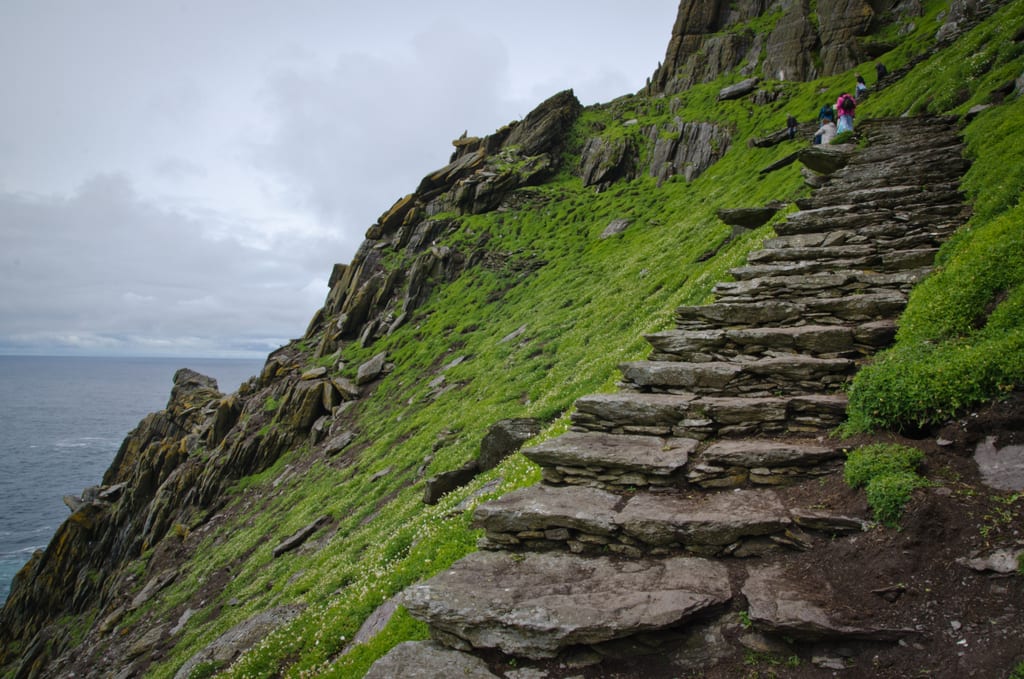
My travel partner and I will fly into Dublin, then travel by car in a great circle route that will head over to the west coast, then up and over to Belfast and back down to Dublin. This post will cover what figures to be a highlight, weather permitting and the creek don’t rise: My clambering to the top of Skellig Michael, “a rocky island off the coast of County Kerry, Ireland, with a Gaelic monastery and a World Heritage Site.”
But even before that ER visit there was a last-minute change. The night before I clamber atop Skellig Michael – weather permitting – we will now be staying at Haven Suites, on Monsignor O’Flaherty Road in Killarney. We originally planned to stay in Dingle, but that would mean a lot of excessive driving. (Mass transit away from Dublin – out in the Irish boonies – is not as good as in England last year, so we rented a car. That in turn will require getting used to driving on the “wrong side of the road.”) So anyway, the point being: That change will reduce driving time from Cork to Killarney from 5.5 to 4.5 hours, and – after we leave Killarney – reduce the driving time from Cork to Galway from an estimated six hours to four hours and 15 minutes.
But before all that, three days in Dublin. We’ll visit places like the Jameson Distillery, Trinity College (with its Book of Kells), and the Guinness Storehouse Tour. That Guinness tour will include a floor featuring 80 years of ground-breaking marketing campaigns, with “one of the most unique collections of advertising in the world from tiny Guinness buttons to giant Guinness posters and statues.” (As shown in the top image.) Then end at “the real best floor of the tour because it’s where you get your free pint of Guinness … at the Gravity Bar,” one of the highest points in the city with “360° panoramic views across all of Dublin.” (And a note: We won’t be driving that rental car until the day we leave town; in town we’ll rely on Dublin mass transit.)
Leaving Dublin we’ll rent a car and drive to Kilkenny, built on both banks of the River Nore, with a population of 27,184. (According to the 2022 census.) There we’ll visit Kilkenny Castle, built in 1260 to control a fording-point of the River Nore and as “a symbol of Norman occupation.” After that we’ll visit the Smithwick’s Experience: “In Dublin, it’s all about Guinness. In Cork, make it a Murphy’s. And Kilkenny? Well, Smithwick’s is the way to go:”
Brewed in the medieval city since the 18th century, this ale has a rich ruby colour with a pale creamy head, and is served in pubs all over the island of Ireland. But tasting it is one thing, experiencing it is another, and the best way to uncover the history, personalities and place behind the beer is with a visit to Smithwick’s Experience Kilkenny.
And after driving that first 80 miles out of Dublin – “on the wrong side of the ^%$# road!” – I’ll be ready for a tall cool glass of Smithwick’s best. And after that, ready for the next day’s drive to Cork. (And once we’re in Cork I’ll be sure to try a Murphy’s Irish Stout, “brewed to be less heavy and less bitter than its chief competitor Guinness.”) Stay tuned for reviews!
* * * *

* * * *
The upper image is courtesy of “guinness ads through the years” Images.
Re “Boonies.” See Why Do We Call the Country “the Boonies”? – Mental Floss. Unbeknownst to me, the term has a history going back to the American occupation of the Philippines in the early 20th century. It was “adopted into English shortly after the turn of the last century from Tagalog, one of the languages of the Philippines. In Tagalog, bundok means “mountain,” and it seems that word also came to be used more loosely in English in reference to any remote place… The use of boondocks among the U.S. military ultimately endured, and led to the word being taken across to Vietnam, where it was first clipped to boonies in the 1950s.” (And that’s why I love blogging; you learn stuff.)
Also about Murphy’s Irish Stout, from Wikipedia:
Its flavour is evocative of caramel and malt, and is described as “a distant relative of chocolate milk.” The resemblance to milk extends beyond flavour to texture: Murphy’s is free from any hint of carbonation, and is delivered “black as strong cappuccino” with an inch of foam – the head – on top. The water of the River Lee in Cork allegedly gave Murphy’s its quality.
Which sounds interesting. (I wonder if it will give me my preferred “two-beer buzz?”)
The lower image is courtesy of Smithwick’s – Wikipedia.
* * * *
Re: The Israelite. Harry Golden grew up in the Jewish ghetto of New York City, but eventually moved to Charlotte, North Carolina. Thus the “Carolina Israelite.” I on the other hand am a “classic 74-year-old “WASP” – White Anglo-Saxon Protestant – and live in north Georgia. Thus the “Georgia Wasp.”
Anyway, in North Carolina Harry wrote and published the “israelite” from the 1940s through the 1960s. He was a “cigar-smoking, bourbon-loving raconteur.” (He told good stories.) That also means if he was around today, the “Israelite would be done as a blog.” But what made Harry special was his positive outlook on life. As he got older but didn’t turn sour, like many do today. He still got a kick out of life. For more on the blog-name connection, see “Wasp” and/or The blog.
* * * *