Author Archives: bbj1969per@aol.com

“Into the Okefenokee” – Part II

*   *   *   *

And now, back to “Operation Pogo:”

1445624973384Operation Pogo was the first episode of my travel-venture “Into the Okefenokee.”  This is a followup.

(The saga will conclude in Part III.  And just a suggestion: You’ll probably want to read Part I first.)

As noted in Part I, I saw tons of alligator “cousins” – like the one basking at left.  (Usually on the ostensible shoreline, or slithering through the waters ahead of me.)

That first episode ended with me trying out one of those “free” campgrounds listed on Freecampsites.net, on Thursday October 22.  (Killebrew Park near Warwick.)

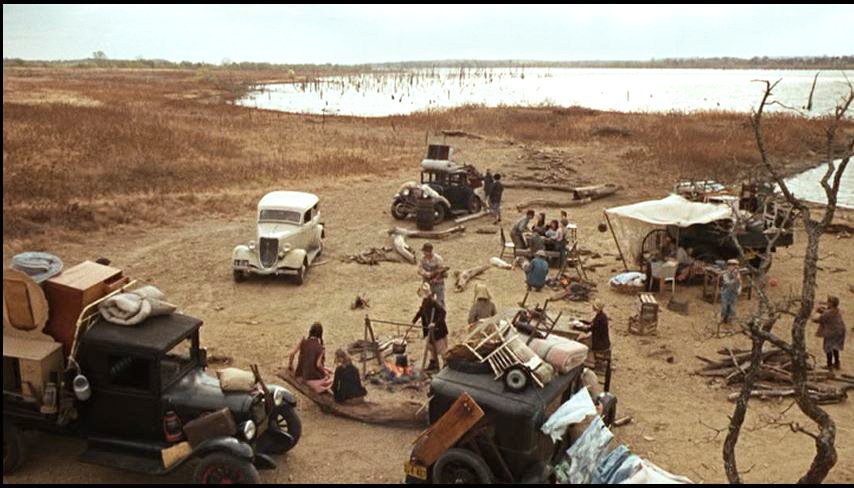
What I found seemed to be a modern-day equivalent of a Depression-era Hooverville:

I’m guessing [that] most people [who stay at such places] already have their Plan B…  Packing up and moving to the next-closest “free campground…”  The point is that after feeling distinctly uncomfortable at the idea of camping at Killebrew Park – even if there had been a space available – I had my own Plan B.

My Plan B was to drive up to nearby Georgia Veterans State Park that late Thursday afternoon.  (West of Cordele and just off I-75.) It’s a beautiful park – and campground – but then I went to register.  Fortunately I’d just renewed my “Friends of Georgia” ParkPass, and so was entitled to one free night of camping.  I then asked how much it would cost to tent-camp otherwise.  (For future reference.)  The best available discount rate was $28.00…

On the other hand, Expedia said there was a nearby Budget Lakeview Inn (Sycamore) for $38.00. That may not be everyone’s cup of teaBut – having camped less than a year ago on a soggy salt marsh 12 miles out in the Gulf of Mexico – that wouldn’t have been so bad to me.  (See 12 miles offshore, on the 8-day primitive-camping canoe trip last November 2014.)

Which brings up what I said in my first Mid-summer Travelog:

For the price you pay to camp these days – as Steinbeck did [in 1960] – you can get a nice Motel 6 with AC.  (And that’s tent camping.  For what you pay for an RV or travel trailer, you can stay at a lot of Motel 6’s.)

And just for the record, I’ve owned motor homes.  (Three in fact.)  So I know whereof I speak.

Which brings up the fact that on that Thursday night – October 22 – I discovered that my spandy-new 2015 Ford Escape offers plenty of room for sleeping.

But first a word about permits.  Before you camp overnight in the Okefenokee, you need a permit.  (See Overnight Camping Permits – Okefenokee.)  That costs $15 a night.  (Of which $6 is non-refundable.  And none of it is refundable if you cancel less than a week before the reservation date.)   Then I also found out Recreation.gov tacks on a $6 “reservation fee.”

So for a grand total of $21, you may tent-camp in a swamp.  Which brings up again:  “For the price you pay to camp these days – as Steinbeck did – you can get a nice Motel 6.”  (On the other hand, you might miss some of the gators, “slithering along.”) Meanwhile, back at Veterans State Park, Thursday night.  (After registering…)

I had my tent, but wanted to get an early start.  So I blew up my air mattress and spread it – and my sleeping bag – in the back of my Ford Escape.  (I’d folded down the seats and moved the kayak outside.)  By moving the front passenger seat up and folding it up toward the dashboard, I had plenty of room in case of jimmy legs.

(The latter term refers to the Seinfeld Money episode.  In it – and perhaps ironically – “Jack Klompus drives the car into a swamp and Jerry returns to Florida.”)

So anyway, I got a pretty good night’s sleep.  Next morning – Friday October 23 – I left Cordele and covered the 160 miles to the Folkston entrance in about three hours.  I took my time getting ready, in part because my reserved camping shelter was only three miles away.

That is, in the time frame I had there was only one camping platform available, Cedar Hammock.  The nice lady at the main (east) entrance assured me I “should be able to reach it before dark.”  I in turn thought her estimate was way off.

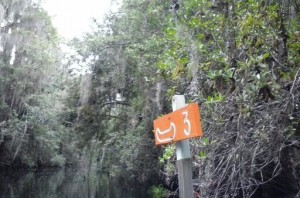
oke 031Remember that I’d made Mile-Marker Three – at right – in 54 minutes the first time I visited.  (See Part I.)

So this Friday, I thought I’d have plenty of time to paddle around that day, and might even make the Canal Run shelter and back. (See Permits, above.  That would allow me to “bisect” the swamp on a later trip, coming in from the Stephen C. Foster State Park – Fargo, to the west.  Or so I thought…)

But there was another reason I took my time getting ready that Friday morning.  I wasn’t sure my “tagalong combo” was completely kosher.  (The rubber raft I towed behind my kayak, to carry supplies, noted in Part I.)  For one thing, according to a “liberal” reading of the park rules, I might be charged twice, for the kayak and the rubber boat.

So I operated on the theory, It’s easier to ask forgiveness than permission.  I figured I’d leave the rubber boat – and supplies – in the car.  Then I’d paddle around happily during the day, and return to the entrance area a bit after closing time.  (6:00 p.m.)

It kind of worked out that way…  But my plan also ended up with me thinking that Monet guy could take his stinking water lilies and “stick ’em where the sun don’t shine.”

But we digress!!!

I’ll conclude this venture in Part III, which means another “To be continued…”  Meanwhile you can consider this as well:  My Utah brother has a brilliant idea for further adventures next summer.  A 16-day, 500-and-some-mile, primitive-camping canoe trip down the Yukon River.

From Whitehorse, up through Lake Laberge – of “Sam McGee” fame – to Dawson City.

But for now, enjoy this lovely painting by Monet, of water lilies.  (And you can thank your lucky stars that you don’t have to paddle your stinkin’ kayak through them…)

*   *   *   *

 “Water lilies:”  Lovely to look at, but a pain to paddle through…   

*   *   *   *

As in Part I, the upper movie-poster image is courtesy of Swamp Water – Wikipedia.

I took the photographs of the first alligator basking on the “shore” and Canoe-mile-marker Three.

Also re: Mile Marker Three.  It’s past the turn-off “canoe only” trail to the Cedar Hammock shelter.

Re: “travel-venture.”  See also Travelogue … at Dictionary.com.

The “floating gator” image is courtesy of Okefenokee Swamp – GA | Kayak Trip … Paddling.net.

Re: “Lake Laberge.”  In his 1907 poem “The Cremation of Sam McGee,” Robert W. Service spelled the name of the lake as “Lebarge.”  

The lower image is courtesy of Water Lilies (Monet series) – Wikipedia.

*   *   *   *

Operation Pogo – “Into the Okefenokee”

A contemporary view of the Okefenokee Swamp, made famous – or infamous- by a 1941 film… 

*   *   *   *

November 7, 2015 – I saw the movie Swamp Water back in the early 1960s.   (When I  was around 10 or 12.)  The part I remember best was watching Walter Brennan getting bitten in the face by a snake. In the scene, he kneels over and parts the bullrushes to get a drink. (Of  “swamp water,” while hiding from John Law in the Okefenokee.) 

As Walter does all that, the viewer can see a grinning cottonmouth off to his right. (The viewer’s left.) The grinning cottonmouth then proceeds to bite him “right on the cheek.”

I’ve been fascinated ever since…

Which is another way of saying that back on October 23, 2015, I fulfilled a life-long dream.

I took my little 8-foot kayak and paddled deep into the Okefenokee Swamp myself.  There I camped overnight, on the Cedar Hammock shelter. On the other hand, I didn’t see any snakes either… There’s more on the overnight camp-out later.  But first a word about that life-long dream. I’ve been fascinated by the Okefenokee as long as I remember.  (In much the same way as I am by New York City.  To me they’re both fascinating and scary…)

Part of it was the movie Swamp Water, but another part was the old Pogo comic strip.  It starred Pogo Possum, and was set in the Okefenokee Swamp.  It also featured “social and political satire through the adventures of its anthropomorphic funny animal characters:”

Pogo is set in the Georgia section of the Okefenokee Swamp;  Fort Mudge and Waycross are occasionally mentioned.  The characters live, for the most part, in hollow trees amidst lushly rendered backdrops of North American wetlands, bayous, lagoons and backwoods.

And characters in the strip included Albert Alligator. Which brings up a note:  I saw tons of Albert’s cousins – and other distant relatives as well.  I usually saw them basking on the “shore,” or slithering through the waters ahead of me. But one time I saw a big bull gator – who eventually submerged – in a very narrow canal. This was on the canoe trail to Monkey Lake. As I paddled over over the water where the gator had been, I could swear he came up and nudged the bottom of my kayak.  I figured it was an accident.  (But the second time?)

That added some spice to the trip.

And speaking of “shore.”  One thing I learned is that – in the Okefenokee – there are precious few places to stop and take a break from your canoe or kayak. The shelters – for day use or overnight – are few and far between.  As a result, the ol’ keister got extremely sore by the end of the second day.  (Not to mention blisters on my palms…)

065Which leads to the fact that the “shore where the gators bask” – noted above and as shown at left – was not really a shore(As that term is generally understood.) In the Okefenokee Swamp, such a shore is usually a line of reeds that an alligator can mash down.  (And where a human steps off at his own peril…)

But we were talking about that life-long dream.

I’ve lived in the Tampa Bay area most of my life.  (Before I ended up in “God’s Country.”)  So to go anywhere north, I always had to drive up I-75 or I-95.  Either way, as I got just past the Florida-Georgia line, there – off to the right or left, respectively – always lurked the Okefenokee. (Begging to be explored, both threatening and fascinating…  Much like New York City.) So when I finally got my chance, I took it.  (Albeit, well past my 64th birthday.)

To prepare for the trip – about two weeks before the October 23 overnight jaunt – I drove down for a short two-hour exploratory kayak.  (Verb, not noun.)  On that short jaunt I paddled out to Mile Marker 3.  Three miles west of the Suwannee Canal East Entrance to the Swamp. I covered that three miles in 54 minutes, a figure that would came back and haunt me later. Having done that, I took the plunge and made a reservation to camp overnight. That – I thought – would enable me to explore a lot more of this mystic swamp.

1445698042386But first a word about transport.

I originally planned to rent a canoe, from the local Okefenokee Adventures at the main entrance.  (11 miles southwest of Folkston.)   The cost would be $25 a day for the two days, and in the canoe I could carry all my gear in comfort.  (In one vessel.) Needless to say, you can’t pack much gear – beyond a cold drink and sandwich – in an eight-foot kayak.  But then I found myself “financially challenged,” for the time being at least…

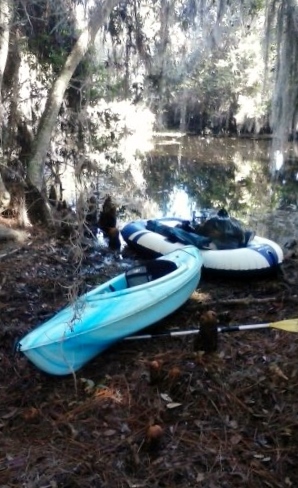
The upshot was that – instead of renting a nice big canoe – I opted for a “tagalong combo.”  I paddled my small kayak and towed a small rubber “dinghy,” as shown at right. And incidentally, this site shown was one of the few places that I could get out and stretch my legs.  That’s another way of saying I found one stretch of hammock(s) along the Suwanee Canal, the ” principal waterway into the swamp.”  Aside from the shelters themselves – few and far between – that was pretty much it for getting a break from paddling.

And finally – for this episode anyway – here’s a word on tent camping.  (Before  we get to the swamp-camping part of the journey into the Okefenokee.) In Mid-summer Travelog (Part I), I wrote about tent camping as a less-expensive alternative to motels, while traveling on the road.  That was part of a discussion of Travels with Charley, the book on a road trip John Steinbeck took in 1960.  I noted some big differences between highway travel in 1960 and highway travel today. Like, in 1960, Steinbeck could camp for a dollar a night, if not free.

Once, early in his trip, Steinbeck stopped at a farm in New Hampshire for fresh eggs.  He then asked permission to “camp beside the stream and offered to pay.”  The farmer said there was no need to pay.  “The land’s not working.  But I would like to look at that rig you’ve got there.”  (At this time motor homes were still rare.)   The two men ended up at the table inside Steinbeck’s “rig,” discussing events of the day over “a good dollop of twenty-one-year-old applejack.”

Old Grand Dad.jpgAnother time – just before he drove into Chicago to meet his wife at the Ambassador East – Steinbeck was relaxing where he’d pulled over to make coffee.  (Beside a lake of clear, clean water.)  Then, “A young man in boots, corduroys” and a mackinaw came up; “Don’t you know this land is posted?  This is private property.”  Steinbeck ended up camping there, after a “bribe … with a cup of coffee.”  Coffee, that is, with a “dollop of Old Grand-Dad.”  (Which may bespeak an object lesson for traveling…)

Then on pages 95-103 of the Penguin Books edition, he wrote of the marvels of the then-new trend in personal housing.  (Mobile homes.)  More to the point, on page 98 he wrote this: “Since I did not require any facilities, sewer, water, or electricity, the price to me for stopping the night was one dollar.”

That seems to be no longer true.  Not in any meaningful way anyway.

In Travelog (Part I), I wrote that for what you pay to camp – as Steinbeck did – you can get a nice Motel 6, with air conditioning and no bugs.  (And that was for tent camping.)  But then I had to add this proviso, in a follow-up post, Mid-summer Travelog – Part III:

It is true that camping at a state park these days – even with online reservations – can cost almost as much a night at a Motel 6.  But after the trip I found a website, Freecampsites.net. (See also FreeCampgrounds.com.)  I haven’t actually tried one of these yet, but it does bode well for the future.  (And I suppose there’s some kind of object lesson in all this…)

Which is another way of saying that on the way down to the Okefenokee, I got a chance to try out one of those campgrounds on Freecampsites.net. The site I planned to check out was Killebrew Park – Warwick, GeorgiaWarwick is a cute little town of some 430 souls.  It’s at the south end of Lake Blackshear, and a mere 16 miles southwest of the Cordele ramp to Interstate 75. But Killebrew Park was a different story.  It was indeed at the south end of Lake Blackshear, and thus a possible site for future kayaking adventures.  Before even entering the campground I saw a large sign, “No campsites available.”  (Or Words to that Effect.) Then I drove into the campground itself, just to make sure.

http://1.bp.blogspot.com/-NEdTsiK6DRA/Tz3sF8_7X-I/AAAAAAAACO0/AjUYec-_ZGo/s1600/Bonnie+and+Clyde+1967.JPGWhat I saw reminded me of a scene from Bonnie and Clyde.  (As shown at right.)  That led to me to later Google the term Hoovervilles  – and possibly discover their modern-day equivalent:

The communal “Hoovervilles,” “Hobo Jungles” and “Shanty Towns” of the Great Depression evoked
the hippie communes that were springing up all over the country in 1967.  The nomadic, anti-establishment rebel  lives of Bonnie & Clyde struck a chord with young audiences of the 60s.

But the campground at Killebrew Park had a different feel to it.  The standard practice at most campsites is for a 14 Day Stay Limit.  So after driving through the place, I’m guessing at what most people do when staying at such places as Killebrew Park.  I’m guessing they already have their Plan B mapped out:  Packing up and moving to the next-closest “free campground.” Whether these free campgrounds are the modern equivalent of such “Hoovervilles” is beyond the scope of this post.  (Now just passing the preferred post-length of 1,600 words.)   Or possibly for another, later post.  The point is that after feeling distinctly uncomfortable at the idea of camping at Killebrew Park – even if there had been a space available – I had my own Plan B.

That and the overnight-camp in the Okefenokee will be covered in the next post…

*   *   *   *

SwampWaterPoster.jpg

“…a cottonmouth bites Walter Brennan ‘on the cheek.’”

*   *   *   *

The upper image is courtesy of Okefenokee National Wildlife Refuge – Image Results. From the article, National Wildlife Refuge System celebrates 114th birthday

Re: “John Law.”  See also Urban Dictionary: John Law, and not to be confused with John Law, the noted economist (1671-1729), the “Scottish economist who believed that money was only a means of exchange that did not constitute wealth in itself and that national wealth depended on trade.” 

The “Albert” image is courtesy of www.comicvine.com/four-color-105-albert-the-alligator-and-pogo.  Wikipedia described Albert as “Exuberant, dimwitted, irascible and egotistical…  The cigar-chomping Albert is as extroverted and garrulous as Pogo is modest and unassuming, and their many sequences together tend to underscore their balanced, contrasting chemistry —like a seasoned comedy team.”

Re: “God’s Country.”  See Introduction to Ashley Wilkes:   “I live in the ATL – also known as ‘God’s Country’ – and that’s the birthplace of Gone with the Wind.”

Quotes from “Travels with Charlie” are generally from the 1980 Penguin Books edition.  The “applejack” quote is on pages 27-28.  The “Granddad” quote is from pages 109-13.

*   *   *   *

And finally, as to possible other places to camp free, see RV Parking at Walmart | Walmart Atlas.   See also A Guide to Car-Camping – in Walmart Parking Lots and No Overnight Parking at Walmart | Walmart Atlas.  The upshot seems to be that you should be able to car-camp at some 80% of Walmarts around the country.  For another example – mobile home parks, as Steinbeck used – see Amenities & Rates – Arrowhead Campsites & Mobile Home Park.  That park – located in Ocala, Florida – offers an overnight tent-site rate of $17.00.  

Introduction to “Ashley Wilkes”

GWTW – Good for local business and a “tourist boon for Atlanta…”  

*   *   *   *

I just published a collection of posts from this blog.  The title comes from the one I did on September 1, The mysterious death of Ashley Wilkes.  The sub-title:  “And other tales from the ‘Georgia Wasp.'”  Which is another way of saying that I’m a firm believer in kismet. In one sense it means your lot in life.  (Or the alternative, your fate.)

But in another sense it means a situation “when you encounter something by chance that seems like it was meant to be.”  (Sometimes called a sign from God.  On which see Isaiah 7:11.) That explains why – in my new book of posts – the Mid-summer Travelogs are out of order.  (Part II comes before Part I.)  There’s more on that later, but first an explanation. I live in the ATL – “God’s Country” – and that’s the birthplace of Gone with the Wind.  In turn, “GWTW” has been both good for local business and a “tourist boon for Atlanta.”  (See for example GWTW trail: the top 10 sights in Atlanta.)

Leslie Howard as Ashley Wilkes in Gone With the Wind trailer cropped.jpgSo after I posted Ashley Wilkes – seen at right, as played by Leslie Howard – I sensed a definite marketing opportunity. Like most people my age – 64 – I sat through the full 220 minutes of the film some time in the 1960s.  (At a periodic re-release in theaters.  That’s almost four hours of running time.)   And I saw it all the way through another time or two, with my parents, at home, on TV.  (Complete with what seemed to be more hours of commercials.)

Since then I’ve seen parts of GWTW dozens of times, in the process of channel surfing.  (A side note: Eugene Polley, who invented the first wireless remote control, died in 2012 at age 96.)

And finally – just last summer – I once again watched the entire movie, all the way through.  (My brother and I were traveling back from Astoria on “unfinished canoe-trip business.”)

Bundesarchiv Bild 101I-363-2258-11, Flugzeug Junkers Ju 88.jpgBut it was also only then – after getting home from Astoria – that I learned about Leslie Howard dying so mysteriously.

It happened during the early years of World War II, over the Bay of Biscay off the French coast.  In June 1942, a commercial airliner carried Howard and 16 other passengers and crew from Lisbon to London.  It got shot down by eight Luftwaffe Junkers Ju 88C6 fighter aircraft, like the one above left.

You can see the full story at Mysterious death, the first chapter of this new book.  On that note, some called the shoot down an accident of war.  But others said top Nazis ordered the attack deliberately.  According to this theory, the Germans considered Howard as either a British spy, or as “Britain’s most dangerous propagandist,” or both.

Personally I found this new information fascinating, and wondered why I’d never heard it before.  (Including the part about Conchita Montenegro, seen at right.)  In turn I figured the people of Atlanta would be equally fascinated.  So, I decided to do something about it.

Thus was born The mysterious death of Ashley Wilkes (and other tales from the “Georgia Wasp”), now available in E-book and paperback.

Which brings us back to kismet

To get the book ready to publish, I had to copy-and-paste the first chapter – Mysterious Death – onto a flash drive.  But for some reason, the resulting copy-and-paste resulted in a bunch of posts being transferred.  Some 14 posts in all – including drafts – all the way down to Canoeing 12 miles offshore.  (I posted that on May 23, while I posted Ashley Wilkes on September 1st.)

But rather than get upset, I figured it was kismet.  (Either that or a sign from God)

Which means that a happy accident shaped at least the first draft of the book.  Later I did some tweaking, adding some posts, editing others and deleting some.  But basically the order of chapter-posts in the book came from that initial C&P bit of “kismet.”

There’s more on the other chapters later, but first I wanted to do another bit of homage to Harry Golden.  He’s the guy who inspired me to start this second blog.

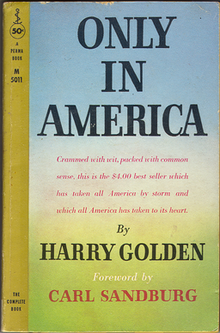
Some years ago I bought a second-hand paperback copy of Harry’s book, Only in America.  (Not to be confused with the 2001 Brooks and Dunn song of the same name, or the 2011 “reality television series” featuring Larry the Cable Guy.)

I admired the way he wrote about topics that interested him, yet still managed to find an audience for his ramblings.  I also admired the way he wove stories that became “a wonderful look into a different time.”  And I admired the way he overcame the obstacles in his life, like serving five years in prison for mail fraud.  (See “Wasp.”)

Only in AmericaBut despite it all, Harry still liked to “accentuate the positive.”  And that alone made him both unique and well worth emulating.

I’m pretty sure he too would be fascinated by the mysterious death of Ashley Wilkes.  And I’d like to think he’d enjoy the rest of the book as well.

For example, the second chapter is “Johnny YUMA was a rebel…”  It’s about The Rebel (TV series), that ran from 1959 to 1961.  (And Harry himself was a bit of rebel.  Facing down intolerance, distrust and greed, and standing up “for the weak and downtrodden.”)  But once again there was a death under mysterious circumstances.  The series’ star – Nick Adams – died at age 36, in 1968.  (A mere seven years after the show ended.)

The third chapter is “When adultery was proof of loyalty.”  That post was inspired directly by Harry Golden, who wrote a column of the same name.  I did it as a “book review plus:”

Unfortunately, in Harry’s delightfully retro format – an old-timey newspaper or newsletter – he couldn’t use the full-color pictures, flashy graphics and built-in links that we can use in today’s blogs.  So, this bit of a book review will be more than a bit of an update. (E.A.)

Other chapters include On Oscar Wilde and “gross indecencies.” It talks about the rise and fall of both Oscar Wilde and “computer scientist Alan Turing.”  (As told in the 2014 film, The Imitation Game.)  The lesson?  It pays to remember our past history.  Which is something Harry would believe in. Then there was a chapter On leaving a legacy. It talks about something that should be near and dear to all of us aging Baby Boomers:  Putting your stamp on the future, giving some meaning to your existence, or both.

And speaking of positive mental health advantages…  That’s one of many things that I got – and get – from reading and re-reading Harry Golden’s old books full of columns, observations and essays.  (Books like Only in America and For 2 Cents Plain.)

One reviewer noted above said that Harry’s essays were “at once insightful, thought provoking and in some instances just plain funny.”  Another noted his special brand “of wit and whimsy, and a love of people and learning.”  A third said that Harry’s Carolina Israelite was “the most quoted newspaper of personal journalism of them all.”

In closing, someone once observed that “a man is known by his dreams.”  Assuming that is so, it is my sincere hope – and dream – that I can carry on the good work done by Harry Golden.

*   *   *   *

*   *   *   *

The upper image is courtesy of Gone With Wind – Image Results.  

Re: positive outlook on life and/or “accentuating the positive.”  Referring to “Ac-Cent-Tchu-Ate the Positive,” the 1944 song written by Harold Arlen with lyrics by Johnny Mercer.

See also curveball, defined in part as a “particularly difficult issue, obstacle, or problem.”  The point being that life seems to have a habit of “throwing us curveballs.”  See also the alternate definition of dinosaur, assomeone who resists change or is old-fashioned.”

Re: “The ATL.”  The link in the text goes to the Wikipedia article on the Atlanta metropolitan areaBut “ATL” or “the ATL” is a common acronym or abbrevation for the same area, if not Atlanta proper.  (Possibly or partly based on the airport code for Hartsfield–Jackson Atlanta International Airport – Wikipedia.  See ATL – Acronyms and Abbreviations – The Free Dictionary.)

The “tourist boon for Atlanta” quote is from “A Tough Little Patch of History:”  Atlanta’s Marketplace for Gone With The Wind Memory.  That was the 2007 history dissertation by Jennifer Word Dickey, presently an Assistant Professor of History at Kennesaw State University:

She has a master’s degree in heritage preservation and a Ph.D. in public history from Georgia State University.  Her research focuses on the cultural impact of Margaret Mitchell’s Gone with the Wind, a subject upon which Dr. Dickey has delivered public programs in the United States and in Vietnam.

Re: “periodic re-release in theaters.”  See for example ‘Jaws’ Re-Release:  Film to Hit Theaters for 40th Anniversary:  “On June 21, [2015,] nearly 500 theaters nationwide will show the thriller for its anniversary, presented by Fathom Events, Turner Classic Movies and Universal Pictures.”

899931_80902243Re: “happy accident.”  Also known as Serendipity, originally a term coined by Horace Walpole in 1754 and meaning a “fortunate happenstance” or a “pleasant surprise.”  See Wikipedia, and also Embracing Creative Failure (II): Cultivating Happy Accidents.  The latter web-article discusses happy accidents in the process of creating works of art – as seen at left – and added this:

Where would we be without serendipity…  Without the “X Factor” that unexpected results bring, who knows how long it would have taken scientists to discover oxygen, electric current, photography or the vulcanization of rubber.  And who knows if such vital medical breakthroughs as the discovery of penicillin [or], the development of chemotherapy as a cancer treatment … would have happened at all.

The view of lower Manhattan is courtesy of oneworldobservatory.com/experience.

Re: “a man is known by his dreams.”  That thought was attributed to Plato, in the third paragraph down of the web article, The Dreams and their Interpretation.

The lower image was featured in Was Moses the first to say “it’s only weird if it doesn’t work?”  In turn it was courtesy of Rephidim – Wikipedia, with the caption:  “Moses holding up his arms during the Battle of Rephidim, assisted by Hur and Aaron, in John Everett Millais Victory O Lord! (1871).”

*   *   *   *

In addition to Gone With The Wind Trail: top 10 sights in Atlanta – vis-a-vis the film being good for local business and tourism – see also Gone with The Wind| Atlanta History CenterVisit the Margaret Mitchell House | AtlantaHistory Center, and/or Gone With The Wind- Roadside Georgia.


Was Moses the first to say “it’s only weird if it doesn’t work?”

Moses at the battle of Rephidim:  “If I let my arms down, the other team will win!


Friday, October 9, 2015 – Week 6 of the college football season started last night.

Which means that many or most fans around the country will be doing a bunch of weird rituals and/or superstitions, all to help their team win.  (Or avoid jinxing their team, thus causing it to lose.)  All of which may sound a bit weird to the more rational among us.  (Which doesn’t necessarily exclude the aforementioned college football fans.)

The thing is, this business of “helping your team win” has been around a long, long time.  (Longer even than “Touchdown Jesus,” seen at left, visible from Notre Dame stadium …)

In fact, it may all have started with Moses, back at the battle of Rephidim, noted above.  There’s more on that later, but first consider “Super”stitions: Fans engage in odd rituals:

[M]any sports enthusiasts have something they do in attempt to increase their team’s odds of winning.  It’s possible that these wacky fan behaviors are related to the superstitious actions some athletes take in attempt to improve their luck … like growing beards or eating certain foods because they think the behavior is lucky.  Adopting their own rituals is a way that fans can feel like they’re part of a team…  “It all comes down to fan identification,” [Dr. Joshua Shuart] said. “They really feel that they’re part of the team.” (E.A.)

But what’s all this about Moses being the first guy who said “It’s only weird if it doesn’t work?”

For that we have to go back to Exodus 17, about 3,500 years ago.  Like Pearl Harbor, the dreaded Amalekites launched a sneak attack on the Children of Israel, as they emerged from “the Exodus, at Rephidim near Mount Sinai.”   Verses 8 to 16 tell of Israel pulling off  an “upset of the season.”  In essence they beat a hated arch-rival, thanks to Moses:

Moses, Aaron, and Hur went up to the top of the hill.  Whenever Moses held up his hand, Israel prevailed; and whenever he lowered his hand, Am′alek prevailed.  But Moses’ hands grew weary; so they took a stone and put it under him, and he sat upon it, and Aaron and Hur held up his hands, one on one side, and the other on the other side; so his hands were steady until the going down of the sun.

As noted elsewhere:  “That sounds a lot like a modern-day football fan, watching his favorite team on TV.”  Sometimes he moves around the room, sometimes he stands, sometimes he sits.  Other times he’ll mute the sound on the TV, sometimes he’ll tell his wife to leave the room – because she may be jinxing his team – but he’s “always trying to ‘help his team win.’”

Or in the case of Moses, his “team” starts winning when he holds his arms up, but they start losing if he lets his arms down…

So imagine Moses – today – watching the “battle” from a stadium seat, or on his TV set at home.  For whatever reason, he holds his arms up, and his team scores a touchdown.  But then his arms get tired.  He lets his arms down for a moment and – lo and behold! – the other team scores a touchdown.   So to help his team win – or avoid “jinxing” his team – Moses got his buddies Aaron and Hur to hold his arms up “for the rest of the game.”

That makes Moses the prototype of the modern-day football fan who does all kinds of strange things to help his team win.  But here’s how one “skeptic” explained the phenomenon:

It’s a natural tendency for people to make connections between events.  “When I do this, that happens…”  Primitive people developed superstitions in similar ways.  One year, the crops were bad.  The next year, they put a basket of dead birds in the middle of the field, and everything turned out great.  Therefore, placing a basket of dead birds in the field ensures a good crop…   Like the primitive farmers, we continue to make assumptions of causation [which] leads us to think that prayer works (you pray for your sports team to win…)   [But we should] not jump to conclusions.  We should make multiple observations.  We should try different sequences in various combinations…  Even with all that, we might never be sure about the real causes.  But we can rule some out, and … increase our confidence in others.

See Faulty logic: Post hoc, ergo . . . Gotham Skeptic (Which apparently “no longer exists.”)

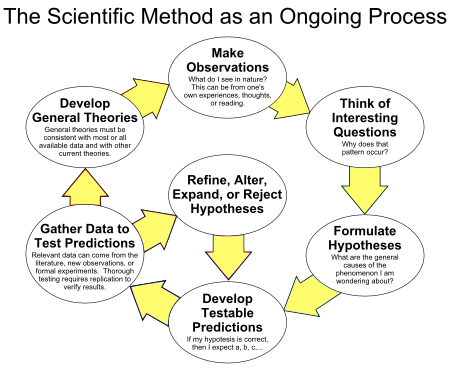
On the other hand, you could just as easily say that such superstitions are a mass example of the scientific method:  “a body of techniques for investigating phenomena, acquiring new knowledge, or correcting and integrating previous knowledge.”  (What fool of a college football fan would keep doing things that ‘hurt” his team?)   See also Thesis, antithesis, synthesis:

The thesis is an intellectual proposition.  The antithesis is simply the negation of the thesis, a reaction to the proposition.  The synthesis solves the conflict between the thesis and antithesis by reconciling their common truths and forming a new thesis, starting the process over.

But the bottom line is this:  “Athletes know it, fans know it, and even Bud Light knows it. Superstitions are as big a part of the game as anything.  They were there when your parents and/or grandparents first started watching, and they’ll be here long after we’re gone.”

On the other hand, there’s the “pessimist” who wrote “It’s only weird if it doesn’t work:” the NEW worst slogan in the world.  Among other things, he said in essence that such fan practices are all part of some axis of evil responsible for all the bad things that have happened in the world since Day One.  (Which brings to mind Marty McFly’s “Lighten up, jerk!”)

Then too he wrote that such fan superstition is “ignorant, embarrassing, and frankly makes me a little pessimistic about humanity.  Do you really think that wearing that unwashed jersey will help your team win?”  To which I can only respond:

“Hey pal, tell that to Moses!”

*   *   *   *

*   *   *   *

The upper image is courtesy of Rephidim – Wikipedia, the free encyclopedia.  The caption:  “Moses holding up his arms during the Battle of Rephidim, assisted by Hur and Aaron, in John Everett MillaisVictory O Lord! (1871).”

The “Touchdown Jesus” image is courtesy of Gallery … University Of Notre Dame Touchdown Jesusimgarcade.com

Re: positive outlook on life and/or “accentuating the positive.”  Referring to “Ac-Cent-Tchu-Ate the Positive,” the 1944 song written by Harold Arlen with lyrics by Johnny Mercer.

See also curveball, defined in part as a “particularly difficult issue, obstacle, or problem.”  The point being that life seems to have a habit of “throwing us curveballs.”  See also the alternate definition of dinosaur, assomeone who resists change or is old-fashioned.”

Another note:  The text of this post was gleaned from other posts in my first blog, Dorscribe.com, including On the readings for September 28, Reflections on a loss and “God’s Favorite Team” – Part I.

The “Touchdown Jesus” image is courtesy of Word of Life Mural // Hesburgh Libraries // University of Notre Dame.  See also Notre Dame Stadium – Wikipedia, the free encyclopedia.

The “crossed fingers” image is courtesy of  Why We’re So Superstitious | Psychology Today.  That’s actually a pretty good – and non-biased – study of the phenomenon, which included this:

Sports fans, for all the ribbing they take, do have some decidedly positive mental health advantages over non-fans.  Evidence cited by [Kent State University researcher Shana] Wilson and her co-workers supports the idea that fans who strongly identify with a team, particularly a local one, are less lonely, feel happier, and feel better about themselves.

The “SM” chart is courtesy of Scientific method – Wikipedia, the free encyclopedia.

The lower image is courtesy of Bud Light Only Weird – Image Results.

*   *   *   *

Of related interest, see also Why Superstition Works: The Science of Superstition in Sports:

If you want to see some [sport superstitions], just go to a baseball game.  Baseball players … are renowned for their superstitious behavior.  Babe Ruth, famously, always touched second base when he came running in from the outfield…   Over the years, players’ superstitious habits have become, if anything, even more extreme.  Before each game, for instance, former Red Sox third baseman Wade Boggs … always practiced batting and wind sprints at the same time of day (5:17 p.m. and 7:17 p.m., respectively), left his house at the same time on game days, and drew the word “Chai” (Hebrew for “life”) in the dirt before coming up to bat (and Boggs isn’t Jewish).  Likewise, All-Star slugger Jason Giambi had a cure for hitting slumps: gold lamé thong underwear, which must have been quite a sight in the locker room.

So what are you saying, “Mr. Pessimist?”  That Babe Ruth and Wade Bogs are evil?  Hah? 


A Mid-summer Travelog – Part III

Atlantic City, seen at dusk from the balcony of the Wyndham Skyline Tower


This post continues Mid-summer Travelog (Part I), and Travelog – Part II.  Of course now that it’s October 2 – a full 10 weeks after that road trip ended – this third-of-four installments will be more of a remembrance.  And among other things, I’ve taken another trip since then.

In August I took a trip out west, to Utah, and from there to “the Columbia River, near Astoria, on unfinished canoe-trip business.”  (See Ashley Wilkes.)  That trip took nearly three weeks, from August 10 to the 27.  In the meantime football season is once again upon us.  Which means it’s been a busy time for me.

And it’s also a good time for reflection.

But before we continue the travelog itself, I should remember that these shouldn’t be just the boring ramblings of an aging Geezer.  That’s because:

The journey motif, where a story’s protagonist must complete a quest … is one of the oldest in storytelling.  Usually, there is a prize or reward promised, but often the true reward is different and more valuable, as the protagonist both proves and humbles himself.

See What is a journey motif?  (Emphasis added.)  So I’ll try to keep that in mind…

Anyway, in Part II I noted Steinbeck’s comment: “when I used to work in the woods it was said of lumber men that they did their logging in the whorehouse and their sex in the woods.”   Then I added my own twist:  “Which is another way of saying that it’s only now that my trip is over that I can look back and relish the memories just lived through.”  That was back on July 22, which means this Part III will be doubly reflective.

We resume this installment in Atlantic City.  And as shown in the upper image, from the top floor of the Wyndham Skyline Tower.   That was one of the most pleasant surprises of the trip.  (I’d thought my brother’s  saying “we rented a condo” would mean a quaint little three- or four-bedroom house, somewhere near the beach.)  Being able to look out on “AC” from a 32d-floor balcony – at dawn and dusk – was refreshing indeed.

The installment will end – perhaps metaphorically – at (or near) “Old Swedes” Episcopal cemetery in Swedesboro, New Jersey.  That’s where where we surviving three brothers – along with a niece and matriarchal aunt – laid our father’s ashes to rest.

(As noted in Part I, that memorial lent “a certain gravitas to the whole ‘joint venture.'”)

1962 first edition coverAlso in Part I, I told of trying to fashion my road trip in the manner of Steinbeck’s Travels with Charley.  Which meant – first of all -noting some key differences between highway travel in 1960 and 2015.  (Differences including but not limited to cruise control.)

I noted another difference, on camping not being a cheaper way to travel.  That is, before leaving I decided not to camp as Steinbeck did.  That was because even for tent camping, the price you pay is almost as much as a Motel 6.  But since then I’ve learned that’s not entirely correct.

It is true that camping at a state park these days – even with online reservations – can cost almost as much a night at a Motel 6.  But after the trip I found a website, Freecampsites.net. (See also FreeCampgrounds.com.)  I haven’t actually tried one of these yet, but it does bode well for the future.  (And I suppose there’s some kind of object lesson in all this…)

That brings up another key difference between Steinbeck’s time and ours.

On page 167 of the Penguin Edition TWC, Steinbeck wrote of driving across the “upraised thumb of Idaho and through real mountains that climbed straight up.”  There he had a problem: “my radio went dead and I thought it was broken, but it was only that the high ridges cut off the radio waves.”  The point?  Steinbeck had only a car radio to entertain him.

I on the other hand had radio, and a CD player that could – and did – provide an education via lectures on CD.   (Like American History, “patched and piebald,” as seen below left.)

Or I could listen to plain old CDs with music.  (I had around 50 such CDs.)  Or I could listen to pre-programmed music on my iPod Shuffle.  (Which had some eight hours of music.)

And last but not least, I had a six-month trial of SiriusXM (satellite) Radio. That trial came with the new Ford Escape I’d bought the previous May.  It alone had over 175 channels, with comedy, sports, news and information, “commercial-free music,” and traffic and weather.

Which I suppose is as good a metaphor as any for the Information Explosion that now envelopes us today.  (And which “can lead to information overload;” that is, a difficulty in making decisions and understanding issues, caused by too much information.)

But before writing more about Atlantic City, I wanted to note another similarity.

On pages 136-37 of the Penguin Books TWC, Steinbeck wrote about rarely making notes along the way.  But (he added), “I made some notes on a sheet of yellow paper on the nature and quality of being alone.”  Such notes – he said – would normally have gotten lost, “as notes are always lost, but these particular notes turned up long afterward wrapped around a bottle of ketchup and secured by a rubber band.”

He found three notes altogether – all on being alone – with one lying “obscurely under a streak of ketchup.“  He took over a full page of TWC on the third note, “Reversion to pleasure-pain basis.”  He then concluded, “so much for the three notes below the red stain on the ketchup bottle.”  Public Chicago Hotel - Chicago, IL, United StatesAll of which had to do with the fact that  “After the comfort and the company of Chicago I had had to learn to be alone again.”  (His wife flew out to meet him in Chicago, and for a few days they stayed at the “Ambassador East.”  The lobby is seen at right.)

Along the same lines, I recently found a note I’d written during my road trip.  It was from Sunday, June 28, written on an odd scrap of paper in the Walmart parking lot on Virginia Beach Boulevard.

Road trip – Sometimes you’re amazed at how well things turn out like you “planned.”  (Appearance of Walmart this morning.)  And sometimes you have to adapt – Saturday driving up I-95 through rain and traffic.

That all had to do with how “fouled up” the driving had been on Saturday, the 27th.  Not only was the traffic on Interstate 95 even worse than usual…  Aside from that, a strong and long line of thunderstorms took it’s sweet time, taking all day Saturday to pass through the area.

(And knocking out the power for five hours in Williamsburg.  See Part II.)

But then on Sunday morning the sun was out, and driving was fun again.  The only problem was that I needed cash for the toll onto the Chesapeake Bay-Bridge.  I pondered the question while driving east toward Virginia Beach.  I wanted to visit the beach itself, and also looked for First Landing State Park, when all of a sudden – “as if by magic” – a Walmart appeared to my left.  (That’s my normal routine when needing cash.  Rather than pay an ATM fee, I generally go to a Walmart, get some inexpensive necessity and get cash that way.)

All of which could be just another way of saying, “Sometimes you get the bear, and sometimes the bear gets you.”  Or as Steinbeck said, “we do not take a trip; a trip takes us.”  (TWC-2, 4)

And by the way, I’m pretty sure they didn’t have ATMs in 1960.

Then too, that “magical moment in travel” was pretty much what happened when – later in the week – the three parts of the family got together for the memorial in Swedesboro.  We all came together “as if by magic.”

In the meantime I just checked the word counter.  It said the last paragraph put me at 1,344 words.  That means it’s time to start wrapping this up.

So here’s a condensed version of journal entries for this trip-part.  For readers more interested – or more masochistic– there’s a longer version at the end of the notes.

On Monday evening, June 29, I treated my hosts to dinner at the Hard Rock Café down on the Boardwalk.  (“I made believe I lost my credit card.  Hah!  Fooled everyone.”)  Then at another restaurant a day or so later, I walked off and left my cell phone.  I got it back, but it reminded me of something a fellow old-person once said:  “I’m not senile, I’m processing!”

Which probably qualifies as the travel writer “humbling himself.”

I don’t recall Steinbeck writing of such problems in his journey.  But see also A “Travels With Charley” Timeline, which noted “screaming signs of fictionalization,” Steinbeck’s being “fuzzy about time and place,” not to mention vague and confusing:

The book also includes scenes of several lonely overnight campouts under the stars that didn’t happen and it omits many things Steinbeck did with his wife Elaine when she joined him for a month on the West Coast.

But hey, nobody’s perfect.  (See also “young pup – definition … from the Oxford dictionary.”)

One definite highlight of the stay in Atlantic City was a visit to the Tuckerton Seaport & Baymen’s Museum (seen at right):

“Only six bucks and a great bargain at that, even though many of the exhibits were still closed, due to Superstorm Sandy.”  And among other things, I learned about the Battle of Chestnut Neck, which I’d never heard of.  (In the Revolutionary War.)

See also Travel broadens the mind, with 50 inspiring quotes, including one from Steinbeck: “A journey is like marriage.  The certain way to be wrong is to think you control it.”

On that note, we also did a lot of walking along the Boardwalk over several days in AC, marked by “stopping and starting, shopping, and watching the ‘passing panoply.'”

But getting back to that Journey Motif, “leading to an epiphany, or some sort of self-realization.”

We left Atlantic city on Thursday, July 2, heading for the Swedesboro cemetery.  I followed my even-more-delightfully-retro brother, who refuses to use anything like a GPS.  West on U.S. 322, not wanting to pay a toll or go through the traffic on the Atlantic City Expressway.  There were a number of stops and starts, not to mention turnarounds and dead ends, and we were supposed to meet up with the rest of the family at noon.

I was starting to have my doubts, but we ended up getting “to the cemetery right at 12:04, just behind the Prius;” i.e., the one  carrying the oldest brother, his wife and matriarchal aunt, “just getting out of the car.”  It reminded me of Steinbeck’s finding a friend’s house on Deer Isle:

I climbed a hill and turned right into pine woods and on a smaller road, and turned right on a very narrow road and turned right again on wheel tracks on pine needles.  It is so easy once you have done it.

Picture(TWC-2, 46)  As I wrote in my journal, “We laid Dad’s ashes to rest where the nice guy had dug a huge hole.  Each of us said a little something, then we had a nice lunch at a ‘Fireside’ restaurant in Swedesboro.”  (Rode’s Fireside Restaurant, at left.)

Then we drove across the Delaware Memorial Bridge to our aunt’s house in Wilmington.

Which brings up the matter of my crossing the Delaware River in my kayak the next morning.  It seems that crossing the Delaware is why there are two “Old Swedes” on each side of the river:

The journey across the Delaware by canoe and sailboat was hazardous and often impossible.  In 1706, the first priest serving St. George’s, The Reverend Lars Tollstadius was drowned while crossing the Delaware.

See the notes below, St. Georges Episcopal Church Pennsville, and also The Delaware Finns:  “on the 29th of May 1706, Tollstadius was drowned in crossing the Delaware in a canoe.  Before his death, the congregation had found objections against him, for his irregular mode of living.”  But see also Trinity Episcopal Church, Swedesboro, which had it this way:

After Tollstadius’ apparent suicide in 1706 (he was under indictment by the Burlington Court), he was succeeded by Jonas Auren, one of the three pastors to arrive in 1697. (E.A.)

Be that as it may…  (I don’t want to get into either “irregular modes of living” or being under indictment.)  Be that as it may, I myself paddled across the Delaware in a little 8-foot kayak, early the next morning and notwithstanding the danger!  (As noted in Parts I and II.)  It took almost exactly an hour, from Battery Park in New Castle, across the river to Riverview Beach Park in Pennsville.  But aside from a couple of humongous freighters on the river – and the wakes they generated – the crossing was pretty uneventful.

So much for learning from history


“Old Swede’s Church [Trinity Church] in Swedesboro, New Jersey…”


The upper image is courtesy of Wyndham Skyline Tower – 64 Photos, and/or “Giovanni A.

The “football” image is courtesy of College football – Wikipedia.  The caption:  “The Rutgers College football team in 1882.”

A note:  Quotes from “Travels with Charlie” are generally from the 1980 Penguin Books edition.  Quotes from “TWC-2” are from the 1962 “Viking Press” edition.

Re: Old Swedes, New Jersey.  That’s not to be confused with Old Swedes – Wilmington, across the river, known as Holy Trinity.  Old Swedes New Jersey was built because of the difficulty in crossing the Delaware River, as noted elsewhere:  “To attend church, the Swedish settlers in Raccoon had to cross the river to Wilmington or Philadelphia.  The difficulty of this crossing led to the decision to build a new church on the banks of Raccoon Creek.”

Another note: The “laying to rest” of my father’s ashes actually occurred at Lake Park Cemetery in Woolwich, some six-tenths of a mile south of the Jersey Old Swedes.  Thus the phrase “at (or near) “Old Swedes.”

Re “Ambassador East.”  See The Pump Room, Chicago – Wikipedia:  “The Pump Room … is a restaurant located in the Public Chicago Hotel, formerly The Ambassador East, in Chicago‘s Gold Coast area.”  The lobby image is courtesy of Public Chicago Hotel – 136 Photos.

Re:  “Sometimes you get the bear, and sometimes the bear gets you.”  A variation of the phrase popularized in 1998’s The Big Lebowski.  (See Wikipedia.)  See also Urban Dictionary: sometimes you eat the bear, and/or What does this quote from The Big Lebowski mean?

The lower image is courtesy of Swedesboro, New Jersey – Wikipedia.

*   *   *   *

Other highlights of this portion of the road trip included a visit to the Absecon Lighthousedinner at the LandShark Bar & Grill Restaurant in Atlantic City (on the Boardwalk), a visit to Longwood Gardens (north of Wilmington in Pennsylvania, “one of the premier botanical gardens in the United States”), and another dinner at Gallucio’s Italian Restaurantt in Wilmington.

All highly recommended by this “travel writer…”


On “A Walk in the Woods” – Part I

Amicalola Falls 01.jpg


Amicalola Falls:  You can see these Falls hiking up to Springer Mountain, “southern terminus of the Appalachian Trail,” as seen in the 2015 movie, A Walk in the Woods


*   *   *   *

September, 2015 – Last September 6, a Sunday afternoon, I went to see A Walk in the Woods. The “American adventure comedy biopic film,” based on the 1998 memoir by Bill Bryson. According to Wikipedia, Robert Redford plays Bryson, “now in his late 50s or early 60s.” The movie has Bryson decide to hike the whole Appalachian Trail in one fell swoop. (2,200 miles, and after living in Britain the past 20 years.)That in itself requires a hefty suspension of disbelief.

You see, in the film Redford – born in 1936 – looks to be all of his 79 years of  age. And he now seems to be “paying the price for all that ultraviolet glare on the ski slopes,” as one reviewer said.  (And noted below.) The same critic said of Nick Nolte – Redford’s hiking buddy in the film – that the “handsomely rough-hewn star of North Dallas Forty looks more like a ruddy-faced Yeti.”

But another critic put this positive spin on the film (also on September 6):

With its odd-couple cast and appeal to grown-up audiences, “A Walk in the Woods” has performed solidly at the box office since its debut on Wednesday.  As of Saturday morning [September 5] it had grossed about $10 million.

See Fact-Checking “A Walk in the Woods.”   The reviewer – John Jurgensen – then noted his personal interest in the movie.

In college he’d spent two summers on the Trail as a ridgerunner. (Someone hired to hike various sections of the trail, and/or “tally hiker traffic, monitor trail and campsite conditions, and generally help visitors navigate and understand the A.T.”)

So I suppose I should note my own personal interest in the movie.

Back in 1967 – I was 16 – my next-older brother and I hatched the idea of hiking the Trail from Springer Mountain to Gettysburg, where our aunt and uncle lived,   (Some 623 miles.  My brother was a year or two older.)  For some reason my parents didn’t bust out laughing. (And didn’t say “Are you serious?”  Or  slap their knees while wiping away tears of laughter…)

Instead they thought it was a great idea.  (Apparently.)

So in the early summer of 1967 my brother and I found ourselves dropped off at Amicalola Falls State Park, gateway to Springer Mountain.  (Dropped off by our oldest brother, a student at Georgia Tech at the time.)  Which brings up one key difference.  (To me anyway…)

Back in 1967 we didn’t seen any “magic archway” at our Amicalola Falls entrance to the Approach Trail.  (Nor did we see a paved path of any kind.)  The park at the time was extremely primitive…  But first, a note about my brother and quitting.  (Not unlike Redford and Nolte.)

The thing is, metal-frame backpacks were all the rage back in 1967.  But as we found out, they had a tendency to chisel great gouges of flesh in one’s lower back.  See also Why Internal Frame Backpacks, on the “shift away from external frame backpacks.”  The article added:

The downsides to externals are that, because they carry the weight high and away from your back, they don’t have the best stability.  So, you run the risk of feeling tippy and off-balance … climbing or descending dicey terrain [and] you’ll likely get hung up on branches and brush…  I can’t remember the last time I saw a new or innovative external.

But it was the “flesh-gouging” that caused my brother and I to reconsider our plans after a single afternoon.   On the other hand, our oldest “Tech brother” couldn’t come back and pick us up until the following weekend.  So we were stranded, but we ended up spending a quite pleasant – and isolated – week of tent camping, away from adult supervision.

I suppose there’s some kind of object lesson there.  (See also kismet.)

But we were talking about the “magic archway” featured in the movie, but not seen by us back in 1967.  Which is another way of saying that at least one entrance to the Approach Trail has become “all touristy.”  (Again, at least as seen in the film.) On the other hand, the 8.8-mile hike from there up to Springer Mountain is all uphill, as Redford and Nolte noted in the film.  (See AT Approach Trail … to Springer Mountain:  “The AT Approach Trail climbs solidly uphill, departing Black Gap to hike the lower elevations of Springer Mountain’s southern slope.”)

Which in turn could be a metaphor for the uphill battle the film faces at the hands of critics.

At best the film has gotten mixed reviews.  One site called it “amiable yet less compelling” than a movie with Robert Redford and Nick Nolte should be.  (Also, “ultimately a bit too pedestrian,” possible pun intended.)  And critic Susan Wloszczyna asked this musical question:

There is only one question that you need to ask yourself before deciding to see “A Walk in the Woods:”  Can you justify sitting through an utterly predictable and rather tame man vs. nature ramble in order to enjoy the affable odd-couple chemistry shared by Robert Redfordand Nick Nolte?

See A Walk in the Woods Movie Review (2015), at Roger Ebert.com.  (Ebert himself died in 2013, of complications from his earlier papillary thyroid cancer.  See Wikipedia.)

One possible answer is that Ms. Wloszczyna is more into chick flicks. She compared the film negatively with “Reese Witherspoon in last year’s ‘Wild.’”  (As shown in the movie poster at left):

Witherspoon in her Oscar-nominated role struggled with her inner demons as much as she did the elements, [but] “A Walk in the Woods” is more about two unlikely acquaintances… Redford’s wry Bryson … tired of resting on his considerable laurels … is in a funk after attending a funeral.  That is when he spies a marker for the Georgia-to-Maine trail…   Against the wishes of his sensible British wife … Emma Thompson … he decides on a whim to attempt this marathon test of endurance and picks Katz to join him – primarily because none of his other friends are crazy enough to say yes.

“Tired of resting on his considerable laurels?”  (A metaphor perhaps?)  “Against the wishes of his sensible wife?”  “Decides on a whim?”  Ms. Wloszczyna could as easily have come out and said plainly – to Bryson and every other potential geezer over 65 – “Slow down.  Pack your manhood in cotton wool.  Smother your impulses.  Why don’t you just [expletive deleted] give up?

To be continued…

*   *   *   *

*   *   *   *

The upper image is courtesy of Amicalola Falls State Park – Wikipedia.

Re:  “at the hands of the critics.”  Wikipedia noted:  “Walk in the Woods has received mixed reviews from critics.  On Rotten Tomatoes, the film holds a rating of 46%, based on 104 reviews, with an average rating of 5.4/10.  The site’s critical consensus reads, “Amiable yet less compelling than any road trip movie starring Robert Redford and Nick Nolte should be, A Walk in the Woods is ultimately a bit too pedestrian.”  On Metacritic, the film has a score of 51 out of 100, based on 27 critics, indicating “mixed or average reviews.”  On CinemaScore, audiences gave the film an average grade of ‘B’ on an A+ to F scale.”

Re: Roger Ebert.  Wikipedia noted that Ebert himself “described his critical approach to films as “relative, not absolute”; he reviewed a film for what he felt it would be to its prospective audience, yet always with at least some consideration as to its value as a whole.”

The lower “give up” image is courtesy of sumanth-j.blogspot.com/2013/06/the-giving-up-syndrome.

*   *   *   *

On “A Walk in the Woods” – Part II

*   *   *   *

Part I ended with film critic Susan Wloszczyna‘s take on Walk in the Woods. She said Robert Redford’s “wry Bryson” decided to walk the entire Appalachian Trail on a whim. (And he was “in a funk after attending a funeral.”)  She added that at the time he was “tired of resting on his considerable laurels.” (Which I thought a metaphoric zing!)  She said the whole idea was crazy, and “against the wishes of his sensible British wife.” Finally, she said the only reason “Bryson” got “Katz” to come along was that “none of his other friends are crazy enough to say yes.”

The unspoken message? “Why don’t you old geezer-men just give up?

She could have easily asked the same question of two other old geezers – aged 63 and 69 – who planned a canoe trip 12 miles out into the Gulf of Mexico, off the Mississippi coast. (And well into the realm of sharks, drownings, and other potential catastrophes.)  That was us – my brother and I – last November, eight days of primitive camping on isolated offshore islands and the occasional salt marsh. (And against the advice of my older geezer’s sensible daughter…)

For one answer we can turn to John Steinbeck. He began Part Two of his book Travels with Charley by noting that most men his age get told – constantly – to “slow down.”  (The object being to “trade their violence for a small increase in life span.”) But that wasn’t his way:

I did not want to surrender fierceness for a small gain in yardage…  If this projected journey should prove too much then it was time to go anyway.  I see too many men delay their exits with a sickly, slow reluctance to leave the stage.  It’s bad theater as well as bad living.

November 10, 2014 photo IMG_4329_zps7f7b5ddb.jpgFor the full answer see On canoeing 12 miles offshore, posted last May 23. (With the image at right, with the answer, “For moments like this!“)

That post included what Steinbeck said in Travels with Charley, and what Robert Louis Stevenson said in his 1879 book, Travels with a Donkey in the Cévennes. The point being – to Ms. Wloszczyna and others like her – that the problem has been around a long, long time, and is not likely to go away any time soon.

It is true – as she notes – that “Nolte’s wheezy scalawag can barely stumble out of a small plane.” (Which made me wonder as well:  How could his character really hike as far as the movie said he did.)  It’s also true that there’s “an R-rated abundance of salty language, what with Bryson prone to expressing what a bear does in the woods and Katz’s committed embrace of the F-word.”  But her comment about the “lack of deep revelations or bouts of philosophizing along the way” suggested that she doesn’t know men very well.

(We have our flaws, but we are good for one or two good things around the house…)

On the other hand, she did get the connection with Butch Cassidy and the Sundance Kid:

Oddly enough, there is a scene that briefly summons memories of Butch and Sundance when the guys [Redford and Nolte] are trapped on a ledge and peer over a harrowing incline to see a body of water below. I kept hoping they would jump in together.  But it was not to be.

Which brings us back to Wloszczyna‘s question:  “Can you justify sitting through an utterly predictable and rather tame man vs. nature ramble?” The answer – for me anyway, and others as well – is a hearty “Yes!”  (Especially true after having watched the definitely-creepy movie “The Gift” just the day before.)

A Walk in the Woods has flaws. I found myself asking – throughout the film – “Why in the world would he do that?”  (Or the variation, “Why would he do it that way?”) Why would the Redford character pick the Nolte character to tag along, when he would clearly be better off hiking alone?  (Having hiked portions of the Trail myself by now, I can say it’s definitely not “lonely.”)  And why would he commit to hiking the whole length of the Trail, without even considering a preliminary or test* overnight-hike or two?

Which is pretty much the same mistake my brother Tim and I made back in 1967.

Back then we were stupid teenagers.  (Or is that redundant?)  Plus, we had “sensible” parents who should have known better.  One answer is that life is fraught with flaws, so sometimes it’s “good theater” to show life as it really is, or will be if and when you make stupid mistakes. And Fact-Checking “A Walk” offered some positive things about the film.

For one, it’s about “novice hikers who attempt to complete the trail.” (In itself a recipe for disaster.)  For another thing it’s “a movie about nature’s majesty.”  (Not about “philosophizing.”)  And third:

The Appalachian Trail Conservancy has said that additional ridgerunners will be hired in anticipation of an influx of hikers motivated by “A Walk in the Woods” to check out the famous footpath.

Fourth, the reviewer noted many “greenhorns” he met as a ridgerunner “were dangerously unprepared or ridiculously over-packed.”  Also, “the most common source of trail stress I encountered were people with blisters and other foot ailments caused by brand new boots or excessive mileage.”  Then too the director himself noted, “In our story it was important that Redford’s character doesn’t really know why he’s doing it.”

Which I suppose is an viable comment on men in general, and especially older men, on the verge or past the verge of “Geezer-dom.”  Sometimes we do things just for the hell of it.

(“Oh, and women never do things ‘they know not why?'”)

But the best part of the Fact-Checking review?  The part where the director – Ken Kwapis – said that he doesn’t pay any attention to – or even read – those negative reviews:

Didn’t read a one of those reviews.  As people say, if you’re going to believe the good ones, you have to believe the bad ones, so I ignore all of them…

Which provides another valuable lesson.  “Sometimes you should just ignore the critics.”

For all these reasons and more, A Walk in the Woods is definitely a film worth seeing.  If you’re into that sort of thing.  And even if – or perhaps because – “every female [in the film] exists to simply serve the needs of the central male characters.”  (As Ms. Wloszczyna alleged.)

But don’t just take my word for it.  Mi Dulce liked the film almost as much as I did…

 November 10, 2014 photo IMG_4332_zps47e076b9.jpg“Siesta at sea,” 12 miles offshore.  (An experience a “stay-at-home” will never have…)

The upper image is courtesy of Kristen Schaal Talks A Walk in the Woods: “Kristen Schaal is one of those trusted comedic talents who, whenever she pops up in a TV show or film, you know she’ll leave an impression…  [In “Woods” she] plays a fellow trail hiker who is also a know-it-all annoyance.”

And speaking of “every female [in the film] exists to simply serve the needs of the central male characters…”   It’s hard to see how the Kristen Schaal character fit into that stereotype

Re: director Ken Kwapis and what he learned.  He added that after “reading the book and making this movie, I came home and realized I could barely identify any of the trees in my own backyard.  So it has encouraged me to better see what’s right in front of my face.”

The lower image is courtesy of On canoeing 12 miles offshore.  Yours truly took the picture just after the dawn of a morning when we two geezer-canoeists got up at 3:00 a.m.  (The object was to negotiate the Gulf of Mexico before the wind stirred up the waves.)  We paddled 17 miles in 11 hours, in two separate canoes .  And aside from the occasional “siesta at sea,” the only break we took was a one-hour stopover on Cat Island, some seven miles off the Mississippi coast.

*   *   *   *

 Which brings up the wisdom of doing “a preliminary or test* overnight-hike or two.”   (Something the Redford character failed to even consider in the film.)

Which is being interpreted:  My “failure” back in 1967 has always stuck in my craw.  But at this late stage of my life I know I’ll probably never hike the whole Trail, or even the 623-mile segment from Springer Mountain to Gettysburg.  On the other hand I am determined to hike segments of the Trail, one in each state it passes through, and preferably in three- or four-day segments.

To that end, I’ve done two three-hour hikes, one north and south of where U.S. 64 intersects the Trail near Franklin, North Carolina.  The second test-hike was “to” Springer Mountain, but from the other end.  (So to speak.)  That is, from the trailhead in Google Maps as “Three Forks USFS 58 4.3, Appalachian Trail, Blue Ridge, GA.” (That would be “U.S. Forest Service Road.”)  And for both test-hikes I wore a 22-pound weight vest, for training purposes.

My next project is a 27-mile hike from where U.S. 64 intersects the Trail, up to Wesser NC.  The question is whether it’ll take two or three days.  

And a BTW:  My “canoe buddy” from 12 miles offshore is now proposing a 16-day canoe trip down the Yukon River, from White Horse to Dawson City.  (That‘ll be worth a blog-post!)

The mysterious death of Ashley Wilkes

Lesley Howard – middle – played Professor Henry Higgins in the 1938 film Pygmalion.

*   *   *   *

Leslie Howard was best known for playing Ashley Wilkes in 1939’s Gone with the Wind. (As the man Scarlett O’Hara was obsessed with.) At that point Howard was a mere 46 years old.  And – while no one could know at the time – he had only four more years to live. In June 1943 his passenger airliner was shot down over the Bay of Biscay, between Portugal and England. According to one theory, “he” got shot down because the Nazis thought he was a British spy.

Howard’s airliner did get “shot down by the Luftwaffe,” but we may never know if he was really a British spy or if this was a case of mistaken identity. Even so, the question itself is intriguing.

That airliner was shot down some nine months after the release of Howard’s 1942 movie Spitfire. (A poster is shown at left.) And his death did come about under suspicious circumstances.There’s more on that later, but first a word about how I learned about this mysterious death. In August 2015 I’d flown out to Utah for to visit my brother, and the night before I was to fly back we watched “Spitfire.” There’s more detail in the notes, but watching that movie got me on the path to learning about how Howard died so mysteriously.

Spitfire was originally called The First of the Few in Britain.  (The name was changed to “Spitfire” for American audiences.)  Howard played “R.J. Mitchell, who designed the Supermarine Spitfire.” The British title alluded to Winston Churchill‘s memorable speech, attributing victory in the Battle of Britain to “the few.”  (That is, the few men who piloted British fighters in the battle, and especially those who flew the Spitfire.)  As Churchill put it, “Never in the field of human conflict was so much owed by so many to so few.”

Bundesarchiv Bild 101I-363-2258-11, Flugzeug Junkers Ju 88.jpgThe film came out in Britain on September 12, 1942.  Less than nine months later – “on or about” June 1, 1943 – Howard’s airliner was attacked by eight Luftwaffe Junkers Ju 88C6 fighter aircraft.  The airliner – with 16 other passengers and crew – was attacked some 500 miles west of Bordeaux, France. The plane – or parts of it – came down in the Bay of Biscay, some 200 miles north of La Coruña, on the far northwestern tip of Spain.

As to why the Luftwaffe shot down the airliner, here’s what Wikipedia said of Howard:

He was active in anti-German propaganda and reputedly involved with British or Allied Intelligence, which may have led to his death in 1943[.  He] was shot down over the Bay of Biscay, sparking conspiracy theories regarding his death.

There was an alternate theory:  That the Germans were really after Winston Churchill.

During the early years of World War II, Churchill routinely flew over the Bay of Biscay.  By June, 1943, he was just finishing up a month-long trip to North Africa, including an inter-Allied conference in Algiers.  The North Africa Campaign was just ending, and Allied leaders were planning the invasion of Sicily and Italy.  The normal stop-over for such trips from North Africa to London was Lisbon, in ostensibly-neutral Portugal.  (Often via Gibraltar.)

But also during the war, Lisbon was a hotbed of “trade, conspiracy, and subterfuge.”  (Note that Lisbon was the destination of refugees and reprobates alike in the movie Casablanca.)

When Churchill took such flights – to and from London and/or North Africa via Lisbon – he was accompanied by a single bodyguard, Detective Inspector Walter H. Thompson.  Thompson was tall and slender, and looked much like Howard. But in a strange twist, when Howard took his flight from Lisbon, he was accompanied by a close friend and business manager, Alfred Chenhalls. And to some people, Chenhalls looked “Churchillesque.”  Which brings up this:

A long-standing hypothesis states that the Germans believed that Prime Minister Winston Churchill, was on board the flight.  Churchill, in his autobiography, expressed sorrow that a mistake about his activities might have cost Howard his life.

See also “Churchill’s Bodyguard,” the BBC television series that suggested German intelligence agents knew of Churchill’s comings and goings from the area.  On that note, Detective Thompson later wrote that Churchill often seemed clairvoyant about threats to his safety.  And according to Thompson, Churchill had a premonition about his proposed flight over the Bay of Biscay on June 1, 1943, and so changed his departure to the following day.

Thus because of a perceived threat to his safety, Churchill changed his planned flight home:

Full of confidence, the Prime Minister flies home.  And unwittingly causes a tragedy.  Aware of his presence in North Africa, the Germans have prepared a trap.  Their watchful agents in Lisbon report the departure of a thickset gentleman smoking a big cigar aboard a commercial aircraft leaving on a scheduled flight.  Shortly after take-off it is pounced on by a German fighter [sic] and shot down with ridiculous ease.  Among its fourteen passengers is film star Leslie Howard.  The innocent cause of their death is a brilliant accountant and amateur musician called Alfred Chenhalls, whose resemblance to Churchill is superficial merely.
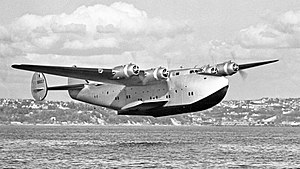
Boeing 314 Clipper-cropped.jpg(TVY 186)  William Manchester‘s book The Last Lion added some telling details.  He indicated that on June 4, 1943, Churchill boarded an Avro York for the flight to Gibraltar, from Algiers.  He said Churchill planned to transfer at Gibraltar to a more-comfortable “Boeing flying boat [seen at left] for the final leg of the trip,” to London.  But bad weather forced him to transfer to a B-24 Liberator instead.  And there was some other confusion:

That day, a German spy at the Lisbon airport reported to his superiors that a thickset man smoking a cigar had been seen boarding a commercial flight, another flying boat, destination London.  Phone calls were made, German fighter aircraft scrambled.  The hapless aircraft was shot down over the sea, killing all fourteen passengers, including the popular screen actor Leslie Howard.

According to Manchester, when Churchill got back to London he noted the brutality of the Germans, as exemplified by the attack on Howard’s airliner.  But – he said – their brutality “was matched only by the stupidity of their agents.”

(Just as an aside, Manchester said this latest incident “unsettled Britons,” who “felt ill at ease” about Churchill’s being away from the country for a full month.  They were equally ill at ease about his taking such unprotected flights so close to enemy territory.)

Roy Jenkins made a similar point in his biography of Churchill.  He wrote that Churchill flew back to London “on the night of 4-5 June (1943),” and that the journey was without incident, except for bad weather.  That in turn meant that Churchill couldn’t transfer to a “more comfortable flying boat,” but had to continue by uncomfortable bomber.  (The B-24.)

Later that same day however another Pan American flying boat did take off from Lisbon for Plymouth and was shot down with the deaths of a full load of passengers, including Leslie Howard of Scarlet Pimpernel fame.  In the same month a Liberator bomber (a companion to Churchill’s plane) flying from Gibraltar to England was also shot down, with the death of General Sikorski, the head of the Polish forces, and two accompanying British MPs.

The point being that Churchill appeared to be taking unnecessary risks.  (Note also that the two “MPs” in this case were Members of Parliament.)

But there were other theories as well.  According to the “Churchill” theory, the German intelligence agents in and around Lisbon were really stupid.  But according to some alternate theories, those agents knew exactly what they were doing.

One such theory had it that Howard was on a top-secret mission – for Churchill – to persuade Spain’s Francisco Franco not to join the Axis powers, Germany and Italy.  (Spain was officially neutral at the time.) Howard’s go-between was said to be Conchita Montenegro (at right), with whom he’d ostensibly had a torrid love affair.

(Not to mention Tallulah Bankhead and Merle Oberon, two of his other leading ladies.   While he was said to be something of a ladies’ man at the time, Howard once quipped that he “didn’t chase women but … couldn’t always be bothered to run away” from them either.)

Other sources indicate that Howard’s successful anti-Nazi activities in the early years of World War Two “enraged Nazi propaganda minister Joseph Goebbels, who called Howard ‘Britain’s most dangerous propagandist,’” and that Howard also worked for British Intelligence.

Still other sources note another passenger on Howard’s airliner, “leading anti-Nazi activist Wilfrid Israel, who had helped Jewish refugees escape from the Holocaust.” You can see even more theories about this or these mysterious death(s) in the notes, but all of them lead to this thought: To think, some people thought those years were better and simpler times…

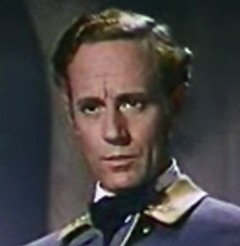
*   *   *   * Leslie Howard as Ashley Wilkes in Gone With the Wind trailer cropped.jpg“Ashley Wilkes,” anti-Nazi agitator?
*   *   *   *

The upper image is courtesy of Leslie Howard (actor) – Wikipedia, the free encyclopedia.  I changed to this image on January 5, 2016, after reviewing the post for a New Year’s “retrospective.”  That look-back showed a foul-up in the image-transfer, originally from The First of the Few – Wikipedia.  That’s where the image to the left of the paragraph beginning “His airliner was shot down” came from.

Note also that while some sources said Howard’s airliner was shot down on June 1, others give the date as June 4, 1943.  Thus the phrase “on or about” June 1, 1943.

Here’s what I wrote in the original post, back in 2015. “In case you hadn’t noticed, I’m back in the saddle after three weeks out of town. (Part of that time was spent on the Columbia River, near Astoria, on unfinished canoe-trip business…) And it was only during that three-week hiatus – from home and daily routine – that I found out there were mysterious circumstances around Leslie Howard’s death. (Aboard an airliner like the one below right.) That happened because my brother is more delightfully retro than [me…]
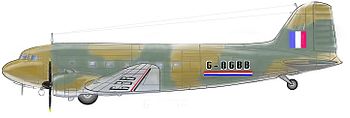
BOAC Flt 777.jpg“[T]he night before I took my own commercial flight back home to God’s Country – the outskirts of Atlanta – we watched an old black-and-white movie:  1942’s Spitfire, starring Leslie Howard… On VHS no less, while enjoying some of Utah’s famed 3.2 beers…” The “airliner” image is courtesy of BOAC Flight 777 – Wikipedia, noted further below.

Re:  “The film was released … 1942.”  See First of the Few (1942) | Inafferrabile [sic] Leslie Howard. The site said in the U.S., Spitfire was released on June 12, 1943, “a few days after Leslie’s death.”

Re:  3.2 beer.  See The Legacy of 3.2% Beer | The Society of Wine and Jurisprudence.  The site said such beer is a “relic” of Prohibition.  “In an attempt to limit the availability of higher-octane beverages, 3.2% is currently the only beverage allowed for sale at grocery stores in Colorado, Utah, and several other states.” (E.A.)

Re: “German fighters,” as to the Junkers Ju 88C6. As Wikipedia noted, a fighter aircraft is a “military aircraft designed primarily for air-to-air combat against other aircraft, as opposed to bombers and attack aircraft.”  The Ju 88C6 was a “twin-engined multirole combat aircraft,” designed to be “too fast for any of the fighters of its era to intercept.”  It was used in roles including but not limited to “night fighterheavy fighter and even, during the closing stages of the conflict in Europe, as a flying bomb.”

That there were eight Ju 88C6s came from the article, List of airliner shootdown incidents – Wikipedia.

“Full of confidence … TVY.”  See Winston Churchill:  The Valiant Years, Jack Le Vien and John Lord, Bernard Geis and Associates (1962), at page 186.  Note also:

     1)   Manchester’s “Last Lion…”  See The Last Lion[:]  Winston Churchill Defender of the Realm 1940-1965, William Manchester and Paul Reid, Little, Brown and Company (2012), pages 688-89.

     2)  William Manchester – noted American author, biographer and historian – died in 2004, while still at work on Last Lion.  He chose his friend Paul Reid to finish the work.  As Reid himself noted, Manchester began this “third and final volume of his biography of Winston Churchill” in 1988.  Reid indicated that Manchester’s research on the book was complete but that he’d written only some 100 pages between 1988 and 1998, due to increasingly poor health.  After Manchester died, Reid began the process of completing the book.  See also Wikipedia:

Following the death of his wife in 1998, Manchester suffered from two strokes.  He announced that he would not be able to complete his planned third volume of his three part-biography of Churchill, The Last Lion: Winston Spencer Churchill: Defender of the Realm, 1940-1965.  He was also initially reluctant to collaborate with anyone to finish to work.  In October 2003, Manchester asked Paul Reid, a friend and writer for The Palm Beach Post, to complete the Churchill biography.

Re: Roy Jenkins.  See Churchill[:]  A Biography, Farrar, Strauss and Giroux (2001), at pages 712-13. For what it’s worth, Jenkins put the “cumulative risk to which Churchill’s manifold journeys exposed him” at some 30 per cent.  

Re: “flying boat.”  The airliner in question was built by Boeing, flown by Pan American Airways and called the Clipper:  “Twelve Clippers were built; nine were brought into service for Pan Am and later transferred to the U.S. military.  The remaining three were sold to British Overseas Airways Corporation (BOAC) by Pan Am and delivered in early 1941.  (BOAC‘s 3 Short S.26 transoceanic flying-boats had been requisitioned by the RAF).” See Boeing 314 Clipper – Wikipedia.

As to other theories, including that Howard’s plane was shot down because another passenger was “leading anti-Nazi activist Wilfrid Israel: Israel was a “friend of Albert Einstein, the philosopher Martin Buber, and Chaim Weizmann, later the first president of the state of Israel.”  Wikipedia indicated that in the wake of Kristallnacht – the 1938 pogrom or “night of broken glass” in Germany – Wilfrid Israel took an active role, contacting among others “the Council for German Jewry in London, informing them that extraordinary measures must now be taken to save at least the children.” Regardless of such theories why this particular airliner was shot down, this fact remains:  The tragedy made Howard “the first cast member from Gone With The Wind to die.”
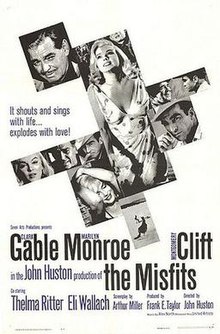
Misfits3423.jpgBut other cast members lived long and productive lives. For example, Vivien Leigh – who played Scarlett O’Hara) – lived on until 1967. Olivia de Havilland – who played Melanie Hamilton, Scarlett’s rival and the cousin Ashley married – is still alive and has been living in Paris since 1960.  And it was only in 1960 that Clark Gable died.

Gable played Rhett Butler in GWTW, but went on to numerous other movie roles including The Misfits, his final screen appearance.  That movie also starred Marilyn Monroe.  (At the time she was going through a “breakdown” of her marriage to writer Arthur Miller.  Miller wrote the Misfits screenplay, and “revised the script throughout the shoot as the concepts of the film developed.”)

Monroe herself died on August 5, 1962 – at age 36 – a little over a year after the release of Misfits on February 1, 1961.  The coroner listed the cause of death as “acute barbiturate poisoning” and/or “probable suicide,” but there were other theories here too:

Many theories, including murder, circulated about the circumstances of her death and the timeline after the body was found.  Some conspiracy theories involved John and Robert Kennedy, while other theories suggested CIA or Mafia complicity.  It was reported that President Kennedy was the last person Monroe called.

The “Conchita” image is courtesy of www.flickriver.com/photos.  Wikipedia added this:

Following a rare interview with Montenegro shortly before her death, Spanish author José Rey-Ximena claims that British actor Leslie Howard used her to get close to Spanish dictator Franco after being given the special mission by Winston Churchill.  She claimed that she used her husband’s influence to secure a meeting between the British actor and the Spanish dictator.  “Thanks to him … Spain was persuaded to stay out of the war.”  (E.A.)

Re:  Franco and Spain’s neutrality. See Francisco Franco – Wikipedia, the free encyclopediawhich noted that on “23 October 1940 Hitler and Franco met in Hendaye, France, to discuss the possibility of Spain’s entry on the side of the Axis.  However, Franco’s demands, which included food, military equipment, and Spanish control of Gibraltar and French North Africa proved too much for Hitler.”

Note that an agitator is someone who “actively supports some ideology or movement with speeches and especially actions.”  The term originally referred to elected soldier-representatives of “the New Model Army of Oliver Cromwell, during the English Civil War.  They were also known as adjutators.”  See Wikipedia, the free encyclopedia.

 *   *   *   *

Other sources for this post include Leslie Howard (actor), Ashley Wilkes, and Gone with the Wind (film) – Wikipedia, the free encyclopedia, as well as the following:

See Clarecolvin.com/ian-colvin/flight-777-the-mystery-of-leslie-howard:

He was travelling with his tax adviser, cigar-smoking Alfred Chenhalls, who bore a resemblance to Winston Churchill – Churchill was at that time about to fly back from an Allied conference in North Africa.  Also on board was leading anti-Nazi activist Wilfrid Israel, who had helped Jewish refugees escape from the Holocaust.

See also BOAC Flight 777 – Wikipedia, which noted thatthe Douglas DC-3 lost in this attack had twice survived attacks by Luftwaffe fighters in November 1942 and April 1943.”

The Shootdown of Leslie Howard | Defense Media Network listed the date as June 1, and added:

Never entirely comfortable with Hollywood life, when war broke out, Howard, a Jew, decided to return to England and apply his fame and talent to a higher calling – helping his country fight the Axis.  Howard starred, directed, and produced anti-German war films [like Spitfire] and radio broadcasts, and conducted lecture tours.  His success enraged Nazi propaganda minister Joseph Goebbels, who called Howard “Britain’s most dangerous propagandist…”  What the public didn’t know, though the Nazis did, was that Howard also worked for British Intelligence.

Note also the critical British base at Gibraltar, which played a key role in Churchill’s travels to and from North Africa.  The base guarded the entrance to the Mediterranean Sea, where the Strait of Gibraltar is a mere eight miles wide or less.  The base was “used primarily as a training area … and as a stopover for aircraft and ships en route to and from deployments East of Suez or Africa.” 

And finally see The actor, the Jew and Churchill’s double. – Eye on Spain, and also Churchill  A Photographic Portrait, by Martin Gilbert, Houghton Mifflin (1974):  

     1)  Photograph 292 in Portrait shows Churchill standing between U.S. General George Marshall and Field Marshal Montgomery, with the caption:  “While in Algiers, Churchill finalized the plans for the invasion of Sicily and Italy with the British and American leaders.  This photograph, taken on 3 June 1943, was annotated by General Montgomery.”  Montgomery later recalled, “Winston wanted me to say the Sicilian invasion would be all right.  But I wouldn’t.”  Despite Montgomery’s doubts, the Allied invasion liberated Sicily in some six weeks.  (July 10-August 17, 1943.)  

On rectal thermometers and “you’re entitle'”

“Voyageur canoe shooting the rapids,” not unlike what yours truly will do in the next few weeks… 


I’m leaving town on Monday, August 10, and won’t be back until August 27.  (A matter of some unfinished business, canoe-trip-wise.)   So here’s a post that I hope will tide you over.

I recently ran across one of Harry Golden‘s later books.  It’s called You’re entitle’ , and it was published in 1962.  (By the World Publishing Company of Cleveland.)  As noted in Harry Golden, My Father & ‘Entitlements’ – Zest of Orange, that was the “expression of a free man:”

You’re Entitle’ … was not nearly as successful as its predecessors[, including] Only in America (1958), For 2¢ Plain (1958)…  Golden dedicated the book to his father[:]  “All his life he spoke a halting English, though he certainly made his ideas clear enough,” wrote Golden. “He was enamored of the phrase, ‘You’re entitle’.’  In his youth, Golden would correct him, saying, “It ends with a d, Poppa.”  His father would nod understandingly “but the next time it still came out, ‘You’re entitle’.”

As noted below, this later book contains a number of gems that could be reflected on.  Things like “the good life,” the ongoing Conservative Tide, and rectal thermometers as a sign of gradual integration.  (Not that there’s any connection…)

Product DetailsThe first nugget of wisdom came on page 25, “A note in passing:”
I am a reporter and, I hope, no sermonizer.  But that doesn’t mean I don’t know something about this process of living.  I shall soon see my sixtieth year and along with hundreds of thousands of other middle-aged men, I believe the good life, as the Greeks called it, is within reach.  We only have to be careful about two things.  First, don’t get in trouble with the Internal Revenue people; and second, don’t get mixed up with a woman.

Those last two are still good advice.  But I was struck by the combination of his referring to almost-60 as “middle aged,” and the connotation with it, that he was “older and wiser.”  Of course we all tend to get wiser as we grow older, but Harry’s idea of “60 as the new 30” seems way ahead of his time.  See On RABBIT – and “60 is the new 30″ – (Part II), which noted John Updike’s “overall image of 65-year-olds in 1969 is of people who really are over the hill. ”

So once again, Harry Golden was ahead of his time.

Which brings up his meditation (also on page 25), “Memo to Senator Goldwater.”

One of the things which the country could stand right now [1962] is a movement spearheaded by Senator Goldwater [seen below right] and Mr. William Buckley, of the National Review, to change the designation of the “liberal arts college” to the “conservative arts college.”  We might as well have this thing out in then open.

Barry Goldwater photo1962.jpgThere’s some debate whether the “Conservative Tide” in America is waxing or waning. See Conservative tide continues to ebb, particularly on social issues, posted in 2014.  But see also Conservative tide that swept Reagan in may be subsiding, which said basically the same thing in 1985.  The fact remains, however, that Harry had a fine sense of irony.
Which brings up again the title of Harry’s 1962 book, as meditated on by the Zest of Orange blogger:

That word, wrote Golden, “was the expression of a free man.  No one was entitled in Eastern Europe.  You served in the army for 10 years and it entitled you to nothing.  Your taxes entitled you to no franchise.  But in America men were free and entitled…”  Golden wrote those words in 1962.  My, how times have changed.

Times have indeed changed, but so far America remains free…

Which is due in large part to both our national despising of phonies and our sense of American ingenuity.  Harry gave an example on page 108, “You had to have baggage.”  This essay had to do with the Raines law.  Passed in 1896 by the New York legislature, the law “prohibited the sale of alcoholic beverages on Sunday except in hotels.”  As Harry noted, the law was also designed to improve the morals of hotel-keepers (and guests), and to cut down on prostitution.

But as Wikipedia noted, the result was “dozens or Raines law hotels,” usually right over saloons. The result was an actual increase in prostitution, “as the rooms in many ‘Raines law hotels’ were used mostly by prostitutes and unmarried couples.”  There were also the “saloon keepers who mocked the law by setting out ‘brick sandwiches,’ two pieces of bread with a brick in between, thus fulfilling the legal requirement of serving food.”

But Harry noted yet another example of the law of unintended consequences:

When the Raines law was passed … it was designed to improve morals, especially the morals of hotel-keepers and their guests.  One of the provisions of the law was that you could not rent a room to a couple unless they had baggage.  A day after the law went into effect, a dozen luggage stores opened up along Sixth Avenue with big signs, “Baggage rented.”  A fellow with a girl walked into one of these stores and for a two-dollar deposit and a fifty-cents-an-hour rate got a bag filled with newspapers, and they went off together happily to the hotel. When they were through  they returned the bag and got the deposit back.

Which brings up what Calvin – of Calvin and Hobbes – had to say on the matter:

Calvin on Obeying the Law - debate Photo

See also On “expressio unius,” which discussed the concept of gaming the system, otherwise known as “manipulating the system for a desired outcome.”  (At which Americans seem adept.)

And finally, getting back to Harry Golden’s “fine sense of irony.”

On page 218 of You’re entitle’, Harry noted a telling anomaly.  (Again, in 1962):

In the emergency room of the Alachua General Hospital at Gainesville, Florida, there are three thermometers.  They stand in a row on a small shelf with nothing else.  The first is in an open container labeled:  “WHITE – ORAL,” the third is in an identical container labeled, “COLORED – ORAL,” and the middle one, which protrudes through a cork, in its otherwise sameness, is labeled “RECTAL.”

This is what I call gradual integration.

Sometimes you don’t know whether to laugh or cry…


The upper image is courtesy of Canoe – Wikipedia, the free encyclopedia.

Re: World Publishing.  See Encyclopedia of Cleveland History: WORLD PUBLISHING CO., which noted that “World” was a “major publisher of Bibles, dictionaries, and children’s and trade books.”

The Goldwater image is courtesy of Barry Goldwater – Wikipedia, the free encyclopedia.

 The Calvin cartoon is courtesy of Calvin on Obeying the Law – Debate Photo (1160519) – Fanpop.

The lower image is courtesy of wikipedia.org/wiki/Racial_segregation_in_the_United States.  The caption:  “An African-American man goes into the ‘colored’ entrance of a movie theater in Belzoni, Mississippi, 1939.

On American History, “patched and piebald”

https://upload.wikimedia.org/wikipedia/commons/thumb/1/15/Declaration_independence.jpg/600px-Declaration_independence.jpgDeclaration of Independence:  John Adams – “patched and piebald” – stands at center, hand on hip…


Here’s a break in the action from my multi-volume Mid-summer Travelog.

I recently got some  much-needed cheering up on the political front.  I got cheered up by listening to two lectures on CD.  The one I just started is Brotherhood of the Revolution: How America’s Founders Forged a New Nation.  I started listening just a few days ago.

The other CD – actually an audiobook – was Chris Matthew’s Life’s a Campaign.   I talked about it on June 12, in “Great politicians sell hope.”  I noted the book gave me the sense that the most of the U.S. presidents of the past have been – overall, generally, and even the ones I didn’t like – “decent, honorable and capable.”  What’s more, the book gave me a sense that the same applies – in general – “to politicians today.  (Gasp!)”

I’ll write more on Campaign later, but for now I’ll focus on Brotherhood of the Revolution.

I got as far as Lecture 3 – Disc 2, Track 6 – where I felt moved to note the disconnect between history as it’s written – and taught – and as it actually happens. (How it’s actually lived through.)  John Adams – for one – preferred the more-accurate history as actually lived through, as opposed to the popular rose-colored glasses.  See Adams and American Mythology:

In elementary school, they told us that the Founding Fathers were Great Men.  They sat down in Philadelphia in 1776 with a mandate from God, and calmly and certainly wrote the Declaration of Independence.  Then they fought the British, and then they founded the first democracy ever, and then independence and democracy spread to the rest of the world.  They knew what they were doing.  They were carried by a sure and steady tide.

The American Mythology site said this mythos “became popular while Adams was still alive,” but it was a view of history he loathed.  That was followed by a statement of “nothing certain in what those ‘great men’ did in Philadelphia.”  Our American History – as lived through – was “improvised, patched together, made up from one moment to the next, with every outcome uncertain until it was safely past.”

1776 film poster.jpgThe site noted the musical 1776 – and film, shown at left – which had John Adams saying these words.  (Words that mirrored “almost exactly” what he wrote in a letter to Benjamin Rush in 1790):

I’ll not be in the history books.  Only Franklin.  Franklin did this, and Franklin did that, and Franklin did some other damn thing.  Franklin smote the ground, and out sprang General Washington, fully grown and on his horse.  Then Franklin electrified him with that miraculous lightning-rod of his, and the three of them – Franklin, Washington, and the horse – conducted the entire War for Independence all by themselves.

The article noted another book by Ellis, his 2002 Founding Brothers: The Revolutionary Generation.  See also Wikipedia, which described the “fractious disputes and hysterical rhetoric of these contentious nation-builders.” (Emphasis added.)

Wikipedia said these disputes might come across today as “hyperbolic pettiness.”  (Hyperbole is the use of “exaggeration as a rhetorical device.”)  But the article added that Founding Brothers showed the real issues, the “driving assumptions and riveting fears that animated Americans’ first encounter with the organized ideologies and interests we call parties.”  (And apparently that “hysterical rhetoric” isn’t limited to our times.)  Then came Adams:

As Adams remembered it… ‘all the great critical questions about men and measure from 1774 to 1778’ were desperately contested and highly problematic…   Nothing was clear, inevitable, or even comprehensible to the soldiers in the field at Saratoga or the statesmen in the corridors at Philadelphia:  ‘It was patched and piebald policy then, as it is now, ever was, and ever will be, world without end.’  The real drama of the American Revolution … was its inherent messiness.

(Emphasis added.)  Note that term, “inherent messiness.”

And incidentally, the term “piebald” usually refers to the spotting on a certain type of horse.  (As shown at right.)  But in a metaphoric sense it means “composed of incongruous parts.”  See for example piebald – Wikipedia, and Piebald … Merriam-Webster.

See also American Creation – Book Review, noting Ellis on Adams’ theory that – in the history of the Revolution as people lived it – “contingency played a large role in shaping the decisions of leaders who were often making it up as they went along, teetering on the edge of the abyss.”

Note that term too, “teetering on the edge of the abyss,” which also seems to apply today.

Which brings us back to Brotherhood of the Revolution.  As noted, I’ve gotten as far as Lecture Three.  Ellis said that in the process of studying Adams – living through the Revolution as he did – it was most fascinating to read his letters and diaries.  Those papers give “a sense of how confused and how incoherent and inchoate events seemed at the time.”  And this was especially true of the letters of Adams to his wife Abigail in the critical years 1775-1776.

Ellis noted the turmoil of those two years, engulfing the Colonies.  But during that key time in American History, John and Abigail wrote mostly about their children, and about the smallpox epidemic raging through America at the time.  See Siege of Boston – Wikipedia.  Their biggest fear was of losing their children.  (And so it likely is of all history “as it’s lived through.”)

Which Ellis said brought up the point that when we study history, we normally divide it into “segments.”  But history as it’s lived through – as it happens – “happens in a variety of different ways, all at the same time.”  Which brings up that key difference, between how Adams saw such developing history, and how a guy named Thomas Jefferson saw it.

In later years, Jefferson recalled the Revolution as “clear moral conflict between right and wrong.”  But Adams saw the Revolution as a chaotic event, a “concatenation, a tumbling, overlapping experience of turmoil.”  And that chaos – illustrated at left – swept up all Americans living at the time.  Adams rejected Jefferson’s view of American history.  He thought his patched and piebald memory of the war was more accurate:

“We didn’t know what we were doing.  We were improvising … always on the edge of catastrophe.”

Which brings us to today’s political gridlock.

Before I listened to Brotherhood, I felt that we too are living in a time of chaos.  See Gridlock in Congress?  It’s probably even worse than you think (Washington Post), Political gridlock: Unprecedentedly dysfunctional, (The Economist),  and Political Gridlock – Huffington Post.  (A list of articles on the current gridlock.)

But after listening to the CD, I came to think maybe today’s gridlock is more of a “Situation Normal.”  (Or as Adams would say, politics “as it is now, ever was, and ever will be, world without end.”)  Remember those terms, “improvised, patched together, made up from one moment to the next?”  “Hysterical rhetoric?”  “Teetering on the edge of the abyss?

As Churchill said, “No one pretends democracy is perfect or all wise.  Indeed, it has been said that democracy is the worst form of government, except for all the others that have been tried…

So cheer up.  At least we haven’t come to this!   (Not yet anyway…)


Congressman Brooks makes a point of order with Senator Sumner…


The upper image is courtesy of Wikipedia.org/wiki/Declaration_of_Independence_(Trumbull).  The caption:  “50 men, most of them seated, are in a large meeting room. Most are focused on the five men standing in the center of the room.  The tallest of the five is laying a document on a table.”

See also The Declaration of Independence by John Trumbull, and John Adams – Wikipedia, with the caption: “Trumbull’s Declaration of Independence depicts committee presenting draft Declaration of Independence to Congress.   Adams at center has hand on hip.”  Thus Trumbull showed “only” the presentation of the first draft of the Declaration, not the signing itself.

Re:  The views of Ellis – and Adams – on history as people actually live through it:  “What in retrospect has the look of a foreordained unfolding of God’s will was in reality an improvisational affair in which sheer chance” – not to mention pure luck – “determined the outcome.”  See also Trust and Caution – The New York Times, which noted:  “How to live in a tragic milieu and yet strive toward triumph … was a consuming concern for the founders.”  As it is even to this day

Re: 1775-1776.  The full cite in the text is American Revolution: Conflict and Revolution 1775-1776.

Re: Smallpox during the siege of Boston.  See The Siege of Boston & Smallpox – 1775 – 1776, and Colonial Germ Warfare : The Colonial Williamsburg Foundation.  The latter especially noted the circumstantial evidence that the British engaged in a form of germ warfare against Americans during the siege.  The article noted most British troops had either been inoculated or had smallpox, and thus were immune.  Further, smallpox was endemic in Europe at the time – “almost always present” – so that nearly everyone had been exposed, and “most of the adult population had antibodies that protected it.”  On the other hand, most American soldiers were susceptible; at the time of the siege most Americans had never come in contact with the virus, and thus had no immunity.

As Ellis also noted in Brotherhood of the Revolution,  John Adams was a paradox, a “conservative revolutionary,” as shown by his defending the British soldiers after the “Boston Massacre.”  See The Boston Massacre Trials | John Adams Historical Society, and also Boston Massacre – Wikipedia:

The trial of the eight soldiers opened on November 27, 1770.  Adams told the jury to look beyond the fact the soldiers were British.  He argued that if the soldiers were endangered by the mob, which he called “a motley rabble of saucy boys, negroes, and molattoes, Irish teagues and outlandish jack tarrs [i.e. sailors],” they had the legal right to fight back, and so were innocent.  If they were provoked but not endangered, he argued, they were at most guilty of manslaughter.

Which raises the question:  Are there any such conservative revolutionaries today?

The chaos image is courtesy of Chaos theory – WikipediaThe caption:

Turbulence in the tip vortex from an airplane wing.  Studies of the critical point beyond which a system creates turbulence were important for chaos theory[, including] that fluid turbulence could develop through a strange attractor, a main concept of chaos theory.

The Churchill quote is from Winston Churchill’s Quote on Democracy : Papers – Free Essays.

The lower image is courtesy of Caning of Charles Sumner – Wikipedia, the free encyclopediaThe caption:  “Lithograph of Preston Brooks‘ 1856 attack on Sumner; the artist depicts the faceless assailant bludgeoning the learned martyr.”  See also 1851: Caning of Senator Charles Sumner – May 22, 1856 (Senate Archives), and Preston Brooks – Wikipedia, the free encyclopedia.

Note that Sumner recovered from the attack and returned to the Senate in 1859.  He served throughout the Civil War and beyond, until 1872, where he served much of the time as “powerful chairman of the Senate Committee on Foreign Relations.”

Brooks on the other hand died less than a year later, “unexpectedly from croup in January 1857…   The official telegram announcing his death stated ‘He died a horrid death, and suffered intensely.'”