On RABBIT – and “60 is the new 30” – (Part II)

http://blog.modernmechanix.com/mags/SaturdayEveningPost/2-1969/cover.jpg

The last issue of the Saturday Evening Post, published on February 8, 1969…


Welcome back to the “Georgia Wasp…”

We were remembering the last decades of the 20 century, as memorialized by and through John Updike’s series of five “Rabbit” novels.  (Or four novels and a novella…)

I’d noted that Janice Angstrom – by now Harry’s widow – ended up married to Ronnie Harrison in Rabbit Remembered, the last of the series.  (Thelma Harrison – Ronnie’s wife – had also died, and was one of the women with whom Harry had “an affair.”)  And not to put too fine a point on it, Harry and Ronnie had known – and hated – each other since high school, when they were teammates on the basketball squad.  (They also “shared” Ruth Byers, at different times.)

So now that your up to speed – he wrote sarcastically – let’s get back to the Rabbit is Rich time frame.  In mid-winter 1979 the Angstroms jet off to Jamaica, where they end up in an initial wife swap with two other couples.  (That’s when Harry first learns that Ronnie’s wife Thelma has the hots for him.)  But then they have to go back home before the second swap, where Harry would have “known” the wife he really wanted (Cindy Murkett).   Son Nelson is causing no end of problems at the dealership, including smashing up two trade-in convertibles.

The next sequel, Rabbit at Rest, starts with Harry and Janice spending the winter of 1988-89 at their condo in Florida.  They leave Nelson in charge of the dealership, which turns out to be a mistake.  (He’s hooked on cocaine, which leads Toyota to “pull out,” Freudian slip intended.)

Other incidents include Harry having a heart attack – based on his crappy diet – and having a one-night stand with Nelson’s wife Pru while he recuperates.  (Not to mention brief appearances by Annabelle, Harry’s daughter, who’s become a nurse’s aide.)

“Janice’s anger over this betrayal prompts Harry to escape to Florida.” (Wikipedia.)  Which leads to one inescapable conclusion:  Harry was a bit of a sleazeball, albeit loveable to some.

And finally came Rabbit Remembered, set in late 1999.  (On the eve of the New Millennium noted above. )  Harry has died – of another heart attack – while living alone in the Florida condo he “ran” to at the end of Rabbit at Rest.  Nelson is still living with his mother, and her new husband Ronnie Harrison, Harry’s old nemesis ever since high school.  Nelson’s wife Pru has taken their two children Judy and Roy back to Akron Ohio.  Then Annabelle shows up at Janice’s door; her mother Ruth has just died as well.

Aside from Ronnie calling Annabelle “the bastard child of a whore and a bum” at Thanksgiving, the saga includes a tale of childhood sexual abuse, and one of Nelson’s clients committing suicide.  (After his bout with cocaine, Nelson became a certified mental-health counselor, thanks in part to a course of study at the “Hubert F. Farnsworth Community College.”  Farnsworth was the surname of the same “Skeeter” who’d lived with Harry, Nelson and Jill in the summer of 1969.  Skeeter later died in shootout with Philadelphia police.)

To cut to the chase, the final book ends with an uncharacteristic – for Updike – note of hope.

In the rush to make the Y2K celebration, Nelson drives recklessly through an intersection – the stoplights have all gone out – and faces death in the form of a “cocky brat in a baseball cap.”  The cocky brat drives an SUV and goes out of turn at a four-way stop.  Nelson – with decades of “wrongs, hurts, unjust deaths press[ing] behind his eyes” – faces death and comes out unscathed. (As Winston Churchill – seen at right – said, “There is nothing more exhilarating than to be shot at with no result.“)  This act of bravery magically rekindles Pru’s love; “Oh honey, that was great…”  Then too, riding in the back seat are Annabelle and Nelson’s childhood friend – and part-time nemesis – Billy Fosnacht.  In the end these lost souls start “seeing each other.”

As noted, this happy ending was uncharacteristic of Updike, but aside from that the last novella was enjoyable.  And as was characteristic of Updike’s writing, the detail is so thick that I found myself skipping much of it to get to the action.  As Charles Portis might say, Updike’s writing lulls you into a sense of woolgathering, and then he socks it to you with an unexpected twist.  The result was that I went through Rabbit Remembered the first time quickly, from a sense of impatience more than anything.   But now I’ve gone back and started re-reading it, to get the full flavor of the aforementioned Updike attention to detail.

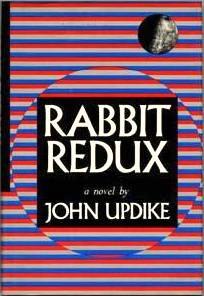
More than that, I pulled out my worn and battered copy of Rabbit Redux, now some 40 years old itself.   (I bought the 1971 “Alfred A. Knopf” edition four or five years after it was first published.)  And re-reading Rabbit Redux brought back some points I’d forgotten.

For example, on page 9 there’s a bit of foreshadowing, one of Updike’s lesser-known fortes.

It’s the summer of 1969.  Harry and his father Earl have gotten off work “from the little printing plant at four sharp.”  They have a drink at a neighborhood bar, before taking separate buses home, in opposite directions.  Earl asks his son to visit “some evening before the weekend.”  (Mary Angstrom “has had Parkinson’s Disease for years now.”)  Harry responds:

“I don’t like to leave the kid alone in the house.  In fact I better be getting back there now just in case.”  In case it’s burned down.  In case a madman has moved in.

Which is of course just what happens later in the book.  A madman – in the form of “Skeeter,” later identified by the Brewer Vat as Hubert Farnsworth – does in fact move in with Harry.  He does so at the invitation of Jill, a runaway from Connecticut.  She in turn dies in the fire set by neighbors repelled by the “goings on” in the house, after Janice had moved in with Charlie…

But a more personal tidbit comes a bit later, when father and son are settling the bar bill.  Earl Angstrom had a Schlitz beer, and tells his son, “Here’s my forty cents.  Plus a dime for a tip.”

“Are you kidding me?”

Which is being interpreted:  “Do you mean to say there once was a time when you could go into a bar, pay 40 cents for a beer and leave a dime for the tip?  And not get thrown out or insulted?”

The answer?  Rabbit Redux reminds us that, “Yes, Virginia, there was such a time.”

But the really interesting tidbit – so far – turns on Harry’s mother turning 65.  Updike wrote of Earl Angstrom that he “looks merely old” once outside the bar, “liverish scoops below his eyes, broken veins along the sides of his nose.”  When Harry asks about their finances Earl responds, “Believe it or not there’s some advantages to living so long in this day and age.  This Sunday she’s going to be sixty-five and come under Medicare.”

On Sunday Harry goes to the house with Nelson.  (Janice is at Charlie’s.)  His mother greets him:

“I’m sixty-five,” she says, groping for phrases, so that her sentences end in the middle.  “When I was twenty.  I told my boyfriend I wanted to be shot.  When I was thirty…”  “You told Pop this?”  “Not your dad.  Another.  I didn’t meet your dad til later.  This other one, I’m glad.  He’s not here to see me now.”

St Pete Florida Vintage PostcardSo notwithstanding the fact that Mary has Parkinson’s, Updike’s overall image of 65-year-olds in 1969 is of people who really are over the hill.  (“Living so long in this day and age?”  Really?)  Or as they used to say of St. Petersburg, they were in “God’s Waiting Room” (shown at left):

St. Pete became a mecca for retired people.  They flocked to the sunshine and lived in the many residential hotels in the downtown area.  The symbol of St. Pete became old people sitting on the many green benches that dotted the sidewalks of the city.

But just like 40-cent beer you could buy in 1969 (plus a dime for the tip), those days are long gone.  See for example “60 is the new 30,” and also “Why 60 Is The New 30.”  The latter post noted that the “55-64 age group has shown the largest increase in entrepreneurial ventures, now accounting for more than 20 percent of all start-ups.”  (Thus literally “starting over when our grandparents would be strolling around golf communities in Florida.”)

I should note that there is some debate on whether 60 is the new 30, or the new 40.  See Is 60 the New 40? –  which noted that what elderly “meant to the Greatest Generation doesn’t hold for their offspring, the baby boomers.”  There’s also 60, Not 50, Is The New Middle Age – Huffington Post, and New research shows 60 is the new 40 – KING5:

Increasingly, people over 60 feel more like 40, and now they have the science to back them up…   The new research argues that since life expectancy continues to rise, age 60 should not be considered old.  It’s more “middle age,” because for many, there’s a lot of living left to do after age 60, even embarking on second or third careers.

Or as you might say of the Christie Brinkley image below:  “Now that’s turning 60!

 http://img2-2.timeinc.net/people/i/2014/news/140210/christie-brinkley-300.jpgA good argument for “60 is the new 30…”


The upper image is courtesy of blog.modernmechanix.com/issue/?pubname=SaturdayEveningPost.

The Churchill image is courtesy of Winston Churchill – Wikipedia, the free encyclopedia.

The Armstrong-on-the-moon photo is courtesy of 1969 – Wikipedia.

The lower image is courtesy of People magazine, www.people.com/people/article/0,,20780764,00.html.

“Great politicians sell hope”

*   *   *   *

 “Great politicians sell hope.”

June 12, 2015 – I heard that quote a few days ago, listening to a “book on CD” by Chris Matthews.  And when I first heard it I thought, “What rock have you  been living under?

But then Chris went on to cite examples from American history, in his book, Life’s a Campaign.

He wrote that looking back, our best presidents – including JFK and Ronald Reagan – were able to “sell themselves.”  They were able to sell themselves by giving Americans a sense of hope for the future.  That led to a thought:  “Maybe that’s what this blog should be about…

But then I had another thought:  “He could be right, but what happened?

What happened to those politicos selling hope?

But let’s get back to how I happened to be listening to Chris Matthews’ book-on-CD in the first place.

It all started back in December 2014, when I attended a funeral back home in Florida.  The funeral was for my step-mother, who’d married my father back in January 1986.  (After my mother died the year before; it was the second time around for both of them.)

At the reception after the service – inside the parish hall  – I saw a table of used books for sale.  I found one that piqued my interest, The Presidents Club:  Inside the World’s Most Exclusive Fraternity.  I’ve been meaning to review it ever since I started this blog.  (In March 2015.)

But one thing I’ve learned during these busy days of retirement:  It’s a whole lot easier to listen to a book on CD – driving around town – than it is to actually read it.  And that’s why I found it far easier to review Life’s a Campaign than The Presidents Club.

Again, that book-on-CD was Chris Matthew’s Life’s a Campaign “What Politics Has Taught Me about Friendship, Rivalry, Reputation, and Success.”  (The quote on “great politicians” is from Disc 2, Track 6.)  And while by now I’ve listened to most of Life’s a Campaign, I’ve only managed to read portions of The Presidents Club.

But the really strange things is – suffice it to say – that both books have given me an inkling of a sense of hope for the future.  (For example, one thing The Presidents Club pointed out was that a funeral – and especially the funeral of former president – really puts things in perspective.)

Put another way, The Presidents Club gave me a sense that – generally speaking – the men who occupied the White House have been – overall – decent, honorable and capable.  Then too, Life’s a Campaign gave me a sense that maybe the same applies to politicians in general.  (Gasp!)

But then came a third thought:  Maybe today’s politicians seem especially nasty because many voters they’re trying to woo are just that way.  Maybe today’s politicians are simply a reflection of the nastiness that seems to have taken hold of a large part of our population.

On that note, see the Wikipedia article on dichotomy.  That article included this paragraph, about two-thirds of the way down under “Usage and examples:”

C. P. Snow believes that Western society has become an argument culture (The Two Cultures).  In The Argument Culture (1998), Deborah Tannen suggests that the dialogue of Western culture is characterized by a warlike atmosphere in which the winning side has truth (like a trophy).  Such a dialogue virtually ignores the middle alternatives.

(Emphasis added.)  In turn, if that is true, then we swing voters need to figure out what a politician really stands for, beyond those nasty things he has to say to get elected.

2015-02-09-GeorgeWallace.jpgTake George Wallace…  Please!  Though he’s widely known as one of the most race-baiting politicians in American history, his “final term as Governor (1983–1987) saw a record number of black Alabamians appointed to government positions.”  See Did George Wallace repent his racism? | Yahoo Answers, and The Redemption of George Wallace.

The gist of the Wallace story is that he changed his tune after his attempted assassination in 1972.  But there are other examples of politicians using shady tactics during an election campaign, then going on to serve honorably.  Think “George Bush the Elder” and his Willie Horton campaign in the 1988 election. (Though in hindsight Bush I comes to us now as a &^%$ genius!)

Then there’s the other side of the story.  Take Tip O’Neill and Ronald Reagan.  (Reviewing another Chris Matthews book.)  Or for that matter Ronald Reagan and Ted Kennedy.

http://inapcache.boston.com/universal/site_graphics/blogs/bigpicture/kennedy_08_31/k15_20120853.jpgEven though the two men were politic arch-enemies, Kennedy admired the fact that Reagan “knew how to manipulate symbols for his causes yet could sup with his enemies:”

He’s absolutely professional.  When the sun goes down, the battles of the day are really gone.  He gave the Robert Kennedy Medal, which President Carter refused to do…   He’s very sure of himself, and I think that people sense that he’s comfortable with himself…   He had a philosophy and he’s fought for it.  There’s a consistency and continuity at a time when many others are flopping back and forth.  And that’s an important and instructive lesson for politicians, that people admire that.

(Bronner, 104)  Which brings us back to Harry Golden and his Carolina Israelite.  See also Great but Forgotten:  “If Golden were writing today, The Carolina Israelite would be done as a blog.”

Golden – who inspired this blog – wrote from 1942 to 1968.  Those years included McCarthyism Vietnam War protests, and the Civil Rights Movement.  Those years featured violence and political rhetoric of a harshness equal to or greater than that of today.  Yet throughout it all, Golden kept a sense of hope and a sense of humor.  (As in his satirical “Vertical Negro Plan,” which involved “removing the chairs from any to-be-integrated building, since Southern Whites didn’t mind standing with Blacks, only sitting with them.”)

Even the title of his best-selling Only in America conveyed a sense of hope and wonder:

The most outstanding ingredients of [Golden’s] personality are a built-in independent way of thinking, an infallible nose for sham and prejudice on any level (which he immediately exposes, lightly but decisively), a special Golden brand of wit and whimsy, and a love of people and learning…   “It could happen only in America,” is his most apt comment.

Carl Sandburg wrote in his introduction to the 1959 edition that “whatever is human interests Harry Golden.  Honest men, crooks, knuckleheads…”  He added that Golden was the perfect antidote for “too much of conformity and complacency, particularly among the young.” (OIA, xv-xvi.   Also on that note see Seinfeld takes on political correctness on college campuses.)

Sandurg further noted that it must have been someone like Golden who was “in the mind of the Yankee, Ralph Waldo Emerson, who wrote:  ‘Whoso would be a man must be a nonconformist.'”

Golden himself said he drew “heavily on history, literature, philosophy,” in addition to “stories of the Lower East Side of New York where I was born.”  And he didn’t present a simplistic Pollyanna view of history, either his own or as it happened before his eyes.  Aside from those turbulent times he lived in, Golden went through five years in prison on an “embezzlement rap” – wire fraud.  Yet through it all he maintained a sense of hope and humor:  “As I continue to write of the passing parade, I am as happy as a mouse in a cookie jar.” (OIA, xx.)

All of which brings us back to the old saying noted in the Peanuts cartoon above, that in “bad times or hopelessness, it is more worthwhile to do some good, however small, in response than to complain about the situation.”  See also Better to light a single candle.  And that great bloggers – like great politicians – should work harder on “selling hope.”

That’s what this blog will try to do.  Harry Golden, “The torch has passed

*   *   *   *

http://www.notable-quotes.com/h/hope_quote.jpg

*   *   *   *

The “stupid darkness” cartoon is courtesy of You Stupid Darkness! | Kurtis Scaletta’s Site, which in turn links to comics.com/peanuts, “one of the most amazing but little-known Internet resources.”  See also lightasinglecandle.wordpress.com, and The 5 Greatest (newspaper) Comic Strips Of All Time.

The Matthews image is courtesy of Chris Matthews – Wikipedia.  For more on the audio version of his book, see Chris Matthews Audio & Video – LearnOutLoud.com, and/or Life’s a Campaign.

Re: Funerals and “perspective.”  See Reminders death provides about what’s really important in life.

Re: “argument culture.”  The full title of Deborah Tannen‘s book is The Argument Culture: Stopping America’s War of Words.  Tannen wrote an earlier book, You Just Don’t Understand: Women and Men in Conversation (1990).  According to Amazon, in that earlier book “Tannen showed why talking to someone of the opposite sex can be like talking to someone from another world.”

The George Wallace picture is courtesy What George Wallace Taught Me About Forgiveness | HuffPost. Written by “Trudy Bourgeois, Contributor,” the black lady standing over Wallace’s left shoulder in the picture. The gist of her article was about the need to forgive in order to move forward. As to the claim that Wallace “recanted his racist views and asked forgiveness from African-Americans,” Bourgeois said she believed he was sincere. “If you can forgive, then you will be able to avoid creating a worldview that is rooted in stereotypes.” See also The American Experience | George Wallace, a story about Wallace’s change of heart (and on “Wallace and his circle”):

In March, 1965, a violent confrontation between Alabama state troopers and peaceful civil rights marchers horrified the nation. The troops that beat and tear-gassed the demonstrators were under orders from Governor George Wallace…   Thirty years later, George Wallace would sit next to the podium at a ceremony commemorating the Selma-to-Montgomery civil rights march, holding the hand of the president of the Southern Christian Leadership Conference.

Re:  “Take George Wallace…  Please!”  This refers to a classic Henny Youngman joke.  Youngman (1906-1998) was known for his one-liners, and his best-known was ‘Take my wife… please.’”   Henny Youngman – Wikipedia, the free encyclopedia.  For more on the technique illustrated, see below.

Re: Willie Horton.  See Willie Horton – Top 10 Campaign Ads – TIME and The legacy of the Willie Horton ad lives on, 25 years later. As to the legacy of that ad, the latter article noted a comment by activist Al Sharpton, “The bad news for our politics has been that the tactics of our Willie Horton ad live on.”

Re:  Ted Kennedy on Ronald Reagan.  See Battle for Justice: How the [Robert] Bork Nomination Shook America, by Ethan Bronner, Anchor Book edition (1989), at page 104.  The Reagan-Kennedy image is courtesy of www.boston.com/bigpicture/2009/08/senator_ted_kennedy.

Re: “the torch has passed.”  See The elements of styling a great inaugural address: , noting that in 1961, President Kennedy gave “what is considered to be one of the greatest inaugural addresses.”

The lower image is courtesy of  www.notable-quotes.com/h/hope_quotes_ii.

*   *   *   *

Re: More on the Henny Youngman joke.  The joke relied on the principle of dislocation, used in comedy as well as magic and the martial arts. See, Shinogi – Budotheory.ca, which noted three types of dislocation: positional, temporal, and functional.  And a magician is also known as an illusionist.  See the Wikipedia article, Magic (illusion) – Wikipedia, the free encyclopedia, and also Alex Davies – Dislocation.  Finally, see The Internet Classics Archive | The Art of War by Sun Tzu, which noted the saying of Sun Tzu (q.v.), the ancient Chinese philosopher who said, “The fundamental principle of the Art of War is deception,” or in other words, dislocating your opponent.

So anyway, in the classic one-liner – told literally “a century ago” – the audience was led to expect Youngman to say “for example” when he began; as in, “Take my wife… for example.”  But instead of saying “for example,” Youngman dislocated his audience by saying, “Take my wife…  Please!

See also On praying in public.

On “Entourage,” the movie


The “characters of Entourage…”


Welcome to the “Georgia Wasp…”

The name of the blog alludes to the Carolina Israelite.  (Get it?)

Note that I’ll do mostly film reviews, and also good reads, good music, and – from time to time – politics and politicians.  (For a recent post of musical interest see “On Pink Floyd….”)

In the meantime:

Mi Dulce and I went to see the new film Entourage.  (Mostly because she wanted to.)

Let’s put it this way:  If we’d gone to the Carmike and paid the $6.75-apiece matinee price, it might have been worth the price of admission.  Instead we went to the more-expensive AMC mall theater, and paid their more-expensive $10.75 apiece.  (Mostly because she wanted to.)

With that in mind, I’d say the film wasn’t worth the price of that admission.  (Let alone the added $13 for popcorn and soda.)  On the other hand, when reviewing a film I’ve always tried to say something nice, even if I didn’t like it.  That started back in the 1970s when I did reviews for my college newspaper.  Back then I followed a “one-third, two-thirds” rule.  A good film got good words for two-thirds of the review, “not so good” for the remaining one-third, and vice versa.

So here’s the positive third:  Entourage is to Hollywood what A Few Good Men was to the world of the Marine Corps and Birdman was to Broadway actors:

Birdman is to Broadway actors what A Few Good Men was to the Marine Corps and the military justice system.  It gives a fascinating, inside view of the world of [those] Broadway actors.  (Which alone makes it well worth the $10.68 that “we” paid to get the tickets, but not worth the extra $13.29 for the one large soda and large popcorn…)

See On “Birdman,” the movie.  (Which could be another way of saying that theater “treats” – like popcorn and soda – are just way over-priced.)  But the strange this was that by the time the  movie ended, we almost felt like we’d gotten our money’s worth.

Which is another way of saying the first half-hour of the film challenges your intelligence.

Note first that according to Wikipedia, “Entourage is a 2015 American comedy-drama,” a sequel to the “HBO TV series of the same name,” featuring the same stars:

The series … chronicles the acting career of Vincent Chase, a young A-list movie star, and his childhood friends from Queens … as they navigate the unfamiliar terrain of Los Angeles…  Mark Wahlberg and Stephen Levinson served as the show’s executive producers, and its premise is loosely based on Wahlberg’s experiences as an up-and-coming film star.  The series deals with themes of male friendship and real-life situations in modern-day Hollywood.

So like I said, Entourage was to Hollywood what Birdman was to Broadway actors.

The plot turns on Vince and his “former agent-turned-studio head Ari Gold” working together on a new film, a “risky project that will serve as Vince’s directorial debut.”

You should know that according to Rotten Tomatoes, only 30% of the critics liked the movie, while 80% of the audience liked it.  (Wikipedia said the movie “received generally negative reviews from critics, and has grossed over $17 million,” since it’s release on June 3.)  The “RT” consensus was that the film “retains many elements of the HBO series, but feels less like a film than a particularly shallow, cameo-studded extended episode of the show.”

Which brings up one big thing that was enjoyable.

Remember the old Alfred Hitchcock movies where he appeared in a cameo?   (See List of Alfred Hitchcock cameo appearances – Wikipedia, including the image at left.)  The fun part was watching the beginning of his movies, to see when he “popped-up.”

There’s a lot of that in Entourage as well.  Wikipedia listed some 50 such cameos, including but not limited to Tom Brady, Warren Buffett, Gary Busey, David Spade, George Takei, Russell Wilson,  and Mark Wahlberg.  The cameos alone were enough to keep you from falling asleep.  (Which I did when we saw the movie Aloha the week before last.  But I woke up in time to mumble, “He’s gonna blow it up.”  That was right before the scene where “Brian and Ng hold hands as the rocket is ruined and explodes.”)

Did I mention that I was a film minor in college?  (See About than “Wasp” name.)

So anyway, the Mark Wahlburg cameo brings up ‘Entourage’ Star Mark Wahlberg Reveals His Own Real-life Entourage.  Basically, his entourage kept him grounded, he said:

The former rapper and model credits his own real-life entourage for his success in Hollywood, saying “I wanted people around me whom I could trust.”  He says: “We’ve enjoyed this great friendship and camaraderie over the years.  It’s good to be faithful to your roots.  It keeps you grounded and reminds you that even though you may have more money and a certain stature, your friends will always know who you really are.”

Of course it must be added that this was after a “chequered history, including drug addiction, crime and emprisonment.”  On a positive note, Wahlburg doesn’t try to hide that history…

But we digress.   The point is that an entourage is defined as agroup of attendants or associates, as of a person of rank or importance.”  Synonyms include retinue, following, cortege, escort.  And the point of the movie is that an entourage is a good thing to have.  

So, borrowing from Rotten Tomatoes, the thing to remember is that the film is rated R for “pervasive language, strong sexual content, nudity and some drug use.”  (As an artist, I must say that I personally enjoyed the “celebration of feminine pulchritude.”)  Or as one reviewer said:

There’s precious little effort made to adapt a Hollywood that is evolving away from the era when bros would be bros and women existed mainly to stand around in tiny bikinis.

Which is another way of saying:  Sure it’s fluff, but it’s enjoyable fluff.

And one final word.  The movie starts slow and pretty much insults your intelligence.  Then too, the film’s denouement was pretty lame.  Vince and his buddies spent most of the movie worrying about getting financed by the Billy Bob Thornton character and his idiot son.  But as it turned out, when Billy Bob pulled the plug, they had enough money on their own to finance the “risky project that will serve as Vince’s directorial debut.”

But by the end of the movie – in an exercise of pure American stick-to-itiveness – both my partner and I found that we liked it.  (We’re both saps for happy endings.)  Somehow, some way – maybe it was the cameos – the plot held together enough to make it all work.

I just wished that I’d paid the Carmike matinee price…


 A former badass who turned his life around…


The upper image is courtesy of the TV series of the same name link in the Wikipedia article on the film The caption:  “The main characters of Entourage. From left to right: Ari Gold (Jeremy Piven), Eric ‘E’ Murphy (Kevin Connolly), Vincent ‘Vince’ Chase (Adrian Grenier), Turtle (Jerry Ferrara) and Johnny ‘Drama’ Chase (Kevin Dillon).

Re: price of admission.  See also pay to play.

Re: Hitchcock cameos.  The full caption in the Wikipedia article was:  “In To Catch a Thief (1955), Hitchcock appears as the bus passenger on the right.”  See also Watch Alfred Hitchcock Make Cameo Appearances in 37 of His Films.

For other views, see Entourage (2015) – IMDb and “Entourage” the Movie – Who Cares?

Re:  Mark Wahlburg’s “chequered history.”  See Mark Wahlberg – Wikipedia, the free encyclopedia, which noted that he is an American actor, producer, former model and rapper, to wit:  “frontman with the band Marky Mark and the Funky Bunch.”

Wahlberg was addicted to cocaine and other drugs by age 13.  He was later charged with attempted murder, for separate assaults on African-American children and two Vietnamese men.  He pleaded guilty to assault and was sentenced to two years in Suffolk County Deer Island House of Correction, but ultimately served only 45 days.  There were other incidents as well, but after “going to prison for assault, he decided to improve his behavior.”

“I was there, locked up … and I realized it wasn’t what I wanted at all.  I’d ended up in the worst place I could possibly imagine and I never wanted to go back.  First of all, I had to learn to stay on the straight and narrow.”

The lower image is courtesy of Mark Wahlberg: ‘My faith in God makes me a better man’, an article in Christian Today.  (Not to be confused with “Christianity Today.”)  Christian Today is a non-denominational Christian news company, with its international headquarters in London, England.”  See Wikipedia, the free encyclopediaRecent articles of possible interest include Why the Duggars serve as a warning against fundamentalist Christianity, and  Is it OK to be angry with God?

On canoeing 12 miles offshore

*   *   *   *

May 23. 2015 – This post is on what you might call a pilgrimage that happened last November, 2014. That’s when my brother and I did an 8-day canoe trip “12 miles offshore.”  We started out on Lake Ponchartrain, then paddled through the Rigolets and on out into the Gulf of Mexico.  We paddled 12 miles out into the Gulf, then “primitive camped” at night, on places like Half-moon Island and Ship Island.  (And from time to time an occasional salt marsh.)

Which naturally brings up the question, Why?  Why would two old geezers – 63 and 69 respectively – paddle so far out, into the realm of sharks and drownings? For one answer we can turn to John Steinbeck.  He began Part Two of Travels with Charley by noting that most men his age get told, “slow down.”  And so they “pack their lives in cotton wool, smother their impulses, hood their passions, and gradually retire from their manhood.”  (They “trade their violence for a small increase in life span.”)   But that wasn’t his way:

I did not want to surrender fierceness for a small gain in yardage…  If this projected journey should prove too much then it was time to go anyway.  I see too many men delay their exits with a sickly, slow reluctance to leave the stage.  It’s bad theater as well as bad living.

That brings up what Robert Louis Stevenson said – in a similar vein – in his  Travels with a Donkey in the Cévennes.   (See also my other blog, to wit: On donkey travel – and sluts.)

Briefly, my feelings about such a challenge – eight days canoeing 12  miles offshore – are pretty much reflected in what Stevenson said in Travels with a Donkey, and what Steinbeck said in Travels with Charley.  (See Wikipedia.) Stevenson wrote of his “12-day, 120-mile solo hiking journey through the sparsely populated and impoverished areas of the Cévennes mountains in south-central France in 1878.”  The book was considered a pioneering “classic of outdoor literature,” and is said to have been the basis for Steinbeck’s Travels with Charley.

Early on in his Travels, Stevenson found himself  groping in the dark for a campsite.  (A site “black as a pit.”)  He ate a crude dinner – a “tin of bologna” and some cake, washed down with brandy – then settled in for the night.  “The wind among the trees was my lullaby.”

He woke in the morning “surprised to find how easy and pleasant it had been,” sleeping in the open, “even in this tempestuous weather.”  He then waxed poetic:

I had been after an adventure all my life, a pure dispassionate adventure, such as befell early and heroic voyagers; and thus to be found by morning in a random nook in Gevaudan – not knowing north from south, as strange to my surroundings as the first man upon the earth…

(Pages 50-56, “Upper Gevaudan.”)   Stevenson seemed to  be saying he’d experienced something that less-adventurous people – then and now – have no idea they’re missing.  That is, something of the feelings that “the explorers back in the olden days had.”  (Those “early and heroic voyagers…”)    On page 64 he expanded on that thought:

Alas, as we get up in life, and are more preoccupied with our affairs, even a holiday is a thing that must be worked for.  To hold a pack upon a pack-saddle against a gale out of the freezing north is no high industry, but it is one that serves to occupy and compose the mind.  And when the present is so exacting, who can annoy himself about the future?

In the same way – as I found out last November – “who can annoy himself about the future” when he’s immersed in the exacting task of paddling for hours on end.  When he’s 12 miles offshore, at the mercy of the elements.  When day’s end promises naught but a lukewarm meal on a soggy beach, or salt marsh.  (Which actually turned out to be quite rewarding.  The wealth of bull rushes growing out of the sloshing water gave one of the softest “beds” of the journey).

But as it turns out, that’s the nature of pilgrimages.   They give us a break from “real life,” from the rat race that consumes so many lives today.  All of which I noted in St. James the Greater. That post from my other blog noted a description of such a journey as “ritual on the move.”

In turn, through the raw experience of hunger, cold and lack of sleep, “we can quite often find a sense of our fragility as mere human beings, especially when compared with ‘the majesty and permanence of God.’”   In short, such a pilgrimage can be “‘one of the most chastening, but also one of the most liberating’ of personal experiences.”

There’s lot more to say about last November’s canoe trip.  But for now it’s enough to say that – despite the discomfort that’s part of the process – there were moments of pure bliss…

*   *   *   *

I gleaned the foregoing from posts in my other blog, including On achieving closure, On achieving closure – Part II, and “I pity the fool!”

The original post included an upper image, a photo I took near dawn on November 10, 2014.  Captioned: “A siesta at sea, a skill you need if you want to paddle 17 miles in 11 hours.” That day we started at 3:00 in the morning, “12 miles offshore.” That’s also the day we did 17 miles in 11 hours. (Some six hours of actual canoeing.) Also, given the age of the intrepid canoeists it behooved us to learn – through “OJTthe technique of “siesta at sea.”  Near dawn there was the calm water “that is a necessity for such a siesta when you’re 10 or 12 miles out in the Gulf.

Also a lower image, a photo I took near dawn on the morning of November 10.  (Showing “clouds on the horizon, not land.”)  That day we got up and broke camp at 3:00 in the morning.  We hit the water at 5:00 a.m. and paddled the 17 miles in 11 hours, not counting an hour break on Cat Island, before proceeding to West Ship Island.  Not bad for a couple old geezers!

*   *   *   *

On “Johnny YUMA was a rebel…”

Nick Adams The Rebel.JPG


“Nick Adams as Johnny Yuma from the television program The Rebel…”


Wikipedia:  The first episode was set in early 1867, with Johnny “returning to his hometown nearly two years after the end of the war.  His father, Ned Yuma … had been killed by a gang that took control of the town.  Dan Blocker of ‘Bonanza’ fame plays the gang leader… ”

Which is being interpreted:  Who knew?  Hoss as a gang leader?

On that note, consider this from an old Seinfeld:

KRAMER:  You go to Tor Eckman…  He’s a herbalist, a healer…   JERRY:  Eckman?  I thought he was doing time?   KRAMER:  No, no, he’s out.  He got out.  See, the medical establishment, see, they tried to frame him.  It’s all politics.  But he’s a rebel.    JERRY:   A rebel?  No.  Johnny Yuma was a rebel.  Eckman is a nut…

Heart AttackSee Seinfeld Scripts – The Heart Attack.  Which brings up another note:  The only connection between Johnny Yuma and Jerry Seinfeld is that the latter finally gave the former some long-overdue props;  “due respect; proper recognition.”  But that wasn’t the only Seinfeld homage:

In [another] episode of Seinfeld, Kramer absent-mindedly sings the theme on the phone after he’s put on hold.  It might have … been a bit of improv by Michael Richards, an actor old enough to remember when the show starring Nick Adams originally aired.

(See Hell’s Unutterable Lament: Nick Adams was a rebel, which added that the star of the series – Adams – died at the age of 36, in 1968, a mere seven years after the series ended.)

Two points.  One is that true rebels tend to die young.  (Think James Dean.)

The second is that we’re fascinated by rebels, a term defined at least two ways.  One way says a rebel is a person who “refuses allegiance to, resists, or rises in arms against the government or ruler of his or her country.”  (Dictionary.com.)   The alternate definition – and by far the more popular these days – is of a “person who stands up for their own personal opinions despite what anyone else says.”  See Urban Dictionary, which added:

It’s all about being an individual and refusing to follow a crowd that forces you to think the same way they do even if it means becoming an outcast to society.  True rebels know who they are and do not compromise their individuality…

You may think all this is something new under the sun, or just the province of beatniks and other weirdos.  But consider Ralph Waldo Emerson (at left), and what he said some 174 years ago:  “Whoso would be a man, must be a nonconformist…”   (See also “I pity the fool!”)

But we digress.  (Sort of.)  We were talking about Johnny Yuma, as a rebel who finally got some due recognition from Seinfeld some 35 years after Nick Adams’ TV series ended.   And as noted in Hell’s Unutterable, above:  “It helps that the theme was sung by Johnny Cash, a bonafide music legend…”

(For a “live” performance see Johnny Cash “The Rebel” – YouTube.)

As the lyrics noted,  Johnny Yuma roamed through the west, wandering alone.   He had a dream he’d hold until “his dyin’ breath.”  He would continue on, roaming, searching his soul and gambling with death, ever restless.  He lived by his wits, and his speed handling a sidearm – he was “panther quick and leather tough.”  And finally, the key phrase:  he “figured that he’d been pushed enough.”  (See JOHNNY CASH LYRICS – The Rebel-Johnny Yuma.)

Which brings up protest songs in general.  (They’ve also been around for a long time):

The tradition of protest songs in the United States is a long one that dates back to the 18th century and colonial period, the American Revolutionary War and its aftermath.  In the 19th century topical subjects for protest in song included abolition, slavery, poverty, and the Civil War amongst other subjects.  In the 20th century civil liberties, civil rights, women’s rights, economic injustice, politics and war were among the popular subjects for protest in song.  In the 21st century the long tradition continues…

See Protest songs in the United States.  Which brings up the natural question:  What’s all this protest about?   “What’s all the hubbub, bub?”  Don’t we live in the greatest country in the world?  Shouldn’t we be happy with we have?  Shouldn’t we respect “law and order?”

Well, yeah…  But the problem seems to be that a desire for “law and order” tends to degenerate into a sense of complacence, if not arrogance.  Or maybe it’s just a matter of “getting old…”

Then there’s the fact that some political candidates – for example – “exaggerate or even manufacture a problem with law and order … to generate public support.”  And finally that law and order expression sometimes carries with it “the implication of arbitrary or unnecessary law enforcement, or excessive use of police powers.”

And speaking of arbitrary law enforcement, see The Rebel | Television Obscurities:

Yuma faced down intolerance, distrust, greed, confusion and revenge.  Despite his rebellious nature, Yuma respected law and order and despised abuse of power.  He stood up for the weak and downtrodden.  He traveled alone and was often forced to work alone because he was the only one willing to stand up to the bad guys. (E.A.)

Which brings up The Establishment.  Remember that?  Also known as The Man?  Either refers to a “dominant group or elite that holds power or authority in a nation.”  And either can also be used to describe oppression, and that seemed to be what Johnny Yuma pledged to face down.

The problem is:  We Baby-boomers who once protested the Establishment – and who so loved The Rebel TV series – are now the major portion of today’s “dominant group or elite.”  And yet – somehow – there’s more than enough intolerance, greed and injustice to go around.

So what happened?  Why are injustice, intolerance and greed still here?

Maybe the problem is that people get lazy when they get older.  Or maybe they just get tired sooner than they used to.  Or maybe – over the years – they lose the drive to correct injustice they had when they were young.  Or maybe they just get afraid to push the envelope.

As John Steinbeck put it, many men his age – he was 58 when he wrote Travels with Charley –  are constantly told to slow down.  And so they “pack their lives in cotton wool, smother their impulses, hood their passions, and gradually retire from their manhood.”  And since these older men have “retired,” they want more than anything else to maintain the status quo.

And maybe that’s why we need young people, pains-in-the-butt that they can generally be:

Although the character Adams plays, Johnny Yuma, fought for the South, the designation “reb” goes deeper than this.  He is a symbol of rebellious youth – a loner, seeking something to hang his life on, wandering through the [] West of a century ago…  I can find parallels for Johnny Yuma’s search for meaning in the slum kid heading out into the streets of the city, aimlessly walking, seeking, or in young David with his slingshot walking toward Goliath..

See The Rebel | Television Obscurities, emphasis added.  And once upon a time, we aging Baby-boomers felt the same way, when we were the rebellious youth.  See for example “Another brick in the wall,” in which Pink Floyd protested an “out-of-touch education system bent on producing compliant cogs in the societal wheel.”

And now people our age are running the educational system.   (See also irony.)

But in the end, maybe it doesn’t have to be that way.  Maybe you don’t have to lose your dreams when you get older.  And maybe you can even start something totally new under the sun.  Think of Abraham, the original patriarch.  After all, he was “75 years young” when he left the homeland that he’d lived all his life, and set off for parts unknown.

But Abraham – you see – wasn’t an old geezer


File:Molnár Ábrahám kiköltözése 1850.jpg

Abraham, leaving home and showing his “still-youthful vigor…”


The upper image and lead-in caption are courtesy of The Rebel (TV series) – Wikipedia.

The “Seinfeld” image is courtesy of The Heart Attack – WikiSein, the Seinfeld Encyclopedia.

Re: Emerson.  See also Self-Reliance – Wikipedia, the free encyclopedia.

Re:  “Hubbub, bub?”  See the Falling Hare (Bugs Bunny cartoon) – Wikipedia, the free encyclopedia.

Re: “The Man.”  Interestingly, the American use of that term with that connotation came first in the Southern U.S. states, where it “came to be applied to any man or any group in a position of authority.”  It was only in the 1960’s that “use of this term was expanded to counterculture groups and their battles against authority, such as the Yippies.”

Re: Steinbeck on aging.  See “I pity the fool!”

Re:  “parts unknown.”  The reference is to the Glossary of professional wrestling terms – WikipediaThe phrase is found under “p,” and refers to a “vague, fictional location.  Billing a wrestler as being from ‘Parts Unknown’ (rather than from his real hometown or another actual place) is intended to add to a wrestler’s mystique.”

The lower image is courtesy of Abraham – Wikipedia, the free encyclopedia, with the caption:  “A painting of Abraham’s departure by József Molnár.”


On leaving a legacy

*   *   *   *

An intense man with close cropped hair and red beard gazes to the left.

Vincent Van Gogh, who left an extensive legacy…

*   *   *   *

April, 2015 – As I approach my 64th summer, the idea of leaving a legacy looms larger and larger. Don’t get me wrong.  Even though I had to retire early – “due to unforeseen circumstances” – I’m enjoying the heck out of this not-having-to-go-to-work-every-day.  But I still want to leave something to future generations, even if it’s only some musings in a blog like this.

Your legacy is putting your stamp on the future.  It’s a way to make some meaning of your existence:   “Yes, world of the future, I was here.  Here’s my contribution, here’s why I hope my life mattered.”

See 4 Smart Ways To Leave A Legacy – Forbes, and also Quotes About Legacy – Goodreads, which included these:  “Carve your name on hearts, not tombstones.  A legacy is etched into the minds of others and the stories they share about you.”  Or consider this:

Our days are numbered.  One of the primary goals in our lives should be to prepare for our last day.  The legacy we leave is not just in our possessions, but in the quality of our lives. What preparations should we be making now?  The greatest waste in all of our earth, which cannot be recycled or reclaimed, is our waste of the time that God has given us each day.

That was by Bill Graham (1931-1991), the noted “impresario and rock concert promoter,” shown at left in 1974.  Then there are the “I write” quotes from Shannon L. Alder, which include these: “I write because God loves stories,” and “I write because one day I will be gone, but what I believed and felt will live on.”

Then too there are the closing lyrics to It Was A Very Good Year, the 1961 song first recorded by Bob Shane and The Kingston Trio, but later made famous “by Frank Sinatra‘s version in D-minor, which won the Grammy Award for Best Vocal Performance, Male in 1966:”

But now the days are short, I’m in the autumn of my years
And I think of my life as vintage wine
From fine old kegs, from the brim to the dregs
It poured sweet and clear
It was a very good year…

See also It Was a Very Good Year – Wikipedia, and for an audio-visual, Frank Sinatra – It Was A Very Good Year (with lyrics on screen). And as an aside, this July I’ll be traveling to Hoboken, New Jersey. It’ll mostly be a home-base for day trips to the Big Apple. But Hoboken is also home to the Sinatra Museum, at 417 Monroe Street, and well worth a visit by itself.

But getting back to those closing lyrics…   Note that in 1966 – when he won the Grammy for Good Year – Frank was only 51 years old.  (A mere pup by present-day Baby boomer standards.)  So his saying both that his “days are short” and that he was – in 1966 – “in the autumn of my years” has turned out to be a huge anachronism, 49 years later.

To make a long story short, for us in the 64-YOA-and-up range, a better musical allegory might be The Best Is Yet to Come.  As Wikipedia noted, this was “the last song Sinatra sang in public, on February 25, 1995, and the words ‘The Best is Yet to Come‘” are etched on his tombstone.  (Which opens up a whole ‘nuther metaphoric can of worms:)

But we digress…

A vase on a table with about a dozen flowers of varying shades of yellow, tan and beige; a few at the top have darker centers and one on the left is greenGetting back to the theme of this column:  That theme is “on leaving a legacy,” exemplified by Frank Sinatra and – in an earlier age – Vincent Van Gogh.  (Of whom more below.)  In my case, the legacy I’m working on includes these blog-musings, and also my art; paintings in the oil and – more recently – acrylic genres.  (Of which more below.)

That legacy also includes things like pushing the envelope when it comes to the physical adventures still available to me, before I get too old and decrepity.  Adventures like last November’s eight-day primitive-camping canoe trip 12 miles off the coast of Mississippi.  (See On achieving closure and “I pity the fool!”)  And like hiking the Appalachian Trail, though in segments and not “the whole dang thing.”  (Of which more later this spring.)

Which brings up how John Steinbeck approached his “getting up in years.”  In Part Two of Travels with Charley, he noted men his age who – told to slow down –  “pack their lives in cotton wool, smother their impulses, hood their passions, and gradually retire from their manhood.”  (Men who “trade their violence for a small increase in life span.”)   But that wasn’t his way:

I did not want to surrender fierceness for a small gain in yardage…  If this projected journey should prove too much then it was time to go anyway.  I see too many men delay their exits with a sickly, slow reluctance to leave the stage.  It’s bad theater as well as bad living.

On the other hand I do want to make sure I stick around as long as I can, for reasons including the art legacy that I’ve only recently started getting up to speed on.

I’ve always wanted to paint, but only since retiring have I had the time to figure out the best artistic expression for me, “painting-wise.”  One thing I’ve learned is that – in a way – painting is like raising a kid.  You start out exercising near-total control, but – if you’ve done your job right – in the fullness of time the painting develops a life and character all it’s own.  Eventually you exercise less and less control, and instead watch it “blossom” before your eyes.

But again we digress…  I’ve always admired Vincent van Gogh and his unique style, which you can spot almost-literally a mile away.  And perhaps someday – if I do the job right in the time I have left – I too can leave behind an artistic legacy like his.  (Though I wouldn’t mind making a few shekels for myself in the process.)  Which brings up the fact that Van Gogh left a huge legacy – as noted – even though he died as poor as a church mouse:

In just over a decade he produced more than 2,100 artworks, including 860 oil paintings and more than 1,300 watercolors, drawings, sketches and prints…   Van Gogh’s works are among the world’s most expensive paintings ever sold…  [For example,] his Self Portrait with Bandaged Ear was sold privately in the late 1990s for an estimated US $80/$90 million.

Now that’s a legacy!!!

*   *   *   *

 http://ecx.images-amazon.com/images/I/51dIJECHBML._SY300_.jpgAnother guy who left a pretty good legacy…

*   *   *   *

The upper image is courtesy of Vincent van Gogh – Wikipedia.  The Wikipedia caption: “Self-Portrait, Spring 1887, Oil on pasteboard.”  The caption from the link provided is:  “An intense man with close cropped hair and red beard gazes to the left.”  Wikipedia further noted:

Van Gogh’s works are among the world’s most expensive paintings ever sold…  Those sold for over US $100 million (today’s equivalent) include Portrait of Dr. Gachet,Portrait of Joseph Roulin, and Irises.   A Wheatfield with Cypresses was sold in 1993 for US $57 million, a spectacularly high price at the time, while his Self Portrait with Bandaged Ear was sold privately in the late 1990s for an estimated US $80/$90 million.

The Bill Graham image is courtesy of Bill Graham (promoter) – Wikipedia.

(An anachronisim is among other things, a “chronological inconsistency.”  But see also Better Living Through Chemistry, a phrase originally designed to praise or promote new products like “chemicals and plastics,” but now often used to imply “the sarcastic criticism of the same.”)

The “sunflower” image is courtesy of Vincent van Gogh – Wikipedia, the free encyclopedia, with the caption:  “Still Life: Vase with Twelve Sunflowers, August 1888, Neue Pinakothek, Munich.”

The lower image is courtesy of www.amazon.com/Nothing-But-Best-Frank-Sinatra/dp/B0013L5M08, vis-a-vis the audio-CD original recording remastered and released in 2008.  For more on Frank Sinatra see the Wikipedia article, and/or (Frank) Sinatra.com.

*   *   *   *

“Oh, for an hour of Truman…”

President Harry Truman, and the sign he made famous…

*   *   *   *

As we gear up for the 2016 presidential election, it might be a good idea to remember how our presidents used to be.  And a good place to start might be the late Harry Truman:

Harry S. Truman [1884-1972] was the 33rd President of the United States (1945–1953).  The final running mate of President Franklin D. Roosevelt in 1944, Truman succeeded to the presidency on April 12, 1945, when Roosevelt died…  Under Truman, the U.S. successfully concluded World War II[, but] in the aftermath of the conflict, tensions with the Soviet Union increased, marking the start of the Cold War.

Simply put, Harry was an uncomplicated shoot from the lip politician with an equally uncomplicated sense of right and wrong.  And so, looking at today’s politicians – and to borrow a phrase from the 1860 presidential election – we might say, “Oh, for an hour of Truman.”

For one thing, Truman was noted for his “refreshing candor.”  For another, Harry was noted for being open-minded.   He was willing to listen to “what the other fella has to say.”  (A trait this blog seeks to promote.)  And he was known for his avid reading, much of it from history books:

There is nothing new in the world except the history you do not know…   [G]o back to old Hammurabi, the Babyonian emperor [shown below right].   Why, he had laws that covered everything, adultery and murder and divorce, everything…  Those people had the same problems as we have now. Men don’t change.

See Plain speaking: an oral biography of Harry S. Truman, Merle Miller, Berkley Publishing NY (1973), at page 26.  (Which book also supplied the quotes that follow, unless otherwise noted.)

See also Code of Hammurabi – Wikipedia, for an idea of the kind of things that haven’t changed much.  Another thing that hasn’t changed is the number of “religious phonies” around.  (I Googled that term and got 2,720,000 results.)   Truman had something to say about them too:

About this counterfeit business.  My Grandfather Young felt the same way.  We had a church in the front yard…  And the Baptists and the Methodists and all of them used it.  And Grandfather Young when I was six years old … told me that whenever the customers in any of those denominations prayed too loud in the Amen corner, you’d better go home and lock your smokehouse…   And I found that to be true.  I’ve never cared much for the loud pray-ers [sic] or for people who do that much going on about religion.

(Miller, 56)  That would seem especially true of politicians today who tend to “wear their religion on their sleeves.”   (Or they might attack their opponents’ religion, or claim they’re “better Christians,” or otherwise use religion for their own benefit.  And incidentally, Jesus felt the same way Harry did about people who “pray too loud.”  See Matthew 6:5-6, and Praying in public.)

For another thing, he didn’t have much use for the reporters – the “media” – of his day.

Newspapermen, and they’re all a bunch of lazy cusses, once one of them writes something, the others rewrite it and rewrite it, and they keep right on doing it without ever stopping to find out if the first fellow was telling the truth or not.

Painting of Jefferson wearing fur collar by Rembrandt Peale, 1800(Miller, 251)  On the other hand, he agreed with what Thomas Jefferson – shown at left – said about the matter: “Were it left to me to decide whether we should have a government without newspapers, or newspapers without a government, I should not hesitate a moment to prefer the latter.” See Jefferson on Politics & Government: Freedom of the Press.

Then there was one of Truman’s best-known statements, “the buck stops here.”  It seems that Harry was quite the avid poker player, and so quite familiar with passing the buck:

The expression [came] from poker, in which a marker or counter … was used to indicate the person whose turn it was to deal.  If the player did not wish to deal he could pass [the “buck“] to the next player.   Another [possible source] is to the French expression “bouc émissaire” meaning scapegoat, whereby passing the “bouc” is equivalent to passing the blame or onus.  The terms “bouc émissaire” and scapegoat both originate from an Old Testament reference (Lev. 16:6-10) to an animal that was ritually made to carry the burden of sins, after which the “buck” was sent or “passed” into the wilderness to expiate them.

See Buck passing – Wikipedia.  (See also the notes and On scapegoating.)

Oliver Wendell Holmes Jr circa 1930-edit.jpgIn another story that Truman liked to tell – quoted in Miller’s book at page 297 – a reporter once asked Supreme Court Justice Oliver Wendell Holmes (shown at right), “What’s the secret of your success?”  Justice Holmes reportedly answered, “Young man, the secret of my success is that at a very early age I discovered that I’m not God.”

And finally, unlike many politicians today, Harry Truman hesitated to ever call anyone a liar. (See for example The accusation of lying – what politics reveals about our need for the truth.)   That was a policy based on his reading – of all things – the four Gospels:

I’ve always done considerable reading of the Bible…  I liked the New Testament stories best, especially the Gospels.  And when I was older, I was very much interested in the way those fellas saw the same things in a different manner.  A very different manner, and they were all telling the truth.  I think that’s the first time I realized that no two people ever see the same thing in quite the same way, and when they tell it the way they saw it, they aren’t necessarily lying if it’s different…   And that is one of the reasons that when I got into a position of power I always tried to keep in mind that just because I saw something in a certain way didn’t mean that others didn’t see it in a different manner.  That’s why I always hesitated to call a man a liar unless I had the absolute goods on him.  (E.A.)

So to sum it all up:  1)  Harry Truman was open-minded, willing to listen to “what the other fella has to say.”  2)  He was an avid reader, and especially of history.  (See also Quote by Harry S. Truman: “The only thing new in the world is the history you do not know.”)  3)  He didn’t “wear his religion on his sleeve.”  4)  He thought most reporters were lazy, but recognized that we need them to function politically.  5)  Not only was he an avid poker player – and thus more of a regular guy – but Harry Truman also realized he “wasn’t God.”   And finally, 7) he hesitated to ever call another politician a liar unless he “had the absolute goods on him.”

Now that’s the kind of “delightfully retro” politician we could use today…

*   *   *   *

The writers of the Four Gospels, as noted by Harry Truman above…

*   *   *   *

The upper image is courtesy of Everyone Is Butchering ‘the Buck Stops Here,’ which said the phrase did not mean a president can be blamed for everything bad that happens on his watch, as used today.  Instead it was aimed at “Monday morning quarterbacking” (also known as “whining“): 

“You know, it’s easy for the Monday morning quarterback to say what the coach should have done, after the game is over.  But when the decision is up before you – and on my desk I have a motto which says The Buck Stops Here’ – the decision has to be made.”

See also Harry S. Truman – Wikipedia, source of the brief biography above.

For more on the the Carolina Israelite, see About than “Wasp” name.

Re: the Code of Hammurabi, vis-a-vis things that have been around for awhile.  For one thing, the code was among the first to be “arranged in orderly groups, so that everyone who read the laws would know what was required of them.”  (This was sometime around 1750 B.C.)  Also, the code is “one of the earliest examples of the idea of presumption of innocence,” and suggested that “both the accused and accuser have the opportunity to provide evidence.”  And finally, “its copying in subsequent generations indicates that it was used as a model of legal and judicial reasoning.

The image of Hammurabi adjacent to the Truman quote about him is courtesy of the Hammurabi link contained in the article, Code of Hammurabi – Wikipedia.  The full caption reads:  “The bas-relief of Hammurabi at the United States Congress.”  That is, the entrance to the chamber of the U.S. House of Representatives features 23 marble portraits of historical figures, one of whom is Hammurabi:

The 23 marble relief portraits over the gallery doors of the House Chamber in the U.S. Capitol depict historical figures noted for their work in establishing the principles that underlie American law.  They were installed when the chamber was remodeled in 1949-1950.

(Emphasis added.)  Hammurabi is included because his code – noted by Truman – is “recognized in legal literature as one of the earliest surviving legal codes.”

The image of Thomas Jefferson is courtesy of Thomas Jefferson – Wikipedia, the free encyclopedia.  The caption:  “Thomas Jefferson, Official White House Portrait, by Rembrandt Peale, 1805.”

The image of Justice Holmes is courtesy of Oliver Wendell Holmes, Jr. – WikipediaFor more pithy quotes from the good Justice, see Oliver Wendell Holmes, Jr. – Wikiquote.  Two samples:  “Lawyers spend their professional careers shoveling smoke,” and, “The young man knows the rules, but the old man knows the exceptions.” 

The lower image is courtesy of Peter Paul Rubens: The Four Evangelists, which noted that “Rubens portrayed the four evangelists while working together on their texts.  An angel helps them…   Each gospel author can be identified by an attribute.  The attributes were derived from the opening verses of the gospels.  From left to right: Luke (bull), Matthew (man [angel]), Mark (lion), and John (eagle).” See also, Four Evangelists – Wikipedia, the free encyclopedia.

Re: “shooting from the lip.”  See AU theatre presents “Give ‘em Hell, Harry”, noting Truman was a man who “wasn’t afraid to ‘shoot from the lip’ and put himself on the line for what he believed in, not for what was necessary to win an election.”  For other views Google “shoot from the lip.” 

Note too that “shooting from the lip” is an ironic twist on the phrase, “shooting from the hip.”  See What Does “Shoot from the Hip” Mean? – wiseGEEK, re:  an American expression referring “to a decision that is reached and implemented without stopping to consider the possible outcomes of the decision.”  The site noted two schools of thought: one that the practice is rash and likely to produce worse consequences.  The second school relies on an individual using instincts drawn on his or her collective experience; “Proponents of this approach note that many opportunities are lost because time is wasted going over the minutiae of how to respond.”

See also the King James Version of Psalm 22:7-8:   “All they that see me laugh me to scorn:  they shoot out the lip, they shake the head, saying, He trusted on the LORD that he would deliver him:  let him deliver him, seeing he delighted in him.” (Emphasis added.)

*   *   *   *

Re:  “Oh, for an hour of Truman.”  See History for Kossacks: Election of 1860 – Daily Kos, which – speaking of the interlude between Lincoln’s election and actually taking office – noted:

Lincoln found himself armed with nothing but words to stop the South from seceding before he could even take office…   President James Buchanan, nearing 70 … looked at the Constitution and saw his hands being tied by a lack of specific instruction.  The cry went up from frustrated members of his own party: “Oh, but for an hour of Jackson!

See also AP US History Chapters 17-19 flashcards | Quizlet, which added that “Old Buck” – Buchanan’s nickname – “almost went out of his way to prove he was no ‘Old Hickory.’

Re: “Grandfather Young.”  According to some sources, “Solomon” Young provided Truman’s middle name, “Harry Solomon Truman.”  But the consensus is that his parents couldn’t decide whether to honor Young, the maternal grandfather, or paternal grandfather Andrew Shippe Truman.  So the parents decided to go with “the letter ‘S’ by itself.”  See snopes.com: Harry Truman’s Middle Name.

The end-quote, on the differences in the Gospels, included this “edited for content,” from page 214:

I think I told you, in school we usually only had one man’s point of view of the history of something, and I’d go to the library and read three or four, sometimes as many as half a dozen, versions of the same thing, the same incident, and it was always the differences that interested me.   And you had to keep in mind that they were all telling what for them was the truth.  (Emphasis in original.)

Re: “discovered that I’m not God” quote.  From an interview on Truman’s firing General McArthur.

Another quote came from Dean Acheson, Truman’s Secretary of State, as to “why the press did such an abysmally poor job” (emphasis in original) in writing and reporting on Truman as president:

It’s as if the correspondents had made up their minds when Mr. Truman became President that he was a country bumpkin, and I am afraid a great many of them never changed their minds.

(Miller, 376, referring to a problem that seems to plague some reporters “even to this day.”)  See also Dean Acheson – Wikipedia, the free encyclopedia.

A final note:  This column-post was originally published on October 27, 2014, as On Harry Truman and the next election.

On Oscar Wilde and “gross indecencies”

Oscar Wilde Sarony.jpg Oscar Wilde in 1882, before he was sentenced to prison for “gross indecency…”


April 9, 2015  –  I saw the movie, The Imitation Game, last January.  It’s a “2014 historical thriller film about Britishmathematician, logician, cryptanalyst and pioneering computer scientist Alan Turing who was a key figure in cracking Nazi Germany‘s naval Enigma code which helped the Allies win the Second World War, only to later be criminally prosecuted for his homosexuality.”

I noted that this all this occurred in another country – England – and before the year 2003.  That’s when the U.S. Supreme Court issued Lawrence v. Texas, thus ending such sentences:

[T]he Court struck down the sodomy law in Texas and, by extension, invalidated sodomy laws in 13 other states, making same-sex sexual activity legal in every U.S. state and territory.  The Court overturned its previous ruling on the same issue in the 1986 case Bowers v. Hardwick…   The Court held that intimate consensual sexual conduct was part of the liberty protected by substantive due process under the 14th Amendment. (E.A.)

Which leads to the general rule that it pays to remember our past history.

That’s good advice even when – and perhaps especially when – that history isn’t all that glorious.  As Harry Truman once said, “The only thing new in the world is the history you don’t know.”  (See for example Harry Truman and his History Lessons.)

Which brings us back to Alan Turing and Oscar Wilde.

Wikipedia said this:  “The film’s closing titles tell of Turing’s suicide in 1954, the royal pardon granted to him in 2013, and how his [code-breaking] machine inspired the invention and design of modern computers.”  Turing’s suicide followed – and may well have been caused by – his court-ordered chemical castration.  (Turing had been given the “choice” of spending some two years in prison or taking the court-ordered drug treatment…)

Wilde on the other hand got two years of hard labor, without a choice of “castration.”  And when he tried to speak, his voice was drowned out by cries of “‘Shame’ in the courtroom.”

Wilde was imprisoned first in Pentonville Prison and then Wandsworth Prison in London.  Inmates followed a regimen of “hard labour, hard fare and a hard bed,” which wore very harshly on Wilde…   His health declined sharply, and in November he collapsed during chapel from illness and hunger…    He spent two months in the infirmary…   Richard B. Haldane, the Liberal MP and reformer, visited him and had him transferred in November to Reading Prison…  The transfer itself was the lowest point of his incarceration, as a crowd jeered and spat at him on the railway platform.

See Oscar Wilde – Wikipedia, the free encyclopedia.   Which brings up the popular notion that some of the world’s best writing has been done in prison.  See 12 Famous Writers Who Did Time | Robert Rotstein – Huffington Post, and 10 Great Works of Literature Written in Prison:

When we imagine the places where our favorite authors penned their greatest masterpieces, a jail cell usually doesn’t come to mind.  But, whether their writers were prisoners of war or victims of bigotry, the solitude and lack of distractions have produced many a great book.  From Oscar Wilde’s apologia on spiritual awakening to Thoreau’s thoughts on civil disobedience, we survey authors whose great mental escapes from incarceration resulted in some of their most insightful and profound works…

Whether that solitude and “lack of distraction” still applies in today’s prisons is a matter of debate.  But a more recent example does come to mind, Martin Luther King’s Letter from Birmingham Jail.  Written on April 16, 1963, this open letter defended the “strategy of nonviolent resistance to racism, arguing that people have a moral responsibility to break unjust laws.”  the letter “became an important text for the American civil rights movement of the early 1960s.”

That brings up the big difference between King’s letter and perhaps the best-known letter that Wilde wrote in prison.  Near the end of his sentence – between January and March 1897 – Wilde wrote a letter.  It was was sent from “Reading Gaol to Lord Alfred Douglas.”  The title of the letter was De Profundus, and it was based on the opening line – in Latin – of Psalm 130.

In English, Psalm 130 begins:  “Out of the depths I cry to you, O Lord!”  The Latin for “out of the depths” is De ProfundusSee De Profundis (letter) – Wikipedia, the free encyclopedia.

All of which marked a drastic change in Oscar Wilde, the person.

Throughout the 1880’s Wilde had been a popular London playwright.  He was noted for his epigrams – his “witty, ingenious or pointed sayings” – and a novel The Picture of Dorian Gray.  Then there were the plays, including a “masterpiece,” The Importance of Being Earnest.  Also:

He wrote Salome (1891) in French in Paris but it was refused a licence for England due to the absolute prohibition of Biblical subjects on the English stage.  Unperturbed, Wilde produced four society comedies in the early 1890s, which made him one of the most successful playwrights of late Victorian London…

But Wilde’s world came crashing down when he filed the ill-advised lawsuit that led to his own arrest, trial and conviction for gross indecency.  In brief, he went from the heights of fame and pleasure, literally to “the depths.”  And there, for whatever reason, he found a measure of serenity.  Wikipedia noted that in the long letter Wilde “discusses his spiritual journey through his trials, forming a dark counterpoint to his earlier philosophy of pleasure.”   Thereafter:

Upon his release he left immediately for France, never to return to Ireland or Britain.  There he wrote his last work, The Ballad of Reading Gaol (1898), a long poem commemorating the harsh rhythms of prison life.  He died destitute in Paris at the age of 46.

Incidentally, Wilde had to publish “Reading Gaol” under an assumed name:

The finished poem was published by Leonard Smithers in 1898 under the name C.3.3., which stood for cell block C, landing 3, cell 3.  This ensured that Wilde’s name – by then notorious – did not appear on the poem’s front cover…   It was a commercial success, going through seven editions in less than two years…

So, in a few short years Oscar Wilde went from the highest acclaim to cries of “shame” in the courtroom.  When he was transferred to Reading Prison, a crowd gathered to jeer and spit at him.  During his exile in France he had to publish his last work under an assumed name.

And now he brings tourists to Dublin, the city of his birth…

Aside from his statue in Dublin’s Merrion Square, there’s also an Oscar Wilde Centre, at Trinity College in Dublin.  Which brings to mind what John Steinbeck wrote about another writer…

In his book Travels with Charley, Steinbeck wrote of wanting to see Sauk Centre, where Sinclair Lewis was born.  It was also the metaphoric setting of Lewis’ satirical novel, Main Street.

As Wikipedia noted, the novel was set in Gopher Prairie, “a town modeled on Sauk Centre.”  The heroine, Carol Milford, is a free-spirited liberal who disdains “the town’s physical ugliness and smug conservatism.”  The novel itself portrayed “petty back-stabbers and hypocrites in a small town.”  It mocked the prevalent desire to live in such “‘wholesome’ small towns,” with its “vicious realism and biting humor.”  Small wonder then that some “small-town residents resented their portrayal and the book was banned in Alexandria, Minnesota.”

Small wonder too that when Steinbeck met him in his later years, Lewis was shrunken, shriveled and constantly cold.  So he too took a voluntary exile – he died in Rome, of advanced alcoholism – prompted in part by the violent hatred his novel “aroused in the country of his nativity.” But now, as Steinbeck noted, “There’s a sign in Sauk Centre all right:  ‘Birthplace of Sinclair Lewis:’”

The only good writer was a dead writer.   Then he couldn’t surprise anyone any more, couldn’t hurt anyone any more….   I’ve heard he died alone.  And now he’s good for the town.  Brings in some tourists.  He’s a good writer now.

There’s probably some kind of lesson there, for writers and for bloggers.


The upper image is courtesy of Oscar Wilde – Wikipedia, the free encyclopedia, with the caption:  “Photograph taken in 1882 by Napoleon Sarony.”  The lower image comes from the same article, with the caption: “Statue of Oscar Wilde in Merrion Square, Dublin:”

[Merrion Square] is a Georgian garden square on the southside of Dublin [and is] considered one of the city’s finest surviving squares.  Three sides are lined with Georgian redbrick townhouses; the West side abuts the grounds of Leinster House (seat of the Oireachtas),Government Buildings, the Natural History Museum and the National Gallery. The central railed-off garden is now a public park.

The full reference to the movie-lead reference is Imitation Game – Wikipedia, the free encyclopedia.  The full reference to the Lawrence case is Lawrence v. Texas – Wikipedia, the free encyclopedia.  The full reference to Turing’s “rehabilitation” is Chemical castration – Wikipedia, the free encyclopedia.

Re: Steinbeck on Sinclair Lewis.  See Travels with Charley, Penguin Books (1980), pages 133-34.   See also Sinclair Lewis Biography – CliffsNotes:  “Although the reaction of Sauk Centre toward the book was at first unfavorable, there is no evidence that it was ever banned from the local library.”  And see Main Street (novel) – Wikipedia, the free encyclopedia.

You can see the original post on which this column was based at On Oscar Wilde and Psalm 130.

On “Gone Girl” and today’s lynch-mobs

An example of “media frenzy” and vigilante justice – from the 19th-century


The 2014 movie Gone Girl explores the modern-day phenomenon of media frenzies, and how such frenzies can be manipulated by those who are apparently being manipulated.   (As a metaphor for the movie, picture a shark-attack victim turning the tables on the sharks…)

Which brings up Harry Truman, who didn’t have much use for the reporters of his day and age:

“Newspapermen, and they’re all a bunch of lazy cusses, once one of them writes something, the others rewrite it and rewrite it, and they keep right on doing it without ever stopping to find out if the first fellow was telling the truth or not.”

Truman also told of plowing a field with a mule, and how that was the “most peaceful thing in the world.”  It was something that gave old-time farmers plenty of time for thought, and made them such good voters and citizens.

But there was a danger, Truman added.  He said “there’s some danger that you may, like the fella said, get kicked in the head by a mule and end up believing everything you read in the papers.”  As updated for today, that could read, “believing all the news you see on TV.”

Some 20 years later – after President Truman had vented his feelings about the press – a brash young “AFL” quarterback named Joe Namath said pretty much the same thing.

Shortly after Namath signed with the Jets – for a then-record salary of $427,000 – a wise-guy New York reporter asked what he had majored in, down at the University of Alabama.  “Basket-weaving?”   Joe answered, “No man, I majored in journalism.  It was easier.”

Then in 2014 came the movie Gone Girl.  It’s a film that expresses pretty much the same feelings about “media frenzies” as Harry Truman and Joe Namath, only more so.

*   *   *   *

I reviewed Gone Girl back in October, for another blog.  I started with Wikipedia, which said the film “examines dishonesty, the media, the economy’s effects on marriage, and appearances:”

On the day of his fifth wedding anniversary, Nick Dunne (Affleck) returns home to find that his wife Amy (Pike), is missing.  In the ensuing media frenzy, suspicions arise that Nick murdered her, and his awkward behavior is interpreted as characteristic of a sociopath.  (E.A.)

See Gone Girl (film) – Wikipedia.  In other words, the character Nick Dunne – played by Ben Affleck – ended up being tried in and by the media.  That media found him guilty, as so often happens these days.  But as it turned out, the process by which he was tried and convicted was “infected by the politicized, media-enabled ‘cult of victimhood.’”  (See the Rothman note below.)

As for the ending…  Like I noted above: “picture a shark-attack victim turning the tables on the sharks.”  And just as sharks have their feeding frenzies, so too do today’s reporters; tabloid, TV or otherwise.  As for the subtle difference between a media frenzy and a media circus, see Media Frenzy Global, a company that specializes in “frenzy manipulation:”

Whether you’re trying to pique interest, incite sales, stir the market, or fan the flames of controversy, one thing is certain – you need to cause a commotion.  Of course, you want to remain cool and composed in the midst of the excitement…   In other words, you want to harness the media frenzy…    We harness the media frenzy by controlling, managing and exploiting the media platforms…

All of which provides an interesting commentary on modern life…

Then too there’s the court of public opinion.   As an example, the Wikipedia article cited the media frenzy – or “circus“ – surrounding the Duke lacrosse case.  “It has been said that the prosecutor in the Duke lacrosse case attempted to try the case in the court of public opinion by making unsupported allegations to the media..

The article also noted that in “the Kobe Bryant sexual assault case, it was alleged that parties were using court pleadings as press releases.”

Which brings up the fact that there is a genuine cause for concern these days, as explored by the movie Gone Girl.   (And yes – in case I’m being too subtle – I am saying that such media frenzies and/or circuses are indeed a form of modern-day vigilantism…)

Which is being interpreted:  There’s a reason we have things like the Sixth Amendment.

That constitutional provision is supposed to guarantee that a person accused of a crime can only be convicted after a public trial “by an impartial jury … and to be informed of the nature and cause of the accusation; to be confronted with the witnesses against him; to have compulsory process for obtaining witnesses in his favor, and to have the assistance of counsel for his defense.”  See Bill of Rights Institute.

And by the way, these aren’t “new-fangled pointy-headed liberal” legal protections.  They go back to Bible times and the Apostle Paul and beyond.  And there’s a good reason for this Biblical protection:  In way too many cases “the crowd” – or today’s media – just gets it all wrong.

On the other hand, some people in that “crowd” might have their own agenda, hidden or otherwise.  (And they might even be using things like Media Frenzy Global, noted above.)

In Paul’s case, that came in the form of certain “rabble rousers,” starting at Acts 21:28.  Then in Acts 23:12, these same rabble-rousers wanted to take the law into their own hands.  (They didn’t trust “Roman justice.”)  There followed a dramatic midnight ride to Caesarea, where the authorities took Paul to save him from a potential lynching.  Finally came a trial before the Roman governor Festus, after the former governor Felix had passed the buck:

Festus discussed Paul’s case with the king.  He said: “There is a man here whom [former Roman governor] Felix left as a prisoner.  When I went to Jerusalem, the chief priests and the elders of the Jews brought charges against him and asked that he be condemned.   I told them that it is not the Roman custom to hand over anyone before they have faced their accusers and have had an opportunity to defend themselves against the charges.”

See Acts 25:14-16, emphasis added.  All of which is another way of saying Gone Girl is a thought-provoking movie well worth seeing.  That is, provided that you are in the mood to explore some deep and unsettling questions about “coupledom,” as well as the potential underlying suspicion that such being-a-couple “necessarily entails victimization.”


A still from Gone Girl.   (Note the “askew” angle…)


The upper image is courtesy of Vigilante – Wikipedia, the free encyclopedia, with the full caption, “A lynching carried out by the San Francisco Committee of Vigilance of 1856.”  The article added:

“Vigilante justice” is rationalized by the idea that adequate legal mechanisms for criminal punishment are either nonexistent or insufficient.  Vigilantes typically see the government as ineffective in enforcing the law; such individuals often claim to justify their actions as a fulfillment of the wishes of the community…   In a number of cases, vigilantism has involved targets with mistaken identities.

The lower image is courtesy of What “Gone Girl” Is Really About, a review in The New Yorker, dated October 8, by Joshua Rothman, which includes this telling tidbit:

[W]e’re fascinated with stories of victimhood – and … especially in tabloid, cable-news culture, we endow victims with specialness, sanctity, and celebrity.   “Gone Girl” asks whether genuine expressions of sympathy or solidarity with victims can ever happen without being infected by the politicized, media-enabled “cult of victimhood.”

Rothman’s review compared the movie with “what I heard” about the book version, and concluded that what’s best about the movie is that it “gets at what is unsettling about coupledom [i.e., marriage or “serious relationships”] : our suspicion that, in some fundamental sense, it necessarily entails victimization.”  See also Gone Girl (film) – Wikipedia, the free encyclopedia.  

As for the “askew”camera angle, that seems to symbolize the them of “media frenzy.”

The Harry Truman quote on reporters is courtesy of Plain Speaking[:]  An oral biography of Harry S. Truman, by Merle Miller, Berkley Publishing NY (1973), at page 251.   The “field-mule” quote is at page 258.

The Namath quote is courtesy of famous alabama football quotes – Angelfire.  See also Joe Namath – Wikipedia, the free encyclopedia, which noted that when Namath signed with the Jets, the NFL and AFL were separate leagues, engaged in a “bidding war” for college players.

Re:  “I reviewed Gone Girl back in October…”  See “Gone Girl” movie review and Media Frenzy.

On Blue Dogs and the “Via Media”

File:Jürgen Ovens - Justice (or Prudence, Justice, and Peace) - Google Art Project.jpg

Justice, seen here balancing the scales of competing claims, turning “neither left nor right…”


Thursday, April 2, 2015  –  Lady Justice, seen above, personifies the “Middle Way” or Via Media:

Via media is a Latin phrase meaning “the middle road…”   Aristotle [urged] his students to follow the middle road between extremes [and] the via media was the dominant philosophical precept by which Ancient Roman civilisation and society was organised.  The term via media is frequently applied to the Anglican churches [and/or] the Church of England.  The idea of a middle way, between the papalist Catholics and the radical Reformers, goes back to early in the Protestant Reformation

See Via media – Wikipedia.  I bring all this up because moderates and moderation seem to be going out of style.  See We All Need Moderate Republicans, lamenting moderate Republicans becoming “scapegoats at which party extremists directed their primal screams.”  (On that note too, see On scapegoating, re: “an individual, group, or country singled out for unmerited negative treatment or blame.   A whipping boy, ‘fall guy’ or ‘patsy’ is a form of scapegoat…”)

Blue Dog CoalitionSee also Where have the Blue Dogs gone?  That post referred to the coalition formed in 1995 in the House of Representatives to “give more conservative members from the Democratic party a unified voice:”

The term “Blue Dog Democrat” is credited to Texas Democratic Rep. Pete Geren [who] opined that the members had been “choked blue” by extreme Democrats from the Left.  It is related to the political term “Yellow Dog Democrat,” a reference to southern Democrats said to be so loyal they would even vote for a yellow dog if it were labeled Democrat…   An additional explanation for the term … is “when dogs are not let into the house, they stay outside in the cold and turn blue,” a reference to the Blue Dogs’ belief they had been left out of a party that they believed had shifted to the political left.

See also Blue Dog Coalition – Wikipedia, the free encyclopedia, which noted that the term “strictly applied” refers only to the “House” coalition, and also that membership there “experienced a rapid decline in the 2010s,” to “14 seats in the 114th Congress.”

So whether we lament the passing of moderate Republicans or conservative Democrats, the point is: the Political Middle Has Disappeared.  (Not to mention the disappearing “middle class.”  See Infuriating Facts About Our Disappearing Middle-Class Wealth…)

The result is Political Polarization, and as the Pew Research Center noted:

In each party, the share with a highly negative view of the opposing party has more than doubled since 1994.  Most of these intense partisans believe the opposing party’s policies “are so misguided that they threaten the nation’s well-being.”

See also Political Polarization Is Here to Stay – NBC News.  But see also Don’t Forget That Politics is Cyclical, which noted that “elections are both seasonal and cyclical in nature:”

If Democrats had a great year and picked up a large number of Republican seats, you know that Democrats are likely to be overexposed and to suffer losses in the coming election cycle. If Republicans had a banner year in the previous election, they are more likely to lose than to gain seats.  It’s all pretty straightforward.

Which may be the best political news “we’ve” heard in a long time…

PsychoCyb-book-cover.gif.jpgThat brings up a guy named Maxwell Maltz, who published a book back in 1969.  (That was when many of us Baby-boomers were coming of age.)  That book was Psycho-Cybernetics (seen at right), and it offers a metaphoric glimpse at how our political system is supposed to work.

Maltz first compared the human mind to a “goal-striving guidance system,” as in a guided missile aimed “at an enemy ship or plane.”  He then said a goal-striving mechanism – like our political system – needs a corrective, so if the missile moves too far to the right, it compensates by moving to the left.  But if it overcompensates – moves too far to the left – the device moves the missile back to the right.  As Maltz put it, “The torpedo accomplishes its goal by going forward, making errors, and continually correcting them.  By a series of zigzags, it literally ‘gropes’ its way to the goal.”  (See also On sin and cybernetics.)

In other words, our political system too seems specifically designed to keep moving back to the middle, even though it’s clumsy at times.  (Maltz said such human “corrections” can best be seen in a baby learning to walk or pick up toys, or – later on – a teenager learning to drive.)

work-in-progressSo if that’s how our political system is supposed to work, we might as well get used to the idea of “groping,” zigzagging first to the right and then to the left, but eventually – the theory goes – “hitting the target.”  (But on that note, see also the definition for work in progress.)

Note also that the Middle Way – by which we “hit the target” – doesn’t necessarily mean “splitting the difference” in every case or dispute.  If that were so, you could just as easily be a true liberal or a true conservative.  (They’re the ones with the “one size fits all” set of answers to all life’s questions.  And aside from not having to think, they get a  lot less flak.  They only get it from one side.  “Middle Wayers” get abuse from both extremes…)

So to me, the Middle Way means having an open mind and being willing to listen to both sides of a dispute.  Note also that for our definitional purposes, being a true liberal or a true conservative means having a closed mind.  If you have an open mind, you’re not really a conservative or liberal.  You’re either a left-leaning moderate or a right-leaning moderate…

And just as an aside, Wikipedia said the Anglican/Episcopal Church has a reputation for this Middle Way, starting with Richard Hooker‘s Law of Ecclesiastical Polity, “the classic depiction of the English via media based upon the sound triumvirate of scripture, reason and tradition.”

Note too the Middle way in Buddhism.  And there’s a Middle Way in Islam, based on Wasat, the “Arabic word for middle, centered, balanced.   In the Islamic context, it refers to the ‘middle way,’ a justly balanced way of life, avoiding extremes and experiencing things in moderation.”

The Middle Way: Finding Happiness in a World of ExtremesBut we’re getting close to the word limit for the average blog reader.  (1,600 words, according to Bloggers: This Is How Long Your Posts Should Be – ViperChill.)  So let me wrap this up by introducing a book published in 2007, The Middle Way: Finding Happiness in a World of Extremes,  by Lou Marinoff.  I’ll be reviewing that book myself in future posts, but for now suffice it to say that it’s gotten both good and bad reviews. 

See for example Miles Derek, who rated it “four stars,” and said as a whole the book “succeeds in being of both sociological and philosophical value.” (See The Middle Way (“Goodreads”).  Then there’s the review by Robert Ellis of the Middle Way Society, who said in part:

This book at least tries to start a discussion on a topic of vital importance – the universal Middle Way…  [However, e]very time an influential writer mistakes the Middle Way for a truth about the universe, the genuinely useful Middle Way – the Middle Way of experience – becomes a little harder to find, because the concept becomes a little more appropriated by metaphysics and its subtle practical form is obscured a little more.

Note also that according to that site, the “Middle Way Society is an international group, first founded in the UK, for the study, promotion and practice of the Middle Way.  For more information about the meaning of the term ‘Middle Way’ as we understand it, please see the Middle Way page.”  In turn, the Middle Way – as defined there – says “progress can be made in addressing conditions by avoiding both positive or negative forms of metaphysics.”

(Which might be an example of “taking the Middle Way to extremes.”)

Be that as it may, I’ll be reviewing the book myself in future posts.  For now it’s enough to say that – by definition – “balancing the scales” seems to mean dealing with a whole lot of negative feedback.  (As Maltz pointed out, with positive feedback you just “stay on course.”)   So who knows, maybe “political polarization” is the new normal.  On the other hand:

Maybe moderation is the true conservatism…


http://www.releasetheape.com/wp-content/uploads/2012/12/arrow-target1-890x556.png

You can’t hit the target without “negative feedback…”


The upper image is courtesy of Wikimedia, File: Jürgen Ovens – Justice (or Prudence, Justice, and Peace, a 1662 painting by Jürgen Ovens, a “portrait painter from North Frisia and, according to Arnold Houbraken, a pupil of Rembrandt.  He is best known for his painting in the city hall of Amsterdam and paintings for the Dukes of Holstein-Gottorp for whom he worked for more than 30 years, also as an art dealer.”  See Wikipedia, the free encyclopedia.

Re:  balancing the scales and turning “neither left nor right…”  See for example Proverbs 4:27 “Do not turn to the right or the left; keep your foot from evil,”  Deuteronomy 28:14 “Do not turn aside to the right or the left from all the things I am commanding you today, and do not go after other gods to worship them,” and Joshua 23:6  “Do all that is written in the Book of the Law of Moses, that ye turn not aside therefrom to the right hand or to the left.”   All which led to the following blog, 20 Reasons Why the Christian Right & the Christian Left Won’t Adopt Me.  (But we digress!!)

The lower image is courtesy of http://www.releasetheape.com/wp-content/uploads/2012/12/arrow-target1-890×556.png., and was also used in Sin and cybernetics.

The “work in progress” image is courtesy of iamerinbrown.com/2014/06/why-im-not-a-work-in-progress., and “may be subject to copyright.”