Monthly Archives: July 2026

A busy and memorable last-May-13 in Ireland…

*   *   *   *

travelyesplease.com | Visiting Cahergall and Leacanabuaile- Irish Stone Ringforts
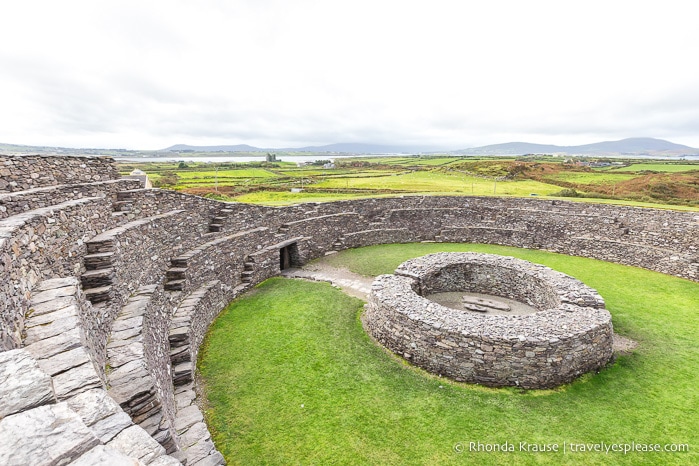
“Cahergall,” built around 600 AD, one of the best-preserved early medieval stone forts.

 *   *   *   *

July 28, 2026 – The last post explored our May ’26 driving trip in Ireland from Dunboy Castle – on May 12, “much of it along Bantry Bay” – over to Killarney. (In County Kerry, southwest Ireland.) On that long day, and the days before that, we kept checking the weather forecast for Portmagee on May 13. There in Killarney, late on May 12, we finally got the bad news: The winds next day would be way too choppy. (“Sustained winds over 28 mph, gusts above 41 mph.”)

That is, way too choppy for me to take the tiny-boat-ride I’d reserved, seven miles out from Portmagee into the stormy Atlantic. There – if the winds had been under 20 miles per hour – I could have climbed gingerly down from the boat onto the tiny dock at Skellig Michael. Once ashore I would then have tried to climb the rugged path up to the top; “not a place for people with mobility difficulties, or kids; ‘It’s just too easy to fall off the path.’” That was the bad news.

The good news? We didn’t have to get up at the crack of dawn to make the 10:00 a.m. boat. (Though actually I had to be at the dock at something like 9:30.) But we did go down to Portmagee, later in the day, and there we visited The Skellig Experience Visitor Centre. (Where we learned that the rugged island is where they filmed some scenes in Star Wars VII. As Wikipedia noted: “On July 28, 2014, filming took place over three days at Skellig Michael.”)

Because we didn’t have to make the 10:00 a.m. boat we took our time heading down. On the way we stopped at the Cahergall stone ring fort (“cashel” in Irish), 40 miles west-southwest of Killarney and 11 miles shy of Portmagee. The ring fort was built around 600 AD and is said to be one of the best examples of an early medieval stone fort on the Ring of Kerry. You can see lots of good picture at Visiting Cahergall and Leacanabuaile- Irish Stone Ringforts, but here’s one man’s take: “The fort was so much bigger than I anticipated, its dry stone wall approximately 6 metres high and 3 metres thick. I felt so tiny when I stood beside it!” Other thoughts:

Another interesting feature of the fort was the flights of steps and terraces all around the inner face of the wall. I wasn’t expecting to be able to climb up and walk the circumference of the fort… The 360-degree view from the top of Cahergall stone fort was wonderful! I could see Ballycarbery Castle and the harbor off in the distance, farmhouses with sheep roaming the fields, and the surrounding green and brown hills.

In plain words, exploring the fort was not for the faint of heart, nor those with bum knees, so I explored the place – wearing 10 pounds of ankle weights to bun off some beer calories – while my partner waited back near the gate. (It was a very steep and rocky climb up to the fort.)

I took my time coming back down, after getting a good workout clambering about those walls; the path itself was made of jagged more-or-less flat-but-slippery rocks. Once back down, “at the gate to the stone fort, a local guy approached us and made conversation, then asked if we wanted to hold the lamb. Of course we did!” That’s what my partner wrote, about how we got the memory of a cute photo of her holding the fuzzy, well-behaved and adorable lamb as I stand to the left, leaning in. And in that photo I’m wearing multiple layers, much of what I’d packed.

Leaving the stone fort we took the Castlequin road to a body of water west of where the River Ferta widens (considerably), then crossed the bridge to Cahersiveen, still nine miles short of Portmagee. There we stopped for brunch at Bari Café Kerry. We split a quiche, very substantial actually, that included some kind of rhubarb compote; very tasty.

And I had a large steaming-hot cup of coffee.

Then came The Skellig Experience, in Portmagee. It featured “the magic and mystery of these famous rocks to you through graphics, film presentation, models, exhibition items, reconstruction and the sound of sea birds and lighthouse keeper ship to shore communication.” Over 1400 years ago – on this End of the World – “Skellig Michael became home to a small group of men seeking religious solitude and isolation on one of the most extraordinary locations on earth.”

It was a great place, fascinating exhibits, but not the real thing. (Thus the “wait’ll next year!”)

After the Skelling Experience we drove to the Cliffs of Kerry, or the Kerry Cliffs, which “stand over 1000 ft above the wild Atlantic and were formed in a desert environment 400 million years ago. Out to the west stand the amazing Skellig Rocks,” including Skellig Michael.

The Kerry Cliffs link included lots of dramatic pictures, then added this observation:

Allow a minimum of 1 hour for a visit to the Kerry Cliffs; many visitors spend a few hours relaxing and bird watching for many hours and even return the next day or another day during their vacation. It is recommended to stay overnight in the local village of Portmagee (Ireland’s top tourist town 2012) to make the most of your visit; to enjoy the local culture and traditional Irish music.

Which is another good reason for that “wait’ll next year,” or some time after that. In other words, we now have two good reasons to go back to Ireland at least one more time. For me to take the boat out to Skelling Michael (and climb to the top), and also to spend a night in Portmagee. There – among other things – we could spend a good hour or more enjoying the Cliffs of Kerry. But on that gusty May 13, 2026, the place was cold.

I walked out to the sheer cliffs that plummet a thousand feet down to the rocky shore below, where wind-tossed Atlantic waves crash and tumble. Out near the edge of one cliff I took a video-selfie. It showed the gusting wind whipping the hood of my rain jacket all about my face and neck; the rain jacket I wore for extra warmth, topped by a doo-rag to cover my ears and keep the wind from howling down my collar. (Did I mention that it was cold, mostly because of the wind?) It felt invigorating, for a time anyway, but it was also cold – and gusty.

On the way back to Killarney we stopped again in Caherciveen (different spelling) at Craineens Bar, “5:00 Ireland time, on the way back from the VERY windy Cliffs of Kerry the other side of Portmagee. Tonight, a pub dinner with traditional Irish music?” And so it happened.

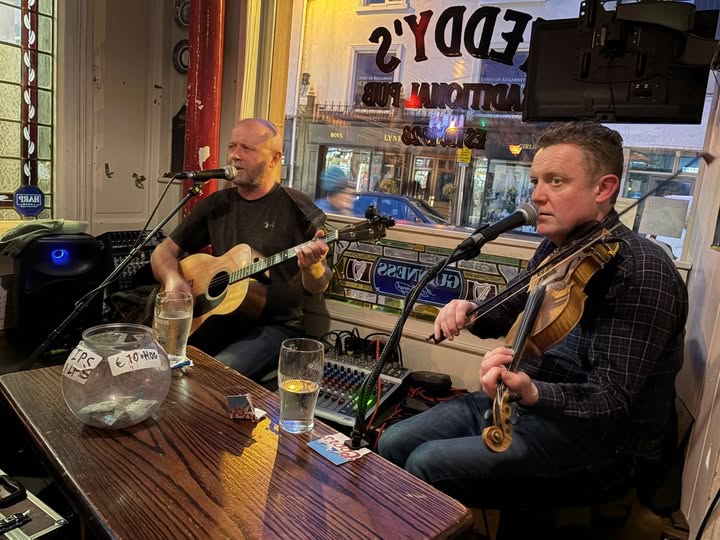
Or as my partner wrote, “To top off the day, traditional Irish music at this place” – O’Connor’s Traditional Irish Pub – “on High Street in Killarney. Introduced ourselves as from Georgia, they played ‘The Devil went down to Georgia.'” Which is being interpreted: When we got there the place was packed, and the only seats were right up front, where the two troubadours shown below sat, their backs to the window out onto High Street. The fiddle player, not two feet away, saw my “LA” hat and asked if I was from California. I said “No, I’m from Georgia.”

From there we played a guessing game; I guessed that the one song they knew about Georgia was “Georgia on my mind,” by Ray Charles. “Wrong!” They knew The Devil went down to Georgia, and proceeded to play that. But I had a bit better luck later, when the duo knew and played The Mountains of Mourne, “a whimsical look at the styles, attitudes and fashions of late nineteenth-century London as seen from the point of view of an emigrant laborer from a village near the Mourne Mountains.” And that’s one of the two main reasons I wanted to come to Ireland: To climb Skellig Michael and also to see “where the dark Mourne sweeps down to the sea.” (From the Don McLean version that always gets me right there at the end.)

The thing is, I remembered the Strand from Don’s version because I was there last year:

You remember young Denny McClaren, of course
But he’s over here working with the rest of the force
I saw him one day as he stood on The Strand
And he stopped all the traffic with a wave of his hand…

Last year I was in London, on August 7, waiting for my brother to fly over and from there we’d start hiking the Canterbury Trail. I wrote of that day that – on my own – and after “hiking down The Strand I headed over to the Thames Path, then west to Waterloo Bridge. Once across the river I took the 77 bus from Waterloo Station down to Nine Elms. Heading home I stopped at The Nott for a pint and nodded to a now-familiar local or two.”

Again, that was last year, but while I stood on The Strand I didn’t stop any traffic, with or without a wave of my hand. (It was more like I was trying to remember that when crossing a street in London, you have to remember that the car or bus that may run your ass over won’t be coming from the left, it’ll be coming from the right.) But back to the Mountains of Mourne, and listening to the two troubadours below singing it, and remembering that it’s such a haunting song that seeing “where the dark Mourne sweeps down to the sea” has been on my Bucket List a long, long time. The last two lines tell of the narrator, standing on the Strand with Denny McLaren (as I remember it), and both longing for home: “But for all his great powers, he’s wishful like me, to be back where the dark Mourne sweeps down to the sea.”

Like I said, those last two lines always get me right there at the end, as they speak of a longing for a time that wasn’t so hectic and troubling, a simpler time when life seemed so much better. And that’s why seeing the Mountains of Mourne was one of the two things I wanted to experience on this trip to Ireland. That “hiking to the top of Skellig Michael” turned out be a bust, but seeing where the dark Mourne sweeps down to the sea is a story for a later post.

In the meantime we enjoyed the authentic Irish music, in a traditional Irish pub, with a pint of authentic Guinness to go with it, all of which made for a cherished-memory Irish evening.

*   *   *   *
*   *   *   *

The upper image is courtesy of Visiting Cahergall and Leacanabuaile- Irish Stone Ringforts.

Re: “Wait’ll next year!” As always, that depends on circumstances, many beyond one’s control. But “we” would definitely like to go back to Ireland at least one more time. But one caveat: To try harder to get that compact car we originally wanted, not the large SUV that kept scraping the many stone walls that lined the narrow roads.

About that stop at Craineens Bar, in Caherciveen, at “5:00 Ireland time.” As I recall I had a celebratory pint there, cold weather be darned. I figured I’d earned it. It’s Five O’Clock Somewhere…”

See Mountains of Mourne, and also My Mourne Mountains Guide: Walks, History + More.

Re: Me on the Strand in London. See In London – August 7 and 8, 2025.

My partner informs me that she took the lower photo.

*   *   *   *

From Dunboy to “wait’ll next year!”

*   *   *   *

“The remains of Dunboy Castle” – seen last May 12 “stronghold of the O’Sullivan family…”

*   *   *   *

Welcome to the “Georgia Wasp…”

This blog is modeled on the Carolina Israelite. That was an old-time newspaper – more like a personal newsletter – written and published by Harry Golden. Back in the 1950s, people called Harry a “voice of sanity amid the braying of jackals.” (For his work on the Israelite.)

That’s now my goal as well. To be a “voice of sanity amid the braying of jackals.”

For more on the blog-name connection, see the notes below.

In the meantime:

July 20, 2026 – The last post got our May ’26 driving trip in Ireland from Cork to the Drombeg stone circle, 41 miles south and hard by the coast. From there it was a bit over two miles to Glandore Inn for lunch, a place that Brian (from Cork) suggested. And about learning how to “adapt, improvise and overcome” is essential to a successful travel-trip, especially renting a car in Ireland. (With it’s “drive on the left side, not the right” and those narrow, twisting roads too often lined by thick stone walls six inches from the side of your rental car.)

Glandore is said to be “one of the most beautiful and most scenic villages in West Cork, positioned on rising ground overlooking Glandore Bay.” And the Glandore Inn provides “commanding views across the bay and the islands of Adam and Eve guarding the entrance to Glandore Bay and the harbour.” (As for those Adam and Eve rocks in the bay, the sailing directions are “to avoid Adam and hug Eve.”) For lunch we shared a “great veggie soup of the day with dark bread while sitting outside viewing the bay.” And as we were to learn, sunny days were rare that May.

From there – on Tuesday, May 12 – we drove 60 miles to Dunboy Castle, much of it along Bantry Bay in southwest Ireland. Built in the 16th century, it’s opposite Bere Island to the east. (Also called Bear Island, though officially it’s An tOileán Mór, or “the big island.”) The castle served as stronghold of the O’Sullivan family, “a prominent Gaelic clan.” (And my partner’s paternal grandmother was a direct descendant.) Strategically located on a rocky outcrop on Beara Peninsula overlooking the sea, it was destroyed in 1652 “during the Cromwellian conquest of Ireland.” (Memorialized by the plaque at left.)

That is, in the summer of 1602 it was the scene of the noted Siege of Dunboy

Elizabeth I had sent a 5000-strong army under the command of Sir George Carew to suppress the insurgents. Even with its small garrison of 143 men, Dunboy Castle was thought to be impregnable but following a fierce artillery bombardment the walls were smashed and after some desperate hand-to-hand fighting amid the rubble the defenders were finally overcome. The 58 survivors of the two-week siege were executed in the nearby market square.

Today it’s in ruins – “reflecting the turbulent past of Ireland” – but still a popular tourist attraction offering scenic views. I don’t remember seeing any other tourists that day, possibly because the footing was shaky, especially for my partner, still nursing a tender knee. Still, the sunny afternoon was perfect, delightfully cool but not cold, and we got lots of good pictures.

In the meantime, we kept watching the weather forecasts. The next morning, May 13, I was scheduled to catch the early boat in Portmagee, and from there I’d ride the choppy waters in a small boat, seven miles out into the Atlantic, to Skellig Michael, “a rocky island off the coast of County Kerry, Ireland, with a Gaelic monastery and a World Heritage Site.” Once there, I could climb to the top of the peak in a hike that can only be described as “arduous:”

First off, “600 steps to climb, most of them jagged slabs of rock.” This guy proceeded “at a snail’s pace, keeping my eye on every step.” And places to stop and rest were few and far between: “At times there was literally nowhere to stop but the steps themselves, as you’d pitch over the side of a cliff.” It’s not a place for people with mobility difficulties, or kids; “It’s just too easy to fall off the path.” (There is a helicopter pad on the island, “just in case.”) You bring your own food and plenty of water. And there are no toilets on the island, so take care of that on the boat ride out?

(That’s from last April 14’s A preview of Ireland – 2026.) The big problem? Getting there.

The dock on the island is very small, as is the boat taking you out there. And being seven miles out, the swells of the Atlantic can toss such a small boat like a cork, so the general rule is “no go if the wind goes above 20 miles an hour.” The forecast that next day? Winds averaging 28 miles an hour, and gusting even higher. But we had to wait for the official word from the tour company to find out for sure. (And get the 100-plus-dollars-or-pounds refund.)

The other problem? If the trip was on we’d have to leave our lodging at 8:00 in the morning, meaning we’d have to get up way earlier than that. (And hope for no bad traffic.) And speaking of lodging, it was 60 miles from Dunboy Castle to “Haven Suites Killarney Self Catering.”

In Killarney’s center, these self-catering apartments feature a welcome pack on arrival and scenic mountain and cathedral views. With free private parking and free WiFi, they are just 1.2 mi from the Lakes of Killarney. Each lounge area in Haven Suites – Killarney Self Catering apartments features a balcony and a TV/DVD player. A fully equipped kitchen is offered in every apartment, including an oven and microwave, a fridge, toaster and kitchen utensils.

So we kept checking the forecast, and meanwhile, driving toward Killarney “there was a minor incident.” I was driving, on the left side of the road. The landscape was sunny but sere, as in dried up or withered, with small rolling hills the color of wheat grass. It was all very enchanting, in a haunting Irish way, then came the incident. The road to the left was lined with a shallow gulley, and in my reverie my mind wandered just a bit. The wheels went off the road, just a bit, but enough to rattle me considerably, trying to get the car back under control.

(“A lesson for all you young kids out there!”)

From there my partner graciously took over the driving duties and we got to Killarney without further ado. We stopped briefly at Tesco in town, then found the apartment “great.” But we were tired from the day’s exertions, so I went out, walking, to a nearby pub for takeout fish & chip. (With a pint while waiting to settle my nerves.) And when I got back to the apartment and checked my email, there it was. The cruise out to Skellig Michael was officially cancelled. That meant we could sleep in a bit and wake up refreshed, ready for further adventures.

In the meantime, and about that trip out to Skellig Michael –Wait till next year!”

*   *   *   *

undefined
Next year I may get to climb these challenging steps to the top of Skellig Michael…

*   *   *   *

The upper image is courtesy of Dunboy Castle – Wikipedia, along with the plaque photo below it. Caption: “Plaque on castle wall. Translation from Irish: ‘In memory of the heroes who fell in Dunboy on behalf of country and faith in June 1602. May their souls rest in peace.'”

See wait till next year — Baseball Dictionary – Baseball Almanac: “The plaintive mantra of fans whose team has once again fallen short of expectations; a baseball euphemism for a season gone awry.” Also Wait Till Next Year by Doris Kearns Goodwin | Goodreads, and Wait ‘Til Next Year: The Fan Bases That Never Catch a Break: “For fans of certain MLB teams … tested through generations of near-misses, epic collapses, and perpetual rebuilding. Here are the 13 MLB fan bases that have endured the most emotional roller-coasters, empty Octobers, and ‘wait till next year’ mantras.”

The lower image is courtesy of Skellig Michael – WikipediaCaption: “Path to Christ’s Saddle.”

*   *   *   *

Re:  The Israelite.  Harry Golden grew up in the Jewish ghetto of New York City, but eventually moved to Charlotte, North Carolina.  Thus the “Carolina Israelite.”  I on the other hand am a “classic 74-year-old “WASP” – White Anglo-Saxon Protestant – and live in north Georgia.  Thus the “Georgia Wasp.”    

Anyway, in North Carolina Harry wrote and published the “israelite” from the 1940s through the 1960s.  He was a “cigar-smoking, bourbon-loving raconteur.”  (He told good stories.) That also means if he was around today, the “Israelite would be done as a blog.”  But what made Harry special was his positive outlook on life.  As he got older but didn’t turn sour, like many do today.  He still got a kick out of life.  For more on the blog-name connection, see “Wasp” and/or The blog.

*   *   *   *

From a “crappy place” in Cork to a Druid’s Circle…

*   *   *   *

This is really Jim Cashmans pub in Cork (Ireland) – the big “Murphy’s” sign threw me off…

*   *   *   *

Welcome to the “Georgia Wasp…”

This blog is modeled on the Carolina Israelite. That was an old-time newspaper – more like a personal newsletter – written and published by Harry Golden. Back in the 1950s, people called Harry a “voice of sanity amid the braying of jackals.” (For his work on the Israelite.)

That’s now my goal as well. To be a “voice of sanity amid the braying of jackals.”

For more on the blog-name connection, see the notes below.

In the meantime:

July 16, 2026 – The last post ended by describing our 60-mile drive from the Rock of Cashel – in County Tipperary – down to Cork. (“In good time and a lot less stress,” thanks to the wide four-lane M8 highway.) Only to arrive at what turned out to be a “very crappy hotel in Cork.”

Let’s just say it was on Leitrim Street, north of the River Lee, and leave it at that. The townhouse with rooms upstairs had a new and strange way to put the entry code in the box by the door, and only after a friendly passerby helped out could we figure how to get in. (No instructions from the landlord and the method was definitely “new under the sun, Qoheleth.”)

Once inside we had to climb steep and narrow stairs up to the “first floor” – really the second floor as they call it in Europe – and those stairs were covered with two thick layers of carpet. That made the footing even trickier for my partner with the bum knee. The room itself was nothing to write home about, as the saying goes, so to escape that and also burn off some beer calories I put on leg weights and hiked around town a bit. Up to Hardwick Street then down St. Patrick’s Hill to the river, then via Camden Place to where it turns into Pope Quay and back.

Then came the metaphoric triumph after the crappy-place ordeal.

My partner had not long ago retired from a high-tech job that had offices and people spread all over the world, and she managed to keep in touch with many of them overseas, especially London and Ireland. Two of them lived near Cork, and one of them, Brian, picked us up at 6:45 and drove us the three minutes across the river to Luigi Malone’s, where we met up with Ash. The verdict? “Great meal, terrific company.” But we were just getting started.

From Luigi’s we walked the two minutes to Jim Cashmans, the pub shown at the top of the page. (Offering “a delightful blend of traditional Irish charm and vibrant nightlife energy. This pub is known for its cozy yet fashionable ambiance, making it a perfect spot to catch up with friends.”) Also, “Jim Cashmans promises an affordable and memorable night out.” And Jim delivered.

But first, a note about my name-confusion. In writing up this post I kept looking for the “Murphy’s Pub” in Cork, based on the big “Murphy’s” sign outside. I found out there’s a Murphy’s Rock Bar, Ballincollie Rd, but that’s over two miles north of Luigi Malone’s. Then a Murphy’s Chip Bar, 76 Gerald Griffin St, but that was a 13-minute walk northwest, not the two minutes we actually walked from Luigi’s. Finally a Noel Murphy’s Pub, 1 Pearse Square, Ballyphehane, but that was a 34-minute walk south of Luigi’s. All very confusing and very frustrating.

But then my partner took a closer look at the picture I took, and saw down below the name “Cashmans” in smaller reddish print that blended into the brickwork, and also the street sign “Academy” which made things easier. (A lesson for all you young kids out there: “Read the fine print.”) The big name “Murphy’s” actually referred to the Irish stout brewed at Murphy’s Brewery in Cork. (Now “owned and distributed by the Dutch brewer Heineken N.V.”)

And for the benefit of beer connoisseurs – and also stout and Irish ale aficionados:

It is brewed to be less heavy and less bitter than its chief competitor Guinness. Its flavour is evocative of caramel and malt, and is described as “a distant relative of chocolate milk.” The resemblance to milk extends beyond flavour to texture: Murphy’s is free from any hint of carbonation, and is delivered “black as strong cappuccino” with an inch of foam – the head – on top. The water of the River Lee in Cork allegedly gave Murphy’s its quality.

If I recall correctly I may have had a second Murphy’s Irish stout at Cashmans – and my verdict was “not bad, actually.” But that memory was overshadowed by another one that made this a most memorable night on the town. And led to the note that came later: “Pub had very enthusiastic soccer fans screaming for their team.” Very enthusiastic. Here’s what happened.

It didn’t take long to figure out the local-fave was the Tottenham Hotspurs. They led 1-0 with a mere minute left to go. But then – at the last minute – the enemy team scored and tied the game. That led to a loud and reverberating “F’ing bollocks” from an intense local fan sitting two tables closer to the TV. (Though without the single quotation mark indicating three letters left out.) And that was the first time I’d ever heard such a loud and creative “expression of disapprobation.” Which leads to why I travel. To enjoy the local color, away from all those bland, boring touristy types – and sometimes learn a new expression that shows just how creative the English language can be. (And led me to some etymology research; see the Notes.)

After that highlight of the night – and much chuckling into a Murphy’s Irish Stout – Brian drove us back to our place-for-the-night on Leitrim. Ash got out and walked us to the door; by coincidence she both lived nearby and was familiar with the townhouse apartments. “Does it still have those steep narrow stairs covered with two layers of thick carpet?” (Yes, it did.)

Tuesday morning, May 12, we tried to wash some clothes on the first floor combination laundry and kitchen, but darned if we could get the washer to work. (Again, no guidance from the management.) I drove out of Cork and we ended up stopping for breakfast at the Amberley Store and Bakery, Glen Road, ten minutes south of downtown Cork, near the airport, via the N27. (Thankfully, one of the rare wide-enough roads in Ireland.) From there we drove southwest the 41 miles to see the Drombeg stone circle, right by the coast. From there it was a bit over two miles to Glandore Inn for lunch, a place Brian suggested. All of which is a story for next time – except the not-able-to-do-laundry part. But that’s travel: “Adapt, Improvise, Overcome.”

*   *   *   *

Drombeg stone circle (also called The Druid’s Altar, near Cork – looking south.

*   *   *   *

The upper image is courtesy of “jim cashmans pub cork ireland” Images.

Bollocks – Wikipedia says the word of Middle English origin meaning testicles “is often used in British English and Irish English in a multitude of negative ways.” It’s often used as an expletive indicating “contempt for a certain subject or opinion. Conversely, the word also appears in positive phrases such as ‘the dog’s bollocks’ or more simply ‘the bollocks,’ which will refer to something which is admired or well-respected.” (I didn’t know about that last “respected” part.)

The link  “Adapt, Improvise, Overcome” indicates that the phrase was born out of necessity during World War II, “when traditional military tactics often failed against unpredictable enemies.” It later became a “cultural mantra” for resilience, problem-solving, and adaptability; a “timeless framework for overcoming adversity,”

The lower image is courtesy of Drombeg stone circle – Wikipedia. Also, at Glandore “We got cream of veg soup and good brown bread,” again, a story for next time.

*   *   *   *

Re:  The Israelite.  Harry Golden grew up in the Jewish ghetto of New York City, but eventually moved to Charlotte, North Carolina.  Thus the “Carolina Israelite.”  I on the other hand am a “classic 74-year-old “WASP” – White Anglo-Saxon Protestant – and live in north Georgia.  Thus the “Georgia Wasp.”    

Anyway, in North Carolina Harry wrote and published the “israelite” from the 1940s through the 1960s.  He was a “cigar-smoking, bourbon-loving raconteur.”  (He told good stories.) That also means if he was around today, the “Israelite would be done as a blog.”  But what made Harry special was his positive outlook on life.  As he got older but didn’t turn sour, like many do today.  He still got a kick out of life.  For more on the blog-name connection, see “Wasp” and/or The blog.

*   *   *   *

From Dublin to “Smith-icks” to Cork…

*   *   *   *

What’s left of St. Peter and St. Pauls’ Cathedral in Glendalough, seen after we left Dublin...

*   *   *   *

July 11, 2026 – The last post – after the fill-in Finding closure – ended with our last of three nights in Dublin. My partner and I shared a Saturday night dinner at TP Smith’s Bar And Restaurant, “a two-minute walk down Abbey Street Upper from ‘the Clink.'” (The Clink i Lár where we stayed those three days.) Smith’s offered European and Irish cuisine, blending “seamlessly with a cozy atmosphere and excellent service.” We had authentic Irish Beef Stew, “steeped in Guinness. Very tasty.” Thus ended our last night in Dublin, “before heading south to the REAL Ireland.”

Sunday morning, May 10, we had an adventure getting our taxi.

We got a taxi ride back to near the airport with all the car-rental places. Enterprise didn’t have the requested small Ford compact. (Which would have been a whole lot better on the narrow Irish roads we were to find; a bit of foreshadowing.) Instead at first they offered a swanky bright red Peugeot, but it had no GPS, as requested and what turned out to be a big necessity in our Irish travels. Plus the dashboard information center was all in French…

My partner wrote that in her notes. (I scooted over her disparaging comment about the driver’s “abilities,” or lack thereof.) I myself fell in love with the swanky red Peugeot, but that “no GPS” part was a deal-breaker. (As was the “all in French.”) It ended up taking an hour of waiting, “shucking and jiving,” but we finally ended up with a big black Hyundai Kona with GPS.

Then the fun part started.

We were about to find out about those unexpectedly narrow Irish back roads.

We left Dublin heading the 46 miles or so to Glendalough, “a glacial valley in County WicklowIreland, renowned for an Early Medieval monastic settlement founded in the 6th century by St. Kevin.” But first we had to negotiate those narrow Irish roads while learning to drive on the left side of the road. As my partner wrote later: “This was our first taste of driving in Ireland, and some of the roads were godawful narrow twisty and scary.” Which pretty much sums up those roads, which were but a foretaste of the driving challenges ahead.

After splitting a burger-and-fries lunch we went to the monastery’s visitor center, “and liked it,” but then realized we had to “leave quick to make it to the Smithwicks experience by 5 pm.” (I.e., the Kilkenny Brewing Tour & Beer Tasting | Smithwick’s Experience.) Google Maps says it’s 65 miles from Glendalough to Kilkenny, but thanks to those “tiny tiny twisty roads” we got there late. (We got a break when we hit the M9 highway at 4:15 p.m., “a broad four laned super-highway” for a change. The M and N roads in Ireland were a welcome change from the narrow roads too often lined with plant-covered stone walls six inches or less from the side of the road.)

So anyway, when we finally got to Smithwicks (pronounced “Smith-icks”), they honored our tickets and let us join the small group late, and the tour ended with each of us getting a sample pint. I got the regular draft ale and my partner got the lager. However, since she only drank a third of her pint, I had to finish it off. For one thing I didn’t want to hurt their feelings, and that “one and two-thirds” combo helped calm my nerves after those tiny twisty roads.

Which explains my partner driving the short way to Orchard House Bar & Restaurant, our lodging for the night. There we enjoyed a great downstairs dining area for dinner that night and breakfast the next morning. For dinner, the Sunday roast beef special, with parsnips, carrots, mash potatoes and gravy and roasted potatoes. (We rarely went hungry, which explains why I gained five pounds in those two weeks.) Our upstairs room was nice, but we couldn’t get the TV to work. But by this time, we were worn out from our first day driving those “tiny” roads.

Monday, May 11, presented a different challenge. My partner had reinjured the knee that almost forced us to call off the whole trip earlier in April, and so didn’t sleep well; “my knee really hurt.” Which brings up the problem of floor-counting. Because of her bum knee my partner tried to get rooms on the “first floor,” but in most European countries the first floor is actually the second floor. (What we call the first floor they call the ground floor. “A word to the wise” for future reference.) So, after packing up and gingerly going downstairs to the ground floor, we shared half a full Irish breakfast. (I.e., without the baked beans on toast and blood pudding.) Our verdict: “The sausage and ham were especially yummy.” (It was listed as coming with bacon, but what they call bacon is more like our Canadian ham.)

After that we drove on and found a walk-in clinic in Kilkenny. Got a quick prescription for 90 Solpadol (Tylenol 3), then got it filled at a local pharmacy. The whole process was remarkably smooth. Then drove by Kilkenny castle on the way to the Rock of Cashel, the “historical site located dramatically above a plain at CashelCounty Tipperary.” And it was dramatic:

The entire plateau on which the buildings and graveyard lie is walled. In the grounds around the buildings an extensive graveyard includes a number of high crosses. Scully’s Cross, one of the largest and most famous high crosses here, originally constructed in 1860 to commemorate the Scully family, was destroyed in 1976 when lightning struck… The remains of the top of the cross now lie at the base of the cross adjacent to the rock wall.

I drove that morning, with a bit of trepidation, but soon enough got used to driving on the left side of those tiny roads. (Being sure to move towards the center when possible, to avoid those jagged stone walls lining the road, inches from the car’s side.) At one welcome no-other-car stretch I noted, “What a nice one lane road.” (Being sarcastic. It was two lanes, barely.) 

But we made the 39 miles to Cashel in good time. I got delegated to climb Rock Lane, clamber through the ruins and take pictures to share, but first we did touristy stuff. My partner visited a wool store near the parking lot, bought a scarf and took pictures of the local sheep. (We saw plenty on our days of driving, some ambling quietly on the road itself.) Meanwhile I walked the eight minutes into beautiful downtown Cashel and found Feehans Bar, “steeped in history. Through generations of family we have a vision to provide locals and tourists with an experience each time they step through our doors.” Then shared a note to the folks back home:

Had some warming-up “soup of the day” (mushroom) before climbing the Rock of Cashel. And after taking over the driving duties from Kilkenny. No accidents, just got cussed out once at a roundabout getting out of Kilkenny. “Drive on the left, dumbass!” (Or however they say it in Irish.)

That soup came in a full steaming bowl, and with two thick slices of hearty brown bread and real Irish butter; not refrigerated ice-cold like at home, and so very smooth spreading. And by the way, I had a pint to go with the soup at Feehan’s – and later retired to the far-left passenger side for the afternoon drive. That became our routine. I’d drive in the morning, then have a pint to go with lunch, then ride in the passenger seat for the afternoon drive. Also by the way, I found driving less stressful than being a passenger. The left side-view mirror gave the driver a better feel for the distance separating those stone walls from the Kona’s left side.

Anyway, fortified with that hearty hot-soup-and-pint lunch I proceeded up through town, up the steep Rock Lane, then up, through and around the grave-marker-and-high-cross-strewn monastery grounds. I took lots of pictures and videos, while also getting in some good hiking and clambering to work off some of those beer calories. The day was cold, windy and overcast – as it was most days during our visit – but not much rain, thankfully. (Though often I wore my SJK Hydrotek Rain Jacket, both “just in case” and for the extra layer of warmth it provided.)

After that we made the 60 miles to Cork in good time and a lot less stress, mostly because much of the drive was on the nice and wide four-lane M8. Only to arrive at what turned out to be a “very crappy hotel in Cork,” but that was followed by a metaphoric story of ordeal and triumph, through a pub visit featuring the English language at its creative best. (Courtesy of an avid but disappointed-at-the-last-minute Hotspur soccer fan.) And that’s a story for next time.

*   *   *   *

 The Rock of Cashel in County Tipperary, the first Irish Romanesque church

*   *   *   *

The upper image is courtesy of Glendalough – Wikipedia. And about that post-title. I wanted one with the rhythm of “Lions and Tigers and Bears,” used most famously in the classic 1939 film “The Wizard of Oz.” The phrase first became an idiomatic expression symbolizing a confrontation with fears or the unknown but has transcended its original context and become a phrase capturing “a sense of adventure, fear, and excitement all at once, making it a versatile expression in popular culture. And that’s not to mention the same rhythm of “Tinker to Evers to Chance,” referring to the 1910 poem about the Chicago Cub infielders “Joe Tinker, Johnny Evers, and Frank Chance … known for their exceptional defensive skills and ability to turn double plays with remarkable speed and efficiency.”

The lower image is courtesy of Wikipedia. Full caption: “The Rock of Cashel in County Tipperary, Ireland, features the ruins of a Gothic cathedral and a 12th century round tower. King Cormac’s Chapel (1127) on the Rock was the first Romanesque church in Ireland.”

*   *   *   *