Author Archives: bbj1969per@aol.com

On the Chilkoot &^%$# Trail! – Part 2

*   *   *   *

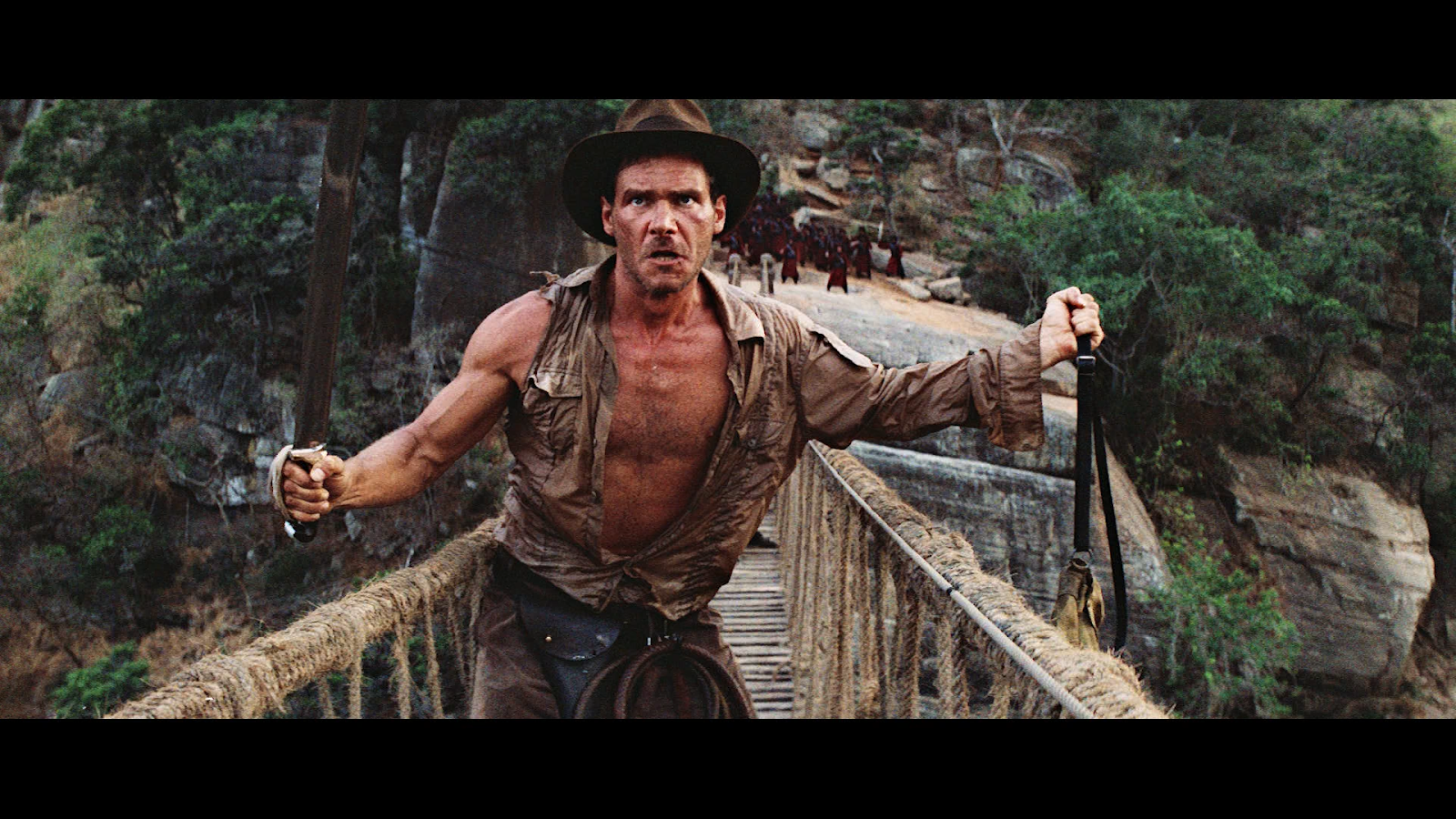
Okay, it wasn’t quite as bad – crossing that “swinging bridge” the first day on the Chilkoot Trail – as it was for Indiana Jones in the photo above.  (For example, we hadn’t been “cornered by Mola Ram and his henchmen on a rope bridge high above a crocodile-infested river.”)

But that second day on the Trail was pretty &^%$ bad…  In case you hadn’t noticed, this continues Part 1 of “On the Chilkoot &^%$# Trail!”  We left Part 1 with we three – brother, nephew and I – all having made Sheep Camp by 7:30 p.m. on the first day of the hike.

13 miles or so – nobody seems sure how many – by 7:30 p.m…  That included crossing the swaying footbridge … à la Indiana Jones and the Temple of Doom.

(Reprised in the photo above right.)  Part 1 also included the tale of a “young thing” I managed to insult on the second day of the hike – approaching the summit of Chilkoot Pass – and how most or all us hikers met up again – on the fourth day – waiting for the 3:15 train back to Skagway.

But I had to cut it short – and make this a two-parter – because I was “approaching the limit of the ideal length for a blog-post.”  (About 1,200 words.)  So now, back to Day 1 of the hike.

On Monday August 1, we left the trailhead – near “Die-eee” – at 9:00 a.m.  We made Sheep Camp by 7:30 that night, and after getting situated I managed to write a little something in the notebook I’d packed.  I wrote:  “I’m shivering as I’m writing.  I’ve been sweating all day despite the cool 68-degree temps.  And now it’s turning cool, so I’m shivering.”  I then added:

There were many times – many times – today when I wondered what the hell I was doing here.  And that this was just too far to go in one day.  And I like hiking at my own pace.  Rather than always bringing up the rear…  So today was the tough one, as far as miles traveled.  “Only” eight miles, but we’ll be climbing the Pass [tomorrow].  BTW:  I just had my fifth swallow of “O be joyful.”

So here’s another side note:  “O Be Joyful” was our code-word for ardent spirits.  We started packing them – in past canoe trips, like down the Missouri River from Fort Benton, MT – as a way of following in the footsteps of Lewis and Clark, and other American pioneers.

You see, back in the old days of our country, whiskey – for example – was used instead of hard currency:

One of the first media of exchange in the United States was classic whiskey.  For men and women of the day, the alcohol did more than put “song in their hearts and laughter on their lips.”  Whiskey was currency.  Most forms of money were extremely scarce in our country after the Revolutionary War, making monetary innovation the key to success.

See Why Whiskey Was Money, and Bitcoins Might Be.  So it was in that spirit – primarily – that I took a flask of “O be joyful” along on the Chilkoot.  Be that as it may, after I wrote, “I just had my fifth swallow of ‘Oh be joyful,’” I then added, “Which helps a lot.”

(I wasn’t so sure about the “song in my heart and laughter on my lips…”)

Also on the evening of August 1st, I wrote that the campground was more crowded than I expected.  And that in the audience – listening to a lecture by a ranger when we arrived – there were some cute women, but “romance is the last thing on my mind tonight.”

(Which itself was telling…)  I concluded,Altogether a good day.  I had my doubts, which were justified in a way, but ‘we’ came through.  Albeit with me bringing up the rear the whole day.”

On that note, I “brought up the rear” the next day as well, and for pretty much the rest of the hike.

Which brings up the fact that hiking the Chilkoot Trail is sheer torture for someone – like me – with only one good eye and and thus no depth perception.*  And that applied even on the relatively smooth parts of the trail, like the section shown at right.

Also – as mentioned in the notes – anyone hiking the trail is advised that if they have to get airlifted out, the cost will be a cool $28,000.00.  Which brings up another point rangers make in the process of getting your permit to hike the trail:  Watch out for the bears!

For one thing, the general rule is “no chow in your tent.”  Each camp has a tented-in dining facility,* and there – and only there – are you supposed to eat.  Eating on the trail can be messy, and the usual solution for crumbs or spills is to wipe the stuff off on your pants.  But bears have an extremely keen sense of smell, and so some crumbs in your pocket or syrup from a snack-cup on your pants could lead to an extremely unpleasant midnight visit.

But for me the message distilled down to this:  You don’t have to be faster than the bear.  You only have to be faster than the others in your party.  (Which of course spelled trouble for me…) 

But once again we digress…  The point is that eventually – in our case, the second day – we got  past the smooth parts of the trail and began approaching the summit.  It got so bad for me – after we got up and over the summit – that first my brother and then my nephew left their packs ahead and came back and carried my pack for a while.  Which led to its own problems.  Much like the phantom limb phenomenon, the “phantom pack” syndrome leaves you disoriented.  Especially when negotiating “one big pile of *&^% rocks after another,” you end up walking like the proverbial drunken sailor, weaving to and fro.

Finally – after much anguish – you get to and over the summit.  But as noted, things don’t get any easier.  There – on the other side of the summit of Chilkoot Pass – were at least three “glaciers,” or ice-fields.  (Like the one at right.)  My first reaction was:  “Great!  Nice smooth snow to walk on!”

But these glacier-slash-ice-fields were just as treacherous, though in a different way.  My fellow hikers hadn’t relieved me of my pack yet, so walking on the slippery snow led to several falls.

It got so bad that finally I stayed down – on the snow-slash-glacier – and slip-slid to the end.  That got my pants and boots thoroughly wet in the process, but at least – for a moment or two – I wasn’t struggling over “one big pile of &^%$ rocks after another.”

Somewhere in there I slipped and fell on some rocks, banging my right knee enough that by Thursday, at Bennett, that area of my jeans was covered with crusted blood.

Which leads to my confession – I “do not deny, but confess” – that there were times on the Trail when if I could have cried I would.  (But that wouldn’t have helped the pain in my feet, or made the journey any shorter.)  Which brings us to the late afternoon and evening of the second day.

Along with the usual “one big pile of &^%$ rocks after another” – and the three “glaciers” noted above – the other side of the pass featured a seemingly-endless series of streams and/or rivulets like the one at left.  They too were beautiful, but treacherous.  (I was going to say “like some women I know,” but decided against that.)

I know my brother took a spill or two – and got an infected elbow as a result – but mostly because he told me so later.

And as far as I know my nephew did okay crossing the many “beautiful but treacherous” streams, but not from any personal observation.  He – and my brother as well – were usually so far out in front of me that I often lost sight of them.

Then it started getting dark.

Back at the hotel in Skagway – before we left – it was still light as late as 10:00 p.m.  Therefore – I deduced – we should have plenty of hours to hike on the Trail.  But for some reason it got darker earlier on the Trail, which meant that by 7:00 p.m. or so my brother started getting worried.  The result was that in the fullness of time – just in time – we had a little parade.

To make a long story short, my brother went ahead the couple of miles to Happy Camp, dropped his pack and hiked back to where I was.  He carried my pack for a bit, then some strapping  young lad showed up.  He – the strapping young lad – had heard someone at Happy Camp talk about my struggles, and decided to come back and help.  (Apparently we – or at least I – became quite a conversation piece around Happy Camp that night…)

So the strapping young lad carried my pack a while – “jabbering all the way,” my brother said – and finally my nephew came back.  He had also dropped his pack at Happy Camp and then he carried my pack the final mile and a half.  That was my brother’s recollection.
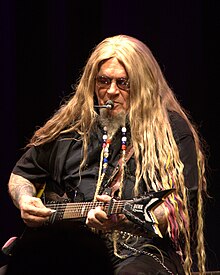
David Allan Coe.jpgAll I remember is that along about 7:30, I could see some people on the Trail ahead of me.  Eventually I limped up to where my brother and nephew were.  Also there were the aforementioned “strapping young lad,” along with a nice white-haired Canadian ranger lady who called me by my name.  (They keep tabs on all hikers on the Trail.)

From that point, we all set off toward Happy Camp.  The nice ranger-lady followed behind me, engaging me in conversation.  (Probably trying to keep my mind off my aching feet.)  So, eventually we all made it to Happy Camp, and that’s how we “had a little parade.”  But this time I wasn’t bringing up the rear.  (For once.)

On that note – and as described in Campgrounds of the Chilkoot Trail:

Happy Camp is the only campground on the Chilkoot Trail in the alpine…  Happy Camp owes its name to the relief prospectors (and hikers) experienced from arriving at the first outpost after the pass. The camp is situated in a true alpine ecosystem and receives heavy use because of its location.

Personally, I can vouch for the “relief” part.  And it got better.  (At least for that night.)  
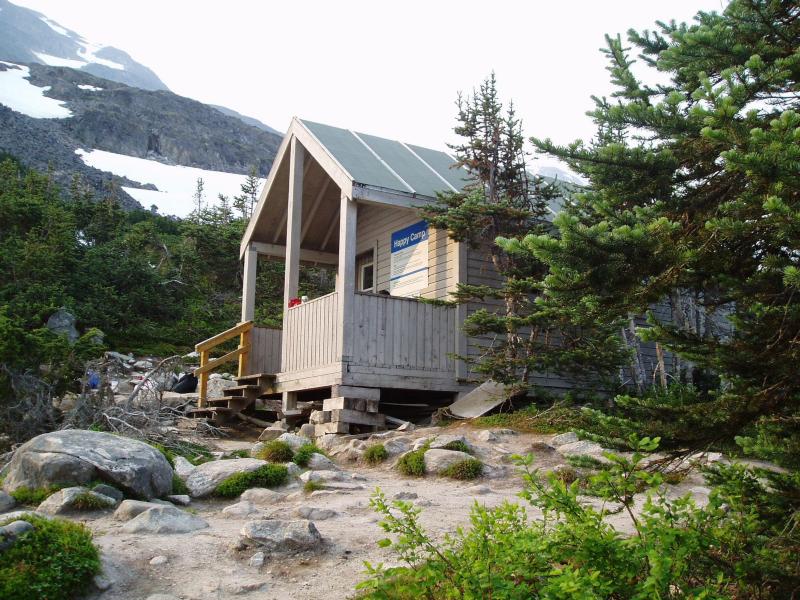
Happy Camp shelterApparently the nice white-haired Canadian ranger lady felt sorry for us.  (Or at least for me.)  So she let the three of us use her personal shelter tent.  That is, she said she had to get up early the next morning for some meeting elsewhere on the Trail, so she’d stay in main – wooden – shelter at Happy Camp, shown at left.

That meant the three of us didn’t have to set up our tents in the waning light of that second day on the Trail.

It also meant that two of us got to sleep on cots.  (My nephew slept on his air mattress on the floor, despite my saying I’d sleep on the floor.  But I made it up to him – for carrying my pack – by splitting two six-packs of beer once we got back to Skagway, as described elsewhere.)   And finally, the nice white-haired Canadian ranger lady brought us each a juice-box.

And a sweeter nectar I’ve never tasted.  
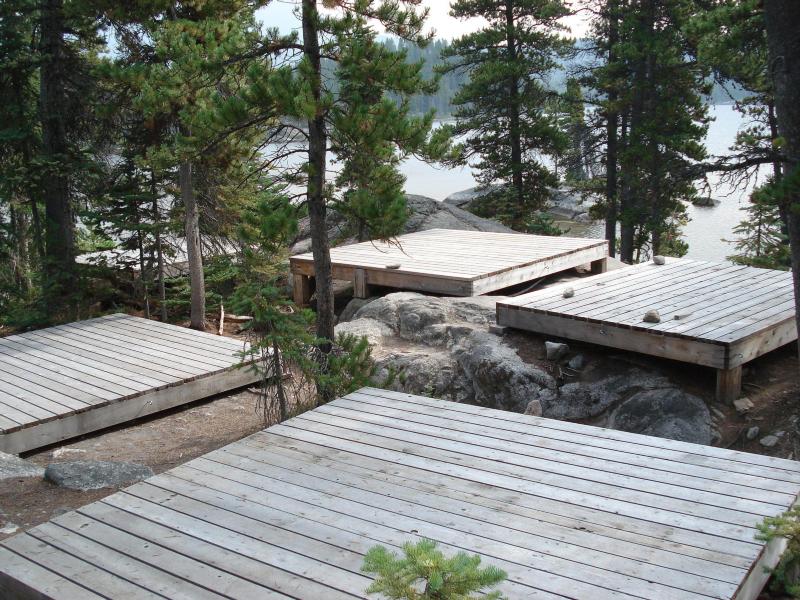
Wooden tent platforms among trees in front of a lakeFrom that point the rest of the hike is a blur.  I know we made it next day to the campground at Bare Loon Lake. (Which included numerous tent platforms like the ones at right.)  

And I know that that left only four miles to do the next day, Thursday, to get to the railroad station at Bennett.  And that rangers and other hikers kept saying the Trail would get easier and smoother “a mile or so further along.”

But it never happened.  At least not until a mile or so from the station, when the Trail got wide and sandy.  In fact the Trail at that point was pretty much like walking on the beach.  Which of course presented its own different challenges, but at that point I wasn’t complaining.  (Much.) 

Thursday, August 4, 1:20 Alaska Time.  We’re at the Bennett railroad station.  Got here at 12:05 AT.  I’ve set up my tent to dry it off – it rained last night – and heated up some water…   Spilled some walking back across the tracks.  (“No open fires.”)  But there was enough left over to make hot coffee.  For the first time since Monday morning.  The right knee of my jeans is covered with blood.  The ankle areas are dried mud.  I have two or three large blisters, one each inner heel, that have already popped.  And one large blister on the right big toe that looks about to pop.  Huge!  But right now the world looks great!

That’s what I wrote in the notebook I’d packed, writing in it for the first time since Monday.  So there – at the railroad station that would remain unmanned until the 3:15 arrived – the right knee of my jeans was crusted with dry blood.  And my feet were blistered and beyond sore.

Which is another way of saying they don’t call the Chilkoot Trail “the meanest 33 miles in history” for nothing.  Meanwhile, I had one final point to be made.  I made it via email – to the folks back home – once the three of us got back to Skagway:  “I used up my quota of expletives for the next couple of years, so any prayers in my direction would help immensely.”

So now, to paraphrase that great philosopher, Forrest Gump:

“That’s all I have to say about the Chilkoot &$%# Trail!”

 that's all i have to say about that - that's all i have to say about that Forrest Gump

*   *   *   *

Unless otherwise noted, the images in this post – including the photos at the bottom and top of the page – are ones I took during the aforementioned “hike.”  (More like sheer torture…)

For example, the image at the top of the page is courtesy of happyotter666.blogspot.com.  See also Indiana Jones and the Temple of Doom – Wikipedia, which provided the “cornered” quote.

Re:  “O be joyful.”  See also Definition of oh be joyful – Online Slang Dictionary, and/or O-be-joyful – 17 of the Finest Words for Drinking.

Re:  Whiskey and other “ardent spirits” used as currency.  See also TTB.gov Alexander Hamilton And The Whiskey Tax:  “small farmers on the young Nation’s western frontier in the Appalachian Mountains, often distilled whisky from their surplus corn crop.  This whisky was then often used as a form of currency on the cash-strapped frontier.”

Re:  “No depth perception.”  As illustrated by the image at right – courtesy of lookfordiagnosis.com – imagine trying to negotiate “one big pile of &^%$ rocks after another,” with no depth perception.  And while trying maintain enough speed to keep up with your brother and nephew, while seeing the “piles of &^%$ rocks” as a blur.  (As in the background at right.)  And with the full knowledge that one bad move – one twisted knee or ankle – will cost you a cool $28,000 to get airlifted out.  (That’s what they told us in Skagway when we got our permits.  Meaning it’s happened often enough that they have the figures down pat.)    

Re: “No chow in your tent.”  The photo at left – courtesy of Campgrounds of the Chilkoot Trail – Wikipedia – shows both a “dining shelter” in the background, and in the foreground a ranger at Sheep Camp giving a lecture like the one in the main text.  Also, “Rangers recommend 7.5 to 10 hours for a group to travel from Sheep Camp to Happy Camp.”  We took longer than that… 

Re:  “Called Me by My Name.”  The allusion is to a song by David Allan Coe.  (Which – incidentally – is one of my signature karaoke songs.)  The photo shows Coe on stage in 2009.  It is not intended to refer in any way to the “nice white-haired Canadian ranger lady.”  That nice white-haired Canadian ranger lady should – in my estimation – be elevated to sainthood, along with Mother Teresa.

Re:  The juice boxes and “sweeter nectar.”  My brother said his was grape juice, but I could have sworn that mine was “raisin.”  I remember thinking that it was such an odd flavor for a juice box, but I couldn’t find any such flavor on the internet.  (Or maybe I was in a state of delirium.)  One thing I do know:  No matter what the flavor, that juice box – at that point in time – was delicious!

The lower image is courtesy of that’s all i have to say about that – Forrest Gump – quickmeme.

“Naked lady on the Yukon…”

This is something like what I saw – unexpectedly – canoeing 440 miles on the mighty Yukon River

*   *   *   *

I just got back from two weeks canoeing the Yukon River.  (That’s also the caption for the Wiki-photo at left.)   And the “mighty Yukon” is the last place on earth I would expect to see a lady sun bathing.
But one moment, out of nowhere, there she was…

You can see the full story below.  I just wanted add – at least for now – that in the picture at the top of the page, for the Yukon setting, you will need to imagine no sand.  (And no “Bikini Bottom,” for that matter.)

Instead, imagine a bend in the Yukon River, a canoe turned over next to a “good campsite,” and a red blanket, on which lay the “naked lady.”  (And I think she was a blonde…)

But first, some background.

Downtown Whitehorse and Yukon River, June 2008My last post – “Many furriners” – noted it was last July 26 – a Tuesday – that my brother and I started the drive from Utah to Whitehorse, Yukon Territory.(Shown at right.)  Four days later – on Friday, July 29 – we met up with my nephew, fresh out of the Army.

From there we drove to Skagway, Alaska.  The following Monday – August 1 – we started a four-day hike on the Chilkoot Trail.  (The “meanest 33 miles in history.”)

And here’s a news flash.  There’s a reason they call it the “meanest 33 miles in history.”  I’ll be detailing that little jaunt in a later post.  (To be titled, “On the Chilkoot &$%# Trail!”)

But back to the Yukon River.  Once we three finished the “Chilkoot &$%# Trail,” my nephew flew back east – to Philadelphia – and from there to Penn State University, to begin fall classes.

That left two old geezers – my brother, 70, and me, just turned 65 – to paddle our canoes “up*” the Yukon River.  From Whitehorse  to Dawson City, that’s a distance of 440 miles, and we covered it in 12 days.  (Not counting the full day we took off on Sunday, August 14, in beautiful Carmacks, Yukon Territory, to rest and refit.)

Before we left I checked a web-post, Canoeing the Yukon River – Our Time Machine is a Canoe, written by Murray Lundberg.  Some years ago he did pretty much the same trip as ours, with his son Steven.  One big difference:  They started at the Lake Laberge Campground – instead of Whitehorse – “to cut down the still-water distance that we’d have to paddle.”

Which is another way of saying that paddling a canoe on Lake Laberge* – shown at left – is a real pain.

But that’s a story for another post.

Now back to the naked lady…

It was Friday, August 12.  We were a day away from Carmacks, and had been on the river five days already.  (And finally made it off “Lake &^%$# Laberge.”)  About 4:00 my brother was way ahead of me, when he went around a right-hand bend and looked like he was heading to shore, for a break.

There followed one lo-o-o-o-o-o-o-ng right-hand curve in the Yukon, one that seemed to last forever.  It was getting late and we were looking for the “good camp” listed in the guidebook.

When I finally got to the end of the long right-hand curve, I could see something, way off, a half-mile or so ahead.  (Where the river turned sharply to the left.)  I saw two small dots, near the bank – at what I later learned was the “good camp” we were looking for.  One of the dots was light and the other dark.  The lighter dot kept moving, to the left, downriver, and I figured it was my brother.  But I wasn’t sure which “dot” to paddle toward.

So I took the middle course, and as I got close to the bend in the river, I could see the dark dot was a green canoe, turned over.  (Which we never do.)  Then – I began to see – there was a red blanket next to the canoe, and something light on it.

That turned out to be the aforementioned naked lady – a reprise interpretation of which is shown at right – laying there in her birthday suit, face down, for all the world to see. (Or at least two passing canoeists.)  
Which brings up the current on the Yukon River.

Generally the current is pretty fast.  It ranges from over four miles an hour up to seven miles an hour in some places.  (Except on “Lake &^%$# Laberge.”)  That’s the kind of current that helps you paddle 440 miles in 12 days.  But it also means that when you see something totally unexpected, by the time you recognize it, the current is already moving you downriver.  (Creating a flash in the pan, so to speak.)   Which meant that by the time I recognized the naked lady as a naked lady, the current was already pushing me farther down-river.

Besides, my brother was already downriver, waiting.  (Having gotten an eyeful himself.)

As to the lady’s identity:  The last day on Lake Laberge we had landed – for a much-needed break – next to a couple in a tandem canoe.  They were from Turin, Italy, and later on in the trip we kept running into them, further downriver.  They pulled into Carmacks not too long after we did, on Saturday, August 13.  And when we finally got to Dawson City – a shade after 3:00 p.m. on Saturday, August 20 – they had gotten there a few hours before.

So it was my brother’s opinion – first expressed at Carmacks, on the 13th – that the “better half” of that nice Italian couple was the mystery lady, sunbathing au naturel on the banks of the Yukon.  (Besides which they took the one “good” camping spot on that stretch of the river.) Unfortunately, neither one spoke very good English, and there seems to be no diplomatic way to translate, “Was that your wife’s naked butt we saw back on Friday the 12th?”

But enough about the Naked Lady on the Yukon.

This is the first of several posts I plan to write about our other adventures this month.  And as noted before, those adventures started with our hike on the Chilkoot Trail.

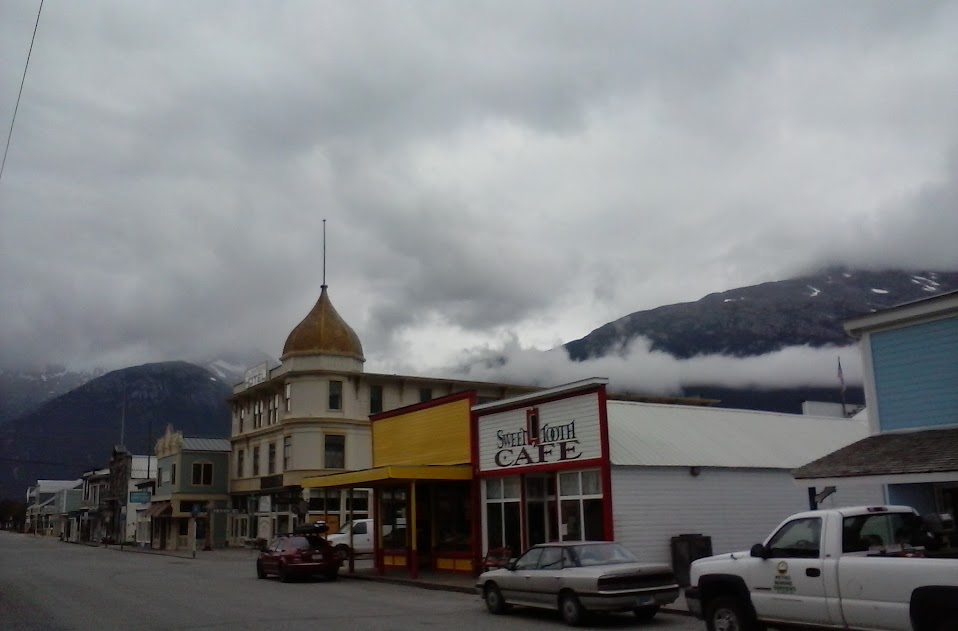
To do that we first had to go to Skagway, Alaska.  And at the left is my picture of beautiful downtown Skagway, the day we got there, last July 30.

This was after checking out the Yukon River, in Whitehorse, after checking out of our hotel.  Then we drove the 110 miles or so to Skagway itself.  That’s where – among other things – we had to get a special permit to hike the Chilkoot &$%# Trail.”  (They won’t let just anybody on there!)

And among other other things, we also learned we’d lost an hour crossing into Canada.  That’s because there’s a special Alaska Time Zone, one hour earlier than the Pacific Time Zone they use in British Columbia and the Yukon Territory.

And there’s one more thing.  I took the photo at right, of one of the first things I saw at the visitor’s center in Skagway.  I thought at the time that it was unique to this part of Alaska.

However, after further review – for this post – I found out that’s not the case.  See for example Footprints on the toilet seats? – Reuters.  (“One Norwegian tourist in Malaysia said, ‘They can be very messy because people don’t seem to know how to use the toilets.  You find black spots, footprints on the toilet seats, and there’s water everywhere.'”) 

Or Footprints on the Toilet Seat: Guidebooks for Novice Travelers, noting Chinese tourists – for example – who behave “in ways the locals saw as inappropriate.”  On that note see also Travel pro-tips from the Chinese government: Don’t leave footprints on toilet seats [or] spit in hotel pools.  All of which is – I suppose – one reason they say Travel Broadens The Mind.

(And you might even see a naked lady along the way.)  But one thing both a good travel experience and a good pilgrimage will teach you:  “There’s No Place Like Home.”  (As shown below.)  

I’ll be writing more about my August adventures, including the next post:

*   *   *   *

Wizard of oz movie poster.jpg

As Dorothy said in The Wizard of Oz, “There’s no place like home!”

*   *   *   *

The upper image is courtesy of Sun tanning – Wikipedia, the free encyclopedia.  The caption:  “A woman sun tanning on a Portuguese beach.”

Re:  Paddling canoes “up” the Yukon River.  To most people, going “up” means to go north, while to go “down” means to go south.  (With “over” meaning east or west.)  But to go “down” a river means to go downstream.  And while many rivers flow “down” or south, the Yukon – like the Nile – flows north.  So while we were paddling “up” north, we were also paddling “down,” as in “downstream…” 

Re:  Lake Laberge.  Most people know the name as “Lake Labarge,” from the poem by Robert Service, The Cremation of Sam McGee.  In the poem, “the narrator winds up hauling the body [of Sam McGee] clear to the ‘marge [shore, edge] of Lake Lebarge.'”  So Service changed the name to “Labarge” to rhyme with “marge.”  (See artistic license – also known as “poetic license” – at Wikipedia.)  Also, the image of Lake Laberge is courtesy of lakelaberge.ca.

The lower image is courtesy of The Wizard of Oz – Wikipedia.  See also No Place Like Home – Wikipedia, which noted that – aside from the famous line in “Wizard of Oz” – the phrase may also refer to “the last line of the 1822 song ‘Home! Sweet Home!,’ (John Howard Payne and Sir Henry Bishop); the source of inspiration for the other references here: ‘Be it ever so humble, there’s no place like home,’” and/or “‘(There’s No Place Like) Home for the Holidays,’ a 1954 Christmas song most famously sung by Perry Como.”  For a “live” version, see also There’s No Place Like Home – YouTube.

Re: “So many dang furriners?”

*   *   *   *

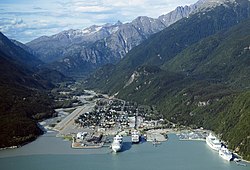
Aerial view of Skagway, Alaska.Last Tuesday – July 26 – my brother and I started the long drive north, from Utah to Skagway, Alaska.  (At left.)

From there our plan was to spend four days hiking the Chilkoot Trail.  (The “meanest 33 miles in history.”)

In fact, the Chilkoot is so mean that we had to invite my nephew – my brother’s son, just out of the Army – to go along with us.  (Just in case one or both old geezers sprained or broke something…)

Now, about “all those furriners…”

That’s pretty much the way I felt several times over the last few days.  (After we crossed over into Canada, on Wednesday, July 27.)  But it got especially bad at the free breakfast we had at the Super 8 in Fort Nelson, BC, on Friday morning, July 29.

I’ll have more on that later.  But first, some highlights from our trip north.

The first day out we made Great Falls, Montana.  We drove 560 miles, starting around 9:00 a.m.  My photo at right shows the sky to the east, just as we got to the Great Falls exit.

That means we had 120 miles to go, to get  the Canadian border. (Unless they’ve built a wall or something.)  And driving through eastern Idaho and Montana was a good reminder of how HUUUUGE this country is, and especially the west.

Meanwhile it looked like there was a fire to the west of Great Falls, as shown in my photo at left.  I figured there was a wild fire to the west of the city, which would explain the smoke we smelled driving up to exit 278.  And it turned out my hunch was right.  (As shown by the front page of the next day’s Great Falls Tribune, for July 27.)

It took about 30 minutes to go through Canadian customs, where Interstate 15 becomes Canada Highway 4.  That’s where we had to “Arretez-vous, ici.”  (“Stop here.”)

Which brings up some of the anomalies of traveling in Canada.

For one thing, aside from speaking French, Canada uses kilometers instead of miles.  So when the speed-limit sign says “Maximum 110,” you have to calculate kilometers to miles.  (Divide the number in half, then add 10 percent.)   So using that method – half of 110 is 55, plus 11 – and you figure out that means about 65 mph on your dashboard.

And that when the speed sign says “40,” that means you have to slow down about 25 mph.

Then too, at first blush the gas prices seemed unbelievable.  For example, we saw signs in Alberta that said “96.9.”  Unfortunately, that was the price for a liter, or one-fourth of a gallon. So multiply that by 4 and you get gas at $3.87.  (In British Columbia we paid over $5.00 a gallon.)

Another thing, driving through Alberta.  We saw acres and acres of fields like this:

At first I thought the yellow-flowered crop-fields might be “golden rod,” but it turns out they were fields of Canola.  (See “A Canadian success story.”)

Then too, they have a weird system for Americans to pay for gas up here.  You have to swipe your credit card, then go in to the office and sign something.  It sounds simple but in practice it can be easy to forget.  Which explains why my brother Tom drove off from the Shell station in Airdrie.  We ended up still making good time, despite having to backtrack a bit.  (And make a belated payment for the gas, on pain of seeing “rollers” in our rear-view mirror.)

That night we made it to Drayton Valley, Alberta.  (West and a tad-bit south of Edmonton. And Calgary was HUGE to pass through!)  The next night – Thursday – we made it to Fort Nelson, British Columbia.  In America-talk, Fort Nelson runs from Mile-marker 301 to 308.

And that would be on the famed Alaska Highway, which officially starts in Dawson Creek, British Columbia.  (As shown at left.)  We passed through Dawson Creek about 3:00 in the afternoon, on the way to Fort Nelson.  And at the border of British Columbia, that 3:00 became 2:00.

(Thanks to the change-over to Pacific Time.)  

The next day – Friday, July 29 – we made it Whitehorse, Yukon Territory.  That happened despite our worst expectations, and a slew of stoppages for highway construction along the way.

This was after three straight days of 12-or-more-hours-of-driving.  I got plenty of pictures, but for some reason they don’t transmogrify from my cell phone to my computer, the way they do back in America.  And in fact there was no cell-phone service at all.  Once you hit the Canadian border, you can forget about texting the folks back home.

And I found out that my American mobile hotspot doesn’t work in Canada either.  (Which may explain why the cell-phone pictures don’t transfer.)  I hoped that once we got to Skagway, in Alaska – which is technically in the U.S. – those problems would go away, but they didn’t.  Still no cell phone service, and still no mobile hotspot.

So anyway, we hit the city limits of Whitehorse at 7:00 p.m.  (Pacific Time, or 10:00 p.m. ATL Time.)  Saturday morning we checked out the Yukon River for the canoe part of this expedition. (That is one FAST current, estimated at about 7 miles per hour.) Then we drove to Skagway and got there early Saturday afternoon.  (To prep for the hike on the Chilkoot Trail, as seen at right, in winter.)

However, there was yet another mix-up about what the actual time was when we got here. When we crossed into British Columbia – Thursday – I started gearing up to Pacific Time.  (Three hours earlier than ATL time.)  But when we got to a “necessary” store in Skagway, the sign said, “Be back at 1:45,” and it was well past that.  That’s when I learned that Skagway is on “Alaska Time.”  Alaska Time is one hour earlier than Pacific Time, which meant that when it 3:10 when we arrived in Skagway, it was 7:10 back in Atlanta.

One final note:  We DID get to watch the 13-minute video on what to do when you meet up with a bear.  That was for the benefit of those hardy folk planning to hike the Chilkoot Trail.  My take on the video:  “Be sure and get behind the OTHER two guys in your hiking party!”

As noted before, stay tuned for “further bulletins as events warrant!”

I’ll let you know how the hike on the Chilkoot Trail turns out…

*   *   *   *

Calvin and Hobbes

*   *   *   *

The upper image is courtesy of Willie & Joe: Summary-1 – amyatishkin.  (And of course,Bill Mauldin.)

The lower image is courtesy Calvin and Hobbes Comic Strip, October 25, 1986.

On the Electoral College – 2016

Here’s how the the U.S. looked in 2012, according to votes in the Electoral College

*   *   *   *

http://www.dralionkennels.com/images/newsflash.jpgDid you know that a candidate for president could get only 40% of the popular vote, yet get 59% of votes in the Electoral College(Thus “winning?”)  It’s happened before, as noted below.

Which brings up some confusion I felt a few mornings ago, after the first day of the Republican convention.  The confusion was about just who is leading in the polls, Hillary or Donald?

For an example, see Pick a poll:  Is the race tied, or is Clinton beating Trump?  As that article noted:  “It all depends on which national polls you believe.”  Which makes this as good a time as any to bring up the subject of the Electoral College:

Citizens of the United States do not directly elect the president or the vice president;  instead, these voters directly elect designated intermediaries called “electors” … who are themselves selected according to the particular laws of each state.

(See Wikipedia.)  Which is another way of saying the candidate who gets the most popular votes doesn’t necessarily become president.  (Think “President Al Gore.”)

President Harry Truman holds up the Chicago Daily Tribune headline trumpeting his "defeat" in the 1948 presidential election.Then there’s the fact that polls aren’t necessarily accurate.

For example, in 1948 “every major political poll predicted a landslide victory for Thomas Dewey.”  (For the history-challenged, Truman won.)  See also the article about such electoral colleges in general, which added:

In the 19th century and beyond, it was usual in many countries that voters did not directly vote the members of parliament.  In Prussia for example, in 1849–1918 the voters were Urwähler (original voters), appointing with their vote a Wahlmann (elector)…  Such indirect suffrage was a means to steer the voting, to make sure that the electors were “able” persons…  The left wing opposition was very much opposed to indirect suffrage.

Which could be another way of saying the powers that be – which for America includes some Founding Fathers, like at right – “didn’t trust the average voter.”  (And some would say – from recent trends – that they had a point.  See Founding Fathers, Trust Issues and the Popular Vote.)

But we digress…  So just in case I’m being too subtle, there are a couple points here.  One is that those “popularity polls” don’t necessarily mean very much.  The other is that what really counts is – are? – the votes in the Electoral College.

The problem is:  Determining the votes in the Electoral College can be a bit tricky.

On the other hand, the present situation in the Electoral College does seem to favor Hillary.  See for example Welcome to the general election: Where did Hillary’s cakewalk go?

Democrats looking for a cakewalk win over Trump in November may eventually get it.  The electoral college strongly favors Clinton.  And Trump is always a step away from a total meltdown.  But in an election in which Americans are disgusted with their choices, anything can happen and a Trump presidency is a real possibility.

The key passage – emphasized – is that the “electoral college strongly favors Clinton.”  Which seems to be true even though the election may come down to which candidate the voters dislike least.  In other words, the election may come down to choosing “the lesser of two weevils.”  (As noted in Independent Voter.)

For another take on the problem, see Don’t Worry About The Electoral College Math.  Among other things, that article noted that while the Electoral College effectively votes “state by state,” there are few if any purely state polls which can reliably show how a state’s electoral delegates will vote.

On the other hand, there’s 270toWin.com, with the trademark, “This isn’t a popularity contest.”

That site shows electoral votes by state.  (Which is – after all – what really matters.)  And that brings up the time in American history where one candidate for president got only 40% of the popular vote, yet won 59% of votes in the Electoral College.

That guy’s name was Abraham Lincoln, and in the presidential election of 1860, he won only 40% of the popular vote.  (The rest were split between John C. Breckinridge, John Bell and Stephen A. Douglas.)  However, Lincoln won 180 Electoral College votes, out of a possible 303.  (Thus his “magic number” was the152 electoral votes needed to win.)  

The amazing thing in that election is that Lincoln lost the Solid South – updated at right – but won what might be called the “Solid North.”  (In 1860, those states generally above the Mason-Dixon line and/or the Ohio River.)
And a side note:  Back in 1860, Lincoln’s “for sure” votes in the Electoral College included New York, Pennsylvania and Ohio.  Those three states had 35, 27 and 23 electoral votes, respectively, for 85 of the total 152 needed for victory.  Which means that those three states alone accounted for almost 60% of the total Abraham Lincoln needed to become president in 1860.

For purposes of comparison – and as updated to the present time – New York state seems “solidly blue,” along with Pennsylvania.  Ohio seems to be one of those swing states, but one big difference – compared to 1860 – is California.  In 1860, California had only four votes in the Electoral College, but today that state has 55.  And it too seems “solidly blue.”

Which means that Hillary seems to start out with a solid 104 votes in the Electoral College.  (29, 20 and 55, respectively.)  Which – along with the beginning – is a “very good place to start.”

That in turn seems similar to the beginning of that other American Civil War.  (Where one side “looked much better on paper.  But many factors undetermined at the outbreak … could have tilted the balance sheet toward a different outcome.”)  But once again we digress…

I’ll be exploring the 2016 presidential election in future posts.  In the meantime, one final note:

This may be the last post I’ll publish for awhile, or the next five weeks.  Next Tuesday – July 26 – I’ll be heading north to Skagway, Alaska.  From there I’ll spend four days hiking the Chilkoot Trail.  (The “meanest 33 miles in history.”)  Once that’s done, my brother and I will spend 16 days canoeing down the Yukon River, from Whitehorse to Dawson City.

Assuming I survive all that, I should be back in business some time after August 29.

But stay tuned.  There may well be “further bulletins as events warrant!”

(See the cartoon below…)


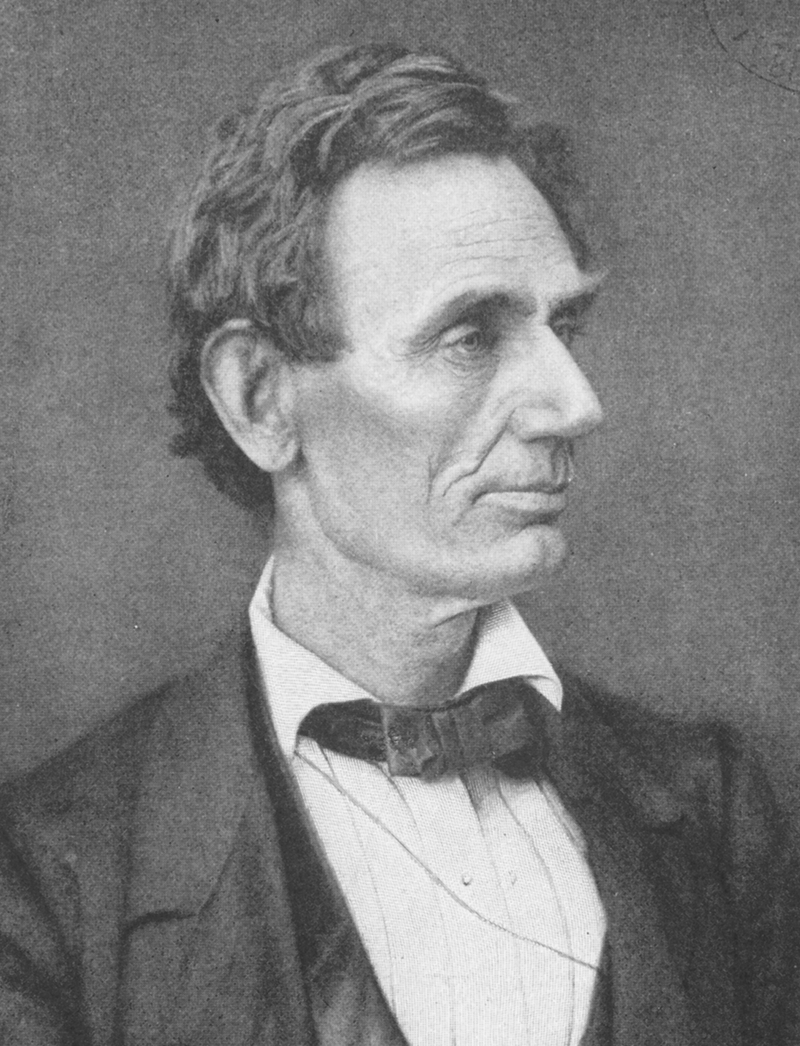
Abraham Lincoln by Alexander Hesler.png

This guy got 40% of the popular vote,  but 59% of the electoral votes…

*   *   *   *

The upper image is courtesy of Electoral College (U.S.) – Wikipedia, the free encyclopedia.  BTW: There is a movement afoot to pass a “National Popular Vote” bill.  That would “guarantee the Presidency to the candidate who receives the most popular votes in the entire U.S.”  See National Popular Vote.com

The “news flash” image is courtesy of www.dralionkennels.com/newsflash.

Re:  “Pick a poll.”  The article said – among other things – that “Trump’s negatives remain sky-high and higher than Clinton’s, and the GOP brand is horrible (and much worse that the Democratic brand).”  See also Myra Adams: How Does Trump Win 270 Electoral Votes?

If we do see Donald Trump push the white vote up into 63-64%, it suggests that as whites move towards minority status that they become more aware of their whiteness, and it plays into politics.  It is a disheartening and dangerous trend, but it might be something we don’t have any control over…  He has no other path to victory.

The “Dewey Defeats Truman” image is courtesy of the link 5 Historic Presidential Campaign Collapses, in the web article How the Electoral College Works | HowStuffWorks.  (“Dewey Defeats Himself.”)

Re: President Al Gore.  See also Al Gore: Electoral College System Needs National Popular Vote Plan.  But see also Would Al Gore Have Won in 2000 Without the Electoral College?  (Not to mention Famed third-party candidate [Ralph Nader] accused of ruining election for Al Gore in 2000 says Bernie [Sanders] shouldn’t run as independent.)

The Founding Fathers image is courtesy of quotesgram.com.

Re: “Left wing opposition … opposed to indirect suffrage.”  They might be changing their minds now…

The “lesser of two weevils” image is courtesy of pinterest.com.  See also Master and Commander: The Far Side of the World – YouTubeLesser of Two Evils – TV TropesReader Opinion: Clinton v Trump and “the lesser of two weevils, Master and Commander: A Movie Review – Maccabee Society, and/or Master and Commander: The Far Side of the World – Wikipedia.

The actual expression of course is the “lesser of two evils.”  See Idioms …Free Dictionary.

Re:  “magic number.”  That term is also defined online as a “figure regarded as significant or momentous in a particular context.”

The comparison in Electoral College votes – between 1860 and 2016 – was gleaned from sources including 270toWin.com, and RealClearPolitics – Opinion, News, Analysis, Video and Polls.

Re:  The beginning of the Civil War, in which “one side ‘looked much better on paper,'” etc. See Strengths and Weaknesses: North vs. South [ushistory.org]

Re: “Further bulletins as events warrant.”  See Calvin and Hobbes Comic Strip, October 25, 1986:

Calvin and Hobbes

The lower image is courtesy of United States presidential election, 1860 – Wikipedia.  The caption: “Black and white portrait photograph (bust) of Abraham Lincoln taken immediately after Lincoln’s nomination.”  The article noted that voter turnout was 81.2%, “the highest in American history up to that time, and the second-highest overall (exceeded only in the election of 1876).”

For some recent historical perspective, voter turnout in the 2008 and 2012 presidential elections was 61.6% and 58.2%, respectively.  

Other notes from the presidential election of 1860:  To be precise, Lincoln won only 39.8% of the popular vote.  His closest competitor – in terms of popular votes – was Stephen Douglas.  Douglas got 1,380,202 popular votes, or 29.5 percent of the total, compared to Lincoln’s 39.8%.  However, Douglas’ million-plus popular votes translated to only 12 votes in the Electoral College.

*   *   *   *

And speaking of voter turnout, see The Americans: The National Experience, by Daniel J. Boorstin. Boorstin indicated that political parties were originally designed – in part – to increase voter turnout, though the blessings of that change seem to be mixed. 

Near the end of his book, Boorstin wrote about the “novel institution of a party ticket.” (429)  The idea – of voting along party lines – originally stirred opposition from political idealists.  For example, one editor in 1790 wrote, “We want no Ticket Mongers.”  (Emphasis in the original.)  And in 1800 a Connecticut Federalist “attacked the whole ‘detestable practice of electioneering.”  

But the practice – which eventually led to our two political parties today – proved “too useful for office-seekers, and too entertaining to voters.” (E.A.)  Which brings up the matter of political conventions.  Boorstin wrote that in its original form – before today’s system of voting in primaries – political conventions “concentrated party strength” and increased the chances of victory.  Also in their original form, party conventions were held only at the state and county level.  It was not until 1832 that national conventions – like we have now – “were for the first time held by all the major parties that offered candidates for president.”  See page 430, which also included this thought:

So long as problems of American political life remained compromisable, the political parties were the great arenas of compromise.  When this ceased to be true, the nation itself would be on the brink of dissolution; and then the political parties, like the nation itself, would have to be reconstructed.

A voter marks a ballot for the New Hampshire primary Feb. 9 inside a voting booth at a polling place in Manchester, N.H.And it seems that we may be seeing that Reconstruction “even as we speak.”  See Sick Of Political Parties, Unaffiliated Voters Are Changing Politics.

See also Five myths about independent voters – Washington Post.  Among the findings:  “Independents are more turned off than partisan voters by negative campaign ads;” “Most independents are socially liberal, fiscally responsible centrists, but some are also libertarians and far-left progressives;” and 60% of Independents “agree with the Republicans on some things, such as the economy and national security, and with the Democrats on social issues.” (The red-blue voting booth image is courtesy of the Sick Of Political Parties article.)

“The Coming Fury?”

NY Post's Shameful 'Civil War' Cover On Dallas

Did someone mention The Coming Fury – first book of Bruce Catton‘s Civil War Trilogy?

*   *   *   *  

My last two posts noted a recent 10-day family road-trip north, via “convoy:”

Three cars, carrying five adults and seven younger folk, ranging in age from 10 to 22.  Among other places, we’ll be visiting Valley Forge, the Liberty Bell and Philadelphia in general…  Last but not least we’ll see Hershey PA … “The Sweetest Place On Earth.”

7096For five nights of that 10-day trip, we all stayed with my aunt in Wilmington.  Her three-story house is pretty much a museum, and a much-loved place to visit.  (By nephews, great-nieces and -nephews, and other relatives through marriage.)
Nowhere is that “museum-ness” more evident than on the third floor.  The third floor was pretty much my aunt’s private “penthouse” when she was young.  (My grandparents stayed on the second floor.)  She was an avid reader then, and a great collector of books.  Which means that now the third floor of her home resembles nothing so much as a library.

And so, late one night that last week of June, in Wilmington, I sat relaxing on the third-floor bed – topped by an air mattress – sipping a bottle of Rolling Rock.  It was then that my eyes lighted on a Bruce Catton book I hadn’t read.  I have read – and pretty much loved – all his other CW books.  But that night, I saw “Bruce Catton,” on a thick, hard-cover book, and the unread title, The Coming Fury.

WmLYancey.jpgI was hooked from the first page.

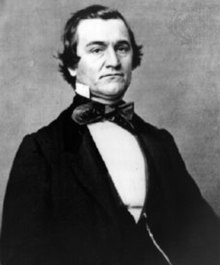
Catton began by describing the first of two 1860 Democratic National Conventions, with the arrival of William L. Yancey.  (At left.)  

It seems that certain “fire-eaters” – like Yancey – didn’t care if they caused a “split convention.”  The result?  A host of Democrat-delegates walked out of the convention.  (In essence, a revolt that split the party.)  That virtually guaranteed the opposition candidate – Abe Lincoln – would be elected.

All of which may sound familiar to modern ears.  That is, what caught my eye – in reading the beginning of The Coming Fury – was the way Catton’s writing seemed to foreshadow some of the surprises that may well be coming at this summer’s Republican convention:

The delegates might look for a safe middle ground [and] work out some sort of compromise that would avert a split in the party and nation;  or they might listen to extremists, scorn the middle ground, and commit all of America to a dramatic leap into the dark.

In 1860, it was the Democrats who saw their party literally split in two.  (Thus virtually guaranteeing the election of a candidate they didn’t want.)  In 2016, it may be the Republicans who experience a delegate revolt, and thus a split party.  (See also karma.)

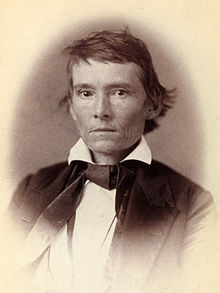
Alexander H Stephens by Vannerson, 1859.jpgThe first 36 pages of Coming Fury led up to Part Four of Chapter One, “The Party is Split Forever.”  (A quote from Alexander Stephens – at right – after a friend said “things might be patched up” at the second, “rump” Democratic convention in Baltimore.)  Then at pages 78-80, Catton explored some of the reasons behind the split in the party.

He began by saying the choices made at the two competing Democratic conventions “came at least in part out of a general, unreasoned resentment against immigration and the immigrant.”  (E.A.)

[By 1860,] Americans both North and South could see that something cherished and familiar was being lost.  Looking back only a few years, it was easy to see a society where … everyone thought, spoke and acted more or less alike, living harmoniously by a common tradition.

Which is being interpreted:  “Some things never change.”  Aside from that, if anyone in 1860 had thought about it, they might have come up with a catchy slogan like “Make America Great Again.”  (That is, a call to “return the country to its previous glory.”)

However (as Catton wrote), that cherished vision of the past – “singularly uncomplicated and unworried … simple and self-sustaining” – seemed to be on the verge of disappearing:

Revolutionary change was taking place everywhere … and people who liked things as they had been found the change abhorrent.  Furthermore, it seemed possible that newcomers were at least partly responsible for the change…  Germans, Irish, French, Italians, men of new tongues and new creeds and new folk ways, cut adrift from Europe…  It was easy to feel they were corrupting the old America. (E.A.)

(79-80)  Which may be another way of saying that a large group of people who hadn’t been free – before – were about to get freedom for the first time in their lives.

But then and now, such a change in the status quo scares a lot of people.  As Catton wrote, “To fear change meant to fear the alien – the man who looked and talked and acted differently, and who therefore was probably dangerous.” (80)  Which helped give rise to the fire-eaters noted above.  (Defined in part as “extremists who did much to weaken the fragile unity of the nation.”)  

Which brings up the subject of “splitting” in another context.

In Independent Voter, I noted the phenomenon of “splitting,” a personality disorder also called “black and white thinking:”

Splitting … is the failure in a person’s thinking to bring together the dichotomy of both positive and negative qualities of the self and others into a cohesive, realistic whole.  It is a common defense mechanism used by many people.  The individual tends to think in extremes (i.e., an individual’s actions and motivations are all good or all bad with no middle ground).

It’s also known as cognitive distortion, or or “all-or-nothing thinking.”  And as noted, it’s a common defense mechanism that seems to be getting commoner and commoner these days.

joe-walsh-defends-tweetWhich means that in times of great stress, people are more prone to say really hurtful, unproductive or downright stupid things.  (Like ex-congressman Joe Walsh, at right.)

But my personal theory is that resorting to cliches, canned responses, and/or downright stupid remarks – in times of great stress – simply “beats the heck out of having to think!”

So in times of great stress – like we’ve seen in the last week or so – one option is to say something really stupid and/or counterproductive, like This is now war!”  Or you can sheathe your sword – metaphorically or otherwise – and stop adding fuel to the fire.

After all, who wants to start another American Civil War?

Or as that great philosopher Henry Ford once put it (offering a better solution):

Don't find fault, find a remedy... poster

In other words, “Be a part of the solution, not part of the problem…”

*   *   *   *

The upper image is courtesy of NY Post’s Shameful ‘Civil War’ Cover On Dallas | Crooks and Liars. (Although there was a literal plethora of internet sources available:  See for example New York Post Recklessly Hypes ‘Civil War’ After Dallas Shooting (Huffington Post), and New York Post Blares Dallas Police Killings Set Off ‘CIVIL WAR‘” – from the Talking Points Memo website – which described the Post as an “infamous tabloid, known for its inflammatory headlines.”)

The book-cover image is courtesy of The Coming Fury by Bruce Catton — Reviews, Discussion. References to the text are from the are from the 1961 hard-cover Doubleday and Company edition, “The Centennial History of the Civil War, Volume 1.”

Re: “Fire-eaters.”  Here’s a quote I found working on this post, but misplaced the cite:

James M. McPherson suggested in Battle Cry of Freedom that the “Fire-eater” program of breaking up the convention and running a rival ticket was deliberately intended to bring about the election of a Republican as President, and thus trigger secession…  Whatever the “intent” of the fire-eaters may have been, doubtless many of them favored secession, and the logical, probable, and actual consequence of their actions was to fragment the Democratic party and thereby virtually ensure a Republican victory.

The “success-failure” image is courtesy of Why Black or White Thinking May be Keeping Keep Your Clients Stuck:  “I don’t know about you, but ‘Black or White’ or ‘All or Nothing’ thinking is one of the commonest issues I see with my coaching clients.  When a client is stuck – it’s often because they are looking at the world through this Black or White thinking filter…”  

(“The Coaching Tools Company.com is based on Salt Spring Island, BC, Canada. Launched in March 2009 … our goal is to inspire coaches and help spread the positive impact of coaching throughout the world. We do this by helping coaches get established, grow their clients, grow their skills and grow their businesses.”)

On that subject, see also All or Nothing’, or ‘Black and White’ Thinking and Depression.

Re:  Ex-congressman Joe Walsh.  See Ex Congressman tweets of war against Obama, Joe Walsh defends tweet threatening “war” on ObamaEx-Congressman Walsh on Dallas shootings: “This is now war,” and/or Ex-congressman threatens “war,’”warns Obama to ‘watch out.” 

And by the way – Joe Walsh – the Bible clearly says, You shall not speak evil of a leader of your people.” (See Exodus 22:28 and the beginning of Acts 23.) 

Re: “sheath your sword.”  See also Sheath Your Sword | Duke Today.

The lower image is courtesy of Don’t find fault, find a remedy… poster | Zazzle.  See also Quote by Henry Ford: “Don’t find fault, find a remedy (Goodreads).  As to the phrase “You’re either part of the solution or you’re part of the problem.”  it is generally – and most recently – attributed to Eldridge Cleaver.  However, a guardian.co.uk article on the subject included one reader who said this was a “misquotation.”  Another reader wrote:  “Eldridge Cleaver was hardly being original.  ‘Those who are not for us are against us’ is in the Bible – and had probably been said before that.”  

Note that the Bible-quote is from Matthew 12:30 “Whoever is not with me is against me…”  Note further that this was part of Jesus’ sermon on A House Divided.  See also the “House Divided” Speech by Abraham Lincoln, given in 1858, when he was running for the office of Senator from Illinois.  (Two years before the original American Civil War.)  And finally, see the post from my companion blog, On Jesus: Liberal or Fundamentalist?  That post compared Matthew 12:30 with what Jesus said in Mark 9:40:  “For whoever is not against us is for us.” 

On the Independent Voter

Emanuel Leutze (American, Schwäbisch Gmünd 1816–1868 Washington, D.C.) - Washington Crossing the Delaware - Google Art Project.jpg

Washington Crossing the Delaware” – which he managed to do without “rocking the boat…”

*   *   *   *  

In the last post, I noted that I was about to take a 10-day “family trip north:”

Three cars, carrying five adults and seven younger folk, ranging in age from 10 to 22.  Among other places, we’ll be visiting Valley Forge, the Liberty Bell and Philadelphia in general…  Last but not least we’ll see Hershey PA … “The Sweetest Place On Earth.”

I’m now writing two days after that family vacation ended, on Sunday, July 3d.

CB Terminology and Trucker SlangWhich means we all managed to get home – in our three-car convoy – on the eve of July 4th.
(It also meant that we had to drive home through FOJ-Weekend traffic, thought without the use of CB lingo, as shown at left.  We used cell phones…)

The three-car convoy lasted until Sunday, the 3d, when one of our three cars “peeled off” after a stop for gas – and fresh peaches – in Spartanburg SC.  The remaining two cars split up near Commerce GA, at Exit 149 on I-85.  (After dropping off a niece and her two kids.)

That left me alone, in my car, for the first time in 10 days.  But by the time I got back on the road – after getting some iced coffee – there was yet another traffic jam, further down I-85, closer to Atlanta.  (Thank you ATL.)  So I ended up getting home about 8:30 Sunday night.  And as noted, this was after a grueling two-day, thousand-mile-plus drive from Doylestown PA.

(A lot of those “grueling traffic jams” had to do with the fact that – in the America psyche – It’s Not Just Your Car, It’s Your Freedom.  But “too many dang cars” is a whole ‘nother topic entirely…)

Getting back to the grueling drive home:  Saturday we left our family reunion about 1:30, then got to drive down through Independence-Day-Weekend traffic.  (Especially heavy around Philadelphia, Wilmington, Baltimore, Washington D.C., and Richmond VA.)

That left us with 550 miles left to drive on Sunday.  (Two days ago.)  But the good news is that – even after all that “quality time” together – we’re all still speaking to each other.  (Mostly.)

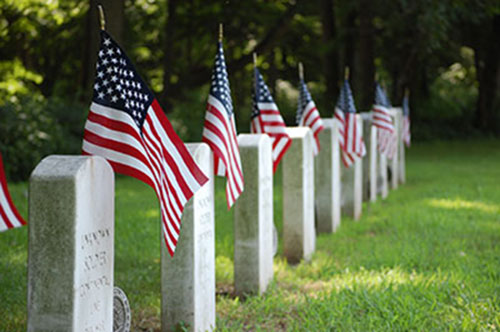
graves-imgTurning to more pleasant topics:  On Friday afternoon – July 1 –  we visited the Washington Crossing Historic Park. (The one on the Pennsylvania side, as seen at right.)  

Which of course makes this a perfect time and place to bring up Independence Day in the U.S.:

Independence Day is a day of family celebrations [with] a great deal of emphasis on the American tradition of political freedom…  Independence Day is a patriotic holiday for celebrating the positive aspects of the United States…  Above all, people in the United States express and give thanks for the freedom and liberties fought by the first generation of many of today’s Americans. (E.A.)

Which brings up the fact that – somewhere along the line – I intended to make this post more about the recent road trip than about Independence Day itself.

For example, I was going to mention what John Steinbeck wrote, about how “We don’t take a trip.  A trip takes us.”  (See also Quote by John Steinbeck.)  I also planned to cite a year-ago post – A Mid-summer Travelog – from my companion blog, along with “I pity the fool!”

The latter post was on Ralph Waldo Emerson – at left – and his saying, “Whoso would be a man, must be a nonconformist.”

Which raises two timely topics for this July 4th.

One topic is Independence Day itself.  The other is the growing number of Independent Voters in this country.  And according to Wikipedia, Independents are those voters who don’t align with either major political party, Republican or Democrat:

An independent is variously defined as a voter who votes for candidates and issues rather than on the basis of a political ideology or partisanship;  a voter who does not have long-standing loyalty to, or identification with, a political party;  a voter who does not usually vote for the same political party from election to election;  or a voter who self-describes as an independent.

And their numbers seem to be growing, which could be either good or bad.

For example, Wikipedia noted first that the definition itself is “controversial and fraught with implications.”  And that according to one theory, the growth of Independent Voters is a bad sign for the country.  (For reasons including but not limited to:  “independents may be more susceptible to the appeals of third-party candidates,” and that “the more independent voters, the more volatile elections and the political system will be.” Which could explain our present political situation…)

But personally I have my own theory.

My theory is that the American political system was designed to keep “moving back toward the middle.”  That is, once a party becomes dominant – for the moment – it tends to pay too much attention to what we might call its lunatic fringe.  Put another way, if one party dominates too long, it tends to move too far away from the middle.  (Left or right, as the case may be.)

5d5d8f10f87f013014e9001dd8b71c47

And so – traditionally – In response to being out of power, the other party has – generally speaking – tended to move back toward the middle of the spectrum.  It does so primarily to reach out to those voters in the middle.  (Those voters who decide elections.)

But that hasn’t happened lately.

One or both parties – it seems – have refused to compromise, and compromise is the keystone of a American democracy.  (See The Spirit of Compromise: Why Governing Demands It and Campaigning Undermines It, and/or The Spirit of Compromise.)

In other words, one or both parties have moved toward black and white thinking.  Psychologists call that splitting, or “the failure in a person’s thinking to bring together the dichotomy of both positive and negative qualities of the self and others into a cohesive, realistic whole:”

It is a common defense mechanism used by many people.  The individual tends to think in extremes (i.e., an individual’s actions and motivations are all good or all bad with no middle ground)…  Splitting creates instability in relationships because one person can be viewed as either personified virtue or personified vice…  [This] leads to chaotic and unstable relationship patterns, identity diffusion, and mood swings.

So one solution to today’s political-party black-and-white thinking – it seems to me – is the growth in the number of voters who identify themselves as Independents.  The problem there is that Independent or Moderate Voters are losing power in the process of one or both parties deciding on a particular candidate.  (As for President of the United States.)

Which brings up the biggest problem of being an Independent Voter.  That problem is:

“One must always choose the lesser of two weevils!”


*   *   *   *  

The upper image is courtesy of Washington Crossing the Delaware – Wikipedia, the free encyclopedia.

Washington Crossing the Delaware is an 1851 oil-on-canvas painting by the German American artist Emanuel Gottlieb Leutze.  It commemorates General George Washington’s crossing of the Delaware River on the night of December 25–26, 1776, during the American Revolutionary War.  That action was the first move in a surprise attack against the Hessianforces at Trenton, New Jersey, in the Battle of Trenton.

I also used the image and related information in my companion blog.  (See On Independence Day, 2016.)  There I noted that “Wikipedia listed inaccuracies” in the painting – by Leutze, working in Germany in 1850 – which included:  The American flag in the boat “did not exist at the time of Washington’s crossing;”  The boat was the wrong model, and much too small;  The painting showed “phantom light sources besides the upcoming sun,” while the crossing itself “took place in the dead of night;”  and finally: “Washington’s stance … would have been very hard to maintain in the stormy conditions of the crossing[, and] would have risked capsizing the boat.”  (See also artistic licence.)

“And speaking of rocking the boat, Washington and his fellow Founding Fathers did in fact rock the boat, according to the British during the Revolutionary War.  (In the sense of causing “trouble where none is welcome;  to disturb a situation that is otherwise stable and satisfactory.”)  See also John Paul Jones’ CLOSEST call, in my companion blog.  It included a British caricature of the man they called “the pirate Paul Jones.”  (To us of course he’s the Father of the American Navy.)”


Re:  Cars representing freedom.  For a different take, see The Car Once Symbolized Freedom… ← The Urban Country, which noted in part:  “Things have changed. We took it too far.”

The image of flags on gravestones is courtesy of Washington Crossing Historic Park – Official Site.  The caption and original image can be found under the “Soldier’s Graves” link:

From the parking area at the Thompson-Neely House, it’s a short walk across the Delaware Canal to the memorial cemetery where an unknown number of Continental soldiers who died during the December 1776 encampment in Bucks County are buried.

The article noted that no American soldiers were killed during the crossing or the First Battle of Trenton, but that “others did succumb to exposure, disease or previous injuries.”  The article also noted a second battle, on or about January 2, 1777, involving Lord Cornwallis:

General Lord Charles Cornwallis of the British Army had been looking forward to a trip home to England…  In fact, on December 27 he had sent his baggage aboard the HMS Bristol.  But after the disaster at Trenton, his leave was promptly cancelled and he was ordered to Princeton.  A very unhappy Cornwallis took command of the British forces there on January 1, 1777.  He had one clear mission: to find the American army and destroy it.

In this second Battle of Trenton, Washington held off the attacking British forces until the evening of January 2, then withdrew north from Trenton, which led to his victory in the Battle of Princeton, on January 3, 1777:  “Washington’s timely withdrawal set the stage for a successful engagement with the enemy at Princeton the following day.”

The full Quote by John Steinbeck on the uniqueness of individual journeys:

Once a journey is designed, equipped, and put in process, a new factor enters and takes over. A trip, a safari, an exploration, is an entity, different from all other journeys.  It has personality, temperament, individuality, uniqueness.  A journey is a person in itself;  no two are alike.  And all plans, safeguards, policing, and coercion are fruitless.  We find after years of struggle that we do not take a trip;  a trip takes us.  Tour masters, schedules, reservations, brass-bound and inevitable, dash themselves to wreckage on the personality of the trip.  Only when this is recognized can the blown-in-the glass bum relax and go along with it.  Only then do the frustrations fall away.  In this a journey is like marriage.  The certain way to be wrong is to think you control it.  (E.A.)

Re:  “Whoso would be a man, must be a nonconformist… I freely translated that to:  ““I pity the fool who doesn’t do pilgrimages and otherwise push the envelope, even at the advance stage of his life.”

I used the “lunatic fringe” cartoon in Is this “deja vu all over again?”  The cartoon itself is courtesy of Peanuts Comic Strip, April 26, 1961 on GoComics.com.  Wikipedia said the term was “popularized by Theodore Roosevelt, who wrote in 1913 that, ‘Every reform movement has a lunatic fringe.’”

The lower image is courtesy of pinterest.com.  See also Master and Commander: The Far Side of the World – YouTubeLesser of Two Evils – TV TropesReader Opinion: Clinton v Trump and “the lesser of two weevils, Master and Commander: A Movie Review – Maccabee Society, and/or Master and Commander: The Far Side of the World – Wikipedia.

“The Sweetest Place on Earth?”

Washington and Lafayette at Valley Forge.jpg

“Washington and Lafayette at Valley Forge,” during the long, cold winter of 1777-78…

*   *   *   *  

Right now I’m in between summer-vacation trips.

On Wednesday, June 1, I went back into the Okefenokee Swamp, on an overnight kayaking trip. (As detailed in “There he goes again…”)  Then on the weekend of Saturday, June 11, I drove up to North Carolina for a grandson’s high-school graduation  (I described that trip in On “latitude, attitude,” and other life changes, in my companion blog.)  

Next up is a family trip north:  Three cars, carrying five adults and seven younger folk, ranging in age from 10 to 22.  Among other places, we’ll be visiting Valley Forge, the Liberty Bell and Philadelphia in general.  (Seen at right, back in the 1910s.)  Last but not least we’ll see Hershey, PA … “The Sweetest Place On Earth.”

Which makes this the perfect time to do a review.

So here it is:  This time last year I posted On RABBIT – and “60 is the new 30,” Part I and Part II. (Both dated June 20, 2015.)  And on June 12, 2015, I posted “Great politicians sell hope.”

And by the way, that part about politicians selling hope seems especially appropriate in view of the 2016 presidential election now  underway.  (See also “More honored in the breach.”)

There were two key points of “Great politicians.”  (From two separate books I’d just read.)  One was that – generally speaking – the presidents who’ve occupied the White House have been – overall – decent, honorable and capable.  Then second was that “maybe the same applies to [today’s] politicians in general.  (Gasp!)”   Those points gave rise to a third thought:

Maybe today’s politicians seem especially nasty because many voters they’re trying to woo are just that way.  Maybe today’s politicians are simply a reflection of the nastiness that seems to have taken hold of a large part of our population.

All of which brought up the difference in those who can work with others to come up with viable solutions to our problems, as opposed to those who just “curse the darkness.”

In other words, the difference between doers and complainers.

On a more positive note, the two RABBIT posts – Part I and Part II – started off about John Updike and his “Rabbit” series.  (Five fiction-books on “the life of the middle-class everyman Harry ‘Rabbit’ Angstrom over the course of several decades, from young adulthood to death.”)  But then Part II turned to the topic of both nostalgia and more hope for the future.

The “nostalgia” went back to 1969, a time when you could go into a bar, pay 40 cents for a beer and leave a dime for the tip.  “And not get thrown out or insulted.”

The “more hope for the future” was about “60 is the new 30,” and “Why 60 Is The New 30:”

Increasingly, people over 60 feel more like 40, and now they have the science to back them up…   The new research argues that since life expectancy continues to rise, age 60 should not be considered old.  It’s more “middle age,” because for many, there’s a lot of living left to do after age 60, even embarking on second or third careers.

I added, “you might say of the Christie Brinkley image below:  ‘Now that’s turning 60!‘”

Did I mention that I turn 65 this summer, and have already gotten my Medicare card?  Which means that I too “have a lot of living left to do,” and now don’t have to worry – so much – about those danged medical bills.  For my part, later this summer – in August – my plans include hiking on the Chilkoot Trail.  (“The meanest 33 miles in history.”)  And taking a 16-day, 500-and-some-mile, canoe trip “down” the Yukon.  (See “There he goes again…”)

But first I’ll have some extended quality time with my seven great-nieces and great-nephews.

As noted, the trip will include a visit to Philadelphia, a city whose “importance and central location in the colonies made it a natural center for America’s revolutionaries.”  (Sounds interesting.)  In other words, a city known as the Birthplace of American Democracy.

Which arguably makes it “the sweetest place on earth.”  But just to make sure, I’ll check out Hershey, home of the “well-known Hershey Bar and Hershey’s Kisses.”

And maybe do some sampling of my own.  (It’s nice being “65 as the new 35.”)


Christie Brinkley: Still Stunning in a Swimsuit at 60!

What was that about the “sweetest place on earth?” 

*   *   *   *

The upper image is courtesy of Valley Forge – Wikipedia, the free encyclopedia.

The image of Philadelphia is courtesy of Wikipedia.  The caption:  “8th and Market Street, showing the Strawbridge and Clothier department store, [in the] 1910s.”

Re:  The places “we” will visit on the upcoming road trip.  See also Liberty Bell – Wikipedia, and Hershey, Pennsylvania – Wikipedia.  

Re: Doers and complainers.  The “Christadelphian” cited Justice Oliver Wendell Holmes, Jr., as saying, “The human race is divided into two classes – those who go ahead and do something, and those who sit still and inquire” – or complain – “Why wasn’t it done the other way?”  For more posts on the topic, just Google “doers and complainers.”

Re: The “Rabbit” series.  Those are Updike’s “novels Rabbit, Run; Rabbit Redux; Rabbit Is Rich; Rabbit at Rest; and the novella Rabbit Remembered.”

The lower image is courtesy of People magazine, people.com/people/article/0,,20780764,00.html.  I included the image in On RABBIT – and “60 is the new 30” – (Part II), with the caption:  “A good argument for ’60 is the new 30…’”

On John Paul Jones’ CLOSEST call

To the British he was “the pirate Paul Jones,” but to us he’s the Father of the American Navy

*   *   *   *

Speaking of “impudent sly sluts…”  (See the last post, “There he goes again.”  It cited Robert Louis Stevenson for the allusion, from his book Travels with a Donkey in the Cévennes )

John Paul Jones by Charles Wilson Peale, c1781.jpgI recently got another book, John Paul Jones:  Sailor, Hero, Father of the American Navy, by Evan Thomas.  Near the end it included a slice of American history that I’d never heard before.  It told of John Paul Jones – seen at left – and what I’ve come to term “his closest call.”

But first a word of explanation.

I published my last post on May 30, on a proposed kayak trip into the Okefenokee Swamp.  Since then I’ve actually done the overnight platform-camping trip to the  Canal Run shelter.  (A trip that included much planning and preparation, not to mention a full day’s drive down to Valdosta GA, the closest major city to the put-in at Foster State Park.)

I also just got back from a weekend trip to North Carolina.  That was for the June 11 high-school graduation of my “favorite grandson named Austin.”  (See On “latitude, attitude,” and other life changes,” in my companion blog.  That trip also involved a lot of planning and preparation.)

But now I’m back home and ready to go.  So, about those “impudent sly sluts…”

Most people know John Paul Jones as the naval hero of the Revolutionary War.

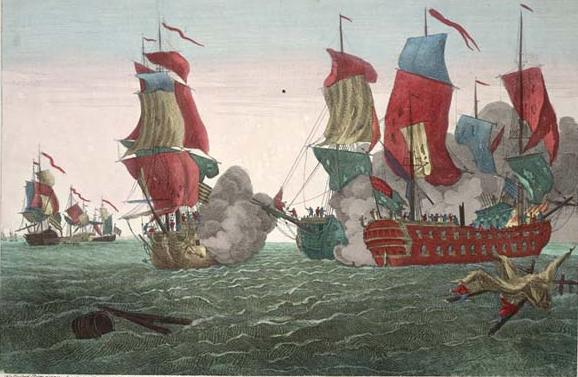
That included his signal victory over the British man-of-war “HMS Serapis,” in the Battle of Flamborough Head, as seen at right.  (At the time, Jones commanded the Bonhomme Richard, which was “originally an East Indiaman.”  That is, it was a merchant ship that had been jury rigged into an ad hoc Navy vessel.)
Not to mention his having said, “I have not yet begun to fight.”  (When asked by the commander of the Serapis if Jones was ready “strike the colours,” that is, to surrender.)  Incidentally, Evan Thomas wrote that Jones probably didn’t say that.

On that note, Jones apparently did say – later in the battle – “I may sink, but I’ll be damned if I strike!”  And in his official report, Jones merely said that he answered “in the most determined negative.”  (An answer that is definitely not as colorful.)  But we digress…

What most people don’t know is that in 1787, Jones joined the Russian Navy.

This was after the War, and after futile attempts to collect prize money for the ships he’d captured.  (And also in response to his general disgruntlement with the American Congress.)  That is, he entered the service of the Empress Catherine II of Russia, who commissioned him a rear admiral.  Thus he was known in the Russian Navy as “Kontradmirál Pavel Dzhones.”

That’s when the trouble started.  Much as he had been in the American Navy, in the Russian navy Jones was also surrounded by people of far lesser ability and courage.  And who were extremely jealous of his ability and courage.  (Which happens a lot in history.) 

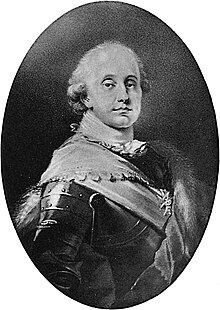
Those Russian enemies included Prince Charles of Nassau-Siegen.  (Seen at left.)  He  in turn “turned the Russian commander Prince Grigory Potëmkin against Jones.”  (And it didn’t help that – like many fighting men – Jones was inapt at “Imperial politics.”  That is, political intrigue.)

To cut to the chase, “In April 1789 Jones was arrested and accused of raping a [10]-year-old girl named Katerina Goltzwart.”

Or as Evan Thomas put it, “In early April, St. Petersburg society was shocked, which is to say delighted, by a police report detailing a sordid episode:”

A ten-year-old German girl claimed that she had been raped by Jones.  As the little girl described the incident, she had been selling butter in the Admiralty District when she was summoned to an apartment to see a man wearing a white uniform with gold braid and a red ribbon.  The man punched her in the jaw, bloodying her mouth.  He locked the door, threw off his uniform, and while holding the girl with one hand, threw a mattress on the floor.  He pinned her down and penetrated her.  Unable to call for help with a handkerchief across her mouth, the girl fainted, woke up, and ran crying into the street.

Moreover, the police had witnesses.  One witness was Jones’ manservant, who described “peering through the keyhole to Jones’ bedroom,” and who later found blood on the floor.  A midwife gave her expert opinion that the girl had been raped, while a doctor testified that her “child bearing parts were swollen,” and that her lip was cut and her jaw bruised.

Which is why I call this episode “John Paul Jones’ closest call.”

That is, such an accusation of “child rape” would have been bad enough under American law.  But under Russian law, anyone convicted of such rape was “to have his head cut off or be sent to the galleys for the rest of his days.”

Jones himself was not afraid of death, and indeed it was his courage under fire that made him such a great commander.  But had he been convicted as charged, he would have gone down in history as a mere child molester, to be punished as he deserved.

He tried to hire a Russian lawyer, “only to have the lawyer quit his case.”  (The Russian government had ordered the lawyer “not to ‘meddle.'”)   One of his few friends – the French Count de Segur – visited, only to find him in a suicidal state, his service pistols on a table in front of him.  As Jones said, “I would have faced death a thousand times … but today I desire it.”

But slowly, the truth came out.  (With a little help from de Segur, “Jones’ last friend in the capital.”) 

For one thing, it turned out the girl was 12, not 10.  (A minor point, to be sure.)  It also turned out both that she’d been “‘selling butter’ for quite a while,” and that “selling butter” was a euphemism for what she had been actually selling.

Then too her customers included that same manservant who’d given damning evidence against Jones.  And finally, the girl’s mother admitted that she’d been “given money by a ‘man with decorations’ in return for telling a damaging story about Jones.”  (In other words, it was a setup, a “situation in which someone is deliberately put in a bad position or made to look guilty.”)  

But enough damage had been done.  Jones didn’t have to go through the ordeal of a trial – as illustrated at left – but he was ostracized by Russian society.  That included the Empress Catherine, who was “finished with him.”  (Notwithstanding the intensity and originality of “her own sexual appetites.”)

And aside from all that, Catherine had hired a number of former British officers, all of whom “refused to serve under the Pirate Jones.”  So in the end, in the “late summer of 1789, Jones left Russia, still resplendent in his beribboned white uniform, but shunned and disgraced.”

From which we can glean at least two key object lessons.  One is that many of our hardest-fighting heroes – like John Paul Jones – also have a “penchant for the ladies.”  (Which can ofttimes be their undoing in civilian life.)  Yet another is that – as a nation – we tend to tear down the very heroes that we build up.  (See e.g. Why Do We Build-Up & Then Tear-Down Our Heroes?)

In the case of John Paul Jones, it took more than a century after he died – not until July 1905 – that his body was finally returned to his adopted homeland – the one that he’d fought so hard for – and given a decent burial.  (In Annapolis, site of the Naval Academy.)

And then only because “Teddy Roosevelt needed a hero…”

*   *   *   *  

The upper image is courtesy of John Paul Jones – Wikipedia, the free encyclopedia.

The caption for the upper image:  “Paul Jones the Pirate,’ British caricature.”  

(Note that a caricature is a “rendered image showing the features of its subject in a simplified or exaggerated way…  In literature, a caricature is a description of a person using exaggeration of some characteristics and oversimplification of others…  Caricatures can be insulting or complimentary and can serve a political purpose…”)

The Wikipedia article also included the image at left, with the caption:  “John Paul Jones and John Barry, honored on U.S. Postage, Navy Issue of 1937.”  Note that Barry is one of at least three men – including Jones – in the running for the title of “Father of the American Navy.”  See for example Commodore John Barry, Father of the American Navy, and also Joshua Humphreys, “Father of the American Navy.”
Re: “Impudent, sly sluts.”  See also Donkey travel – and sluts, in my companion blog.

See also Definition of slut by The Free Dictionary.  Although the term – today – has come to mean almost exclusively either a prostitute or a woman “considered to be sexually promiscuous,” that wasn’t always the case.  For example, in Travels with a Donkey in the Cévennes, Stevenson applied the term to two young girls who were simply being mischievous and/or “pains.”  For another take, see Slut-shaming – Wikipedia, on the form of behavior modification in which a social stigma is “applied to people, especially women and girls, who are perceived to violate traditional expectations for sexual behaviors.”

Re Evan Thomas.  See also Wikipedia.  The quoted portions from Thomas’ Jones: Sailor, Hero (etc.) are from the 2004 Simon and Schuster paperback version, at pages 297-99.)

The oil portrait of Jones is also courtesy of the Wikipedia article on Jones.  The caption:  “A 1781 painting of John Paul Jones by Charles Willson Peale.”

Re: “general disgruntlement with the American Congress.”  Go figure!

Re: Jones’ political enemies in the Russian Navy.  See Wikipedia:

As a rear admiral[, Jones] … took part in the naval campaign in the Dnieper-Bug Liman … against the Turks, in concert with the Dnieper Flotilla commanded by Prince Charles of Nassau-Siegen.  Jones (and Nassau-Siegen) repulsed the Ottoman forces … but the jealous intrigues of Nassau-Siegen (and perhaps Jones’s own inaptitude for Imperial politics) turned the Russian commander Prince Grigory Potëmkin against Jones and he was recalled to St. Petersburg for the pretended purpose of being transferred to a command in the North Sea.

Re: political intrigue.  See also Byzantinism – Wikipedia.

The galley-slave image is courtesy of Ben-Hur (1959) – IMDb.  See also Galley slave – Wikipedia.

Re: Jones’ defense against the rape charge. As Wikipedia noted:

… the Count de Segur, the French representative at the Russian court (and also Jones’ last friend in the capital), conducted his own personal investigation into the matter and was able to convince Potëmkin that the girl had not been raped and that Jones had been accused by Prince de Nassau-Siegen for his own purposes;  Jones, however, admitted to prosecutors that he had “often frolicked” with the girl “for a small cash payment,” only denying that he had deprived her of her virginity.

Note that St. Petersburg [was] the capital of Russia between 1712 and 1918.

The lower image is courtesy of virtualtourist.com, “United States Naval Academy:  reviews, photos.”

In John Paul JonesEvan Thomas described the return of Jones’ body from France at pages 3 and 4 of his Introduction.  “Jones had died, alone and forgotten, in Paris in 1792.”  His body had lain “in a graveyard so obscure that it had been paved over.”  It had taken months for the American ambassador to find the burial site, “beneath a laundry on the outskirts of the city.”  

On page 3, Thomas described the honor guard, in Paris, of 500 American sailors, all picked for their height – over six feet – and “manly good looks.”  In response to the American honor guard marching down the Champs Elysees – wrote Thomas – “‘Quels beaux garcons!’  whispered the French ladies in the vast, cheering crowd.”  (The French translates roughly to “Who are those fine-looking studs?”)  

As to “Teddy Roosevelt need[ing] a hero,” Jones wrote that Roosevelt wanted to make the United States a great naval power, and so wanted to “celebrate Jones’ legacy with appropriate pomp.”  He therefore decreed that every “officer in our navy should know by heart the deeds of John Paul Jones,” and that all Naval Academy cadets must memorize jones’ “pronouncements on the correct training and proper manners of an officer and a gentleman.”  Then there was the tomb itself:

Jones was laid to his final rest in a marble sarcophagus modeled after Napoleon’s own crypt.  “He gave our Navy,” reads the inscription on the tomb, “its earliest traditions of heroism and victory…”  How Jones would have loved it.

And finally, as to Jones having a “penchant for the ladies:”  At page 298 Thomas wrote of Jones’ response – in part – to the charge of rape, “I love women, I confess, and the pleasures that one only obtains from that sex; but to get such things by force is horrible to me.”

“There he goes again…”

An “alligator mississippiensis,” prevalent in the Okefenokee Swamp – where I’ll soon be kayaking…

*   *   *   *

It’s that time of year.  Time to train for future adventures this summer, and finish some unfinished business from last fall.  The future adventures – this coming August – will include a four-day hike on the Chilkoot Trail.  (“The meanest 33 miles in history.”)  

And once that’s over,  my brother and I plan a 16-day, 500-and-some-mile, primitive-camping canoe trip “down” the Yukon.  (From Whitehorse, up through Lake Laberge – of ‘Sam McGee‘ fame – to Dawson City.  And the Yukon is a rare river that flows north, so technically we’ll be going “up…”)

1445624973384But first things first.  I finally wangled a permit to camp overnight at the Canal Run shelter in the Okefenokee.  Which means I’ll be finishing up something I started last fall.

Back in October 2015, I noted – in “Into the Okefenokee” – that I’d finally fulfilled a life-long dream.  “I took my little 8-foot kayak and paddled deep into the Okefenokee.”

In a few days I’ll be going back.

But last October there was a problem.  The only reservation I could get was for the Cedar Hammock shelter.  Unfortunately, that was a mere three miles from the main (east) entrance.

And that pretty much put the kibosh on my plan to “bisect the swamp.”  (See “Okefenokee” – Part II and Part III, where I noted a plan to come in on a later trip from the Stephen Foster State Park – Fargo – to the west.)  So this then will  be that “later trip,” upcoming…

But this time I have a reservation at the CANAL RUN shelter.  It is some nine miles in from the Foster State Park launch site.  And that means that if I can somehow reach the Coffee Bay day shelter on the first day, I will have indeed “bisected the Okefenokee.”

Of course there were naysayers – recently – when I announced my latest plan.  (With comments like:   Where did I want to be buried, and had I made out my “last will and testament?“)

SwampWaterPoster.jpgYet despite it’s fearsome reputation – as illustrated by the lurid movie poster at right – the Okefenokee itself is quite peaceful. (That is, if you can stick to canoe-only water trails and avoid the noisy and/or obnoxious air-boats that touristy-types love.) 
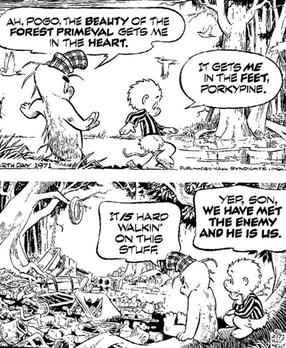
So I’m looking forward to my adventure, which will be the subject of a future post.  But first a few highlights, from the first trip:

…a word about permits.  Before you camp overnight in the Okefenokee, you need a permit.  (See Overnight Camping Permits – Okefenokee.)  That costs $15 a night.  (Of which $6 is non-refundable.  And none of it is refundable if you cancel less than a week before the reservation date.)   Then I also found out Recreation.gov tacks on a $6 “reservation fee.”  So for a grand total of $21, you may tent-camp in a swamp.

Another note:  When paddling a canoe or kayak In the Okefenokee, it’s a rare place where you can actually stop, get out and stretch your legs.   “(And give other body parts a break as well.)”   The shelters – day shelter or overnight – are few and far between.

1445624973384I.e., any “banks” you see will likely be nothing but mashed down reeds or bulrushes.  Beyond that, many of those banks of bulrushes will be already ocupado, by basking gators like the one at left.  But the good news is that you’ll be following in the footsteps of people like Robert Louis Stevenson.

As noted in Donkey travel – and sluts – in my companion blog – Stevenson was an – if not the – original modern travelogue writer.

For example, he wrote books like Travels with a Donkey in the Cévennes.  (Which laid the groundwork for John Steinbeck’s Travels with Charley.)  And a year or so before that, he wrote An Inland Voyage.  (About  a canoe trip through France and Belgium.)

Stevenson said he took pleasure in such arduous trips because he’d “been after an adventure all my life, a pure dispassionate adventure, such as befell early and heroic voyagers.”

And quite often that meant “not knowing north from south, as strange to my surroundings as the first man upon the earth.”  It also meant putting up with the occasional “astonishingly ignorant” fellow traveler.  (Or for that matter the two young country girls he came across, near an isolated French village; “impudent sly sluts, with not a thought but mischief. “)

But in the end, such a hard and difficult journey – or pilgrimage – is usually well worth the effort.  Anyway, that’s what I noted after my first trip into the Okefenokee, last October:

…despite the discomfort that seems to got along with such efforts, it felt good to finally visit the home of Pogo Possum.  To visit – even for such a short while – the “hollow trees amidst lushly rendered backdrops of North American wetlands, bayous, lagoons and backwoods.”

And speaking of Pogo Possum, here’s a bit of homespun wisdom to meditate…

*   *   *   *

Pogo - Earth Day 1971 poster.jpg


The upper image is courtesy of Alligator – Wikipedia, the free encyclopedia.  The caption:  “American alligator (A. mississippiensis).”  The next-down “gator picture” I took myself, in October.

The blog-post title alludes to “There you go again,” a phrase made famous by Ronald Reagan, and later used by politicians as diverse as Bill Clinton and Sarah Palin.  See Wikipedia.

For other past adventures, see 12 miles offshore and/or A late-fall mountain trek…

The lower “enemy is us” cartoon image is courtesy of Pogo (comic strip) – Wikipedia.  The caption:  “Pogo daily strip from Earth Day, 1971.”  In the alternative:  “A 1971 Earth Day comic strip written and illustrated by Walt Kelly, featuring Pogo and Porkypine [sic].”  Wikipedia described Porky Pine:

A porcupine, a misanthrope and cynic; prickly on the outside but with a heart of gold.  The deadpan Porky never smiles in the strip (except once, allegedly, when the lights were out).  Pogo’s best friend, equally honest, reflective and introverted, and with a keen eye both for goodness and for human foibles.  

I wondered why I liked him so much…

“Thou shalt not insult FOREIGN leaders?”

One idea of how you might end up, bad-mouthing the ruler of Cameroon

*   *   *   *

At lunch the other day I glanced at the “Trending” section, on page 8 of the April 25 issue of Time magazine.  (The first issue – from 1923 – is at right.)  As noted in an earlier post, I get the magazines hand–me–down.

The middle item was about German authorities being pressured to prosecute a comedian, under a law that “forbids insults to foreign leaders.”  For reasons noted below, that piqued my interest.

It seems there’s a comedian in Germany – a “satirist and television presenter” – named Jan Böhmermann.  He’s the host of  a popular German TV show, Neo Magazin Royale.  Last March he aired a poem, Schmähkritik.  (Which translates, “abusive criticism.”)  The poem – “full of profanity and criticism” – was about Turkish president Recep Tayyip Erdogan.

After the fact, the comedian himself admitted that his attempt at humor was “unfunny, beyond crude and hardly worthy of the name.”  Among other things, the poem called Erdogan “the man who beats girls,” and also loves to “suppress minorities, kick Kurds, hit Christians, and watch child pornography.”  (Other “accusations” are not fit for mixed company…)

Then – it can be safely said – came the firestorm.  (As in “a firestorm of controversy.”)

The law at issue – which first appeared in the “Prussian legal code of 1794” – was designed to keep German citizens from insulting foreign leaders.  Somewhat ironically:

The United States tried to make a complaint against a shop owner in the city of Marburg in 2003.  The shop owner called then-President George W. Bush, a “state terrorist.”  But the German government decided this did not go against the law.

In turn, Turkish president Erdogan is trying to get Böhmermann prosecuted under the same law.

What piqued my interest was the contrast between the German law and Exodus 22:28.  That Bible passage says – in the English Standard Version – “You shall not revile God, nor curse a ruler of your people.”  However, it doesn’t say anything about “bad-mouthing the ruler of another country.”

Apparently, under the law of the Bible you could insult “foreign leaders” all you wanted.

That seems to be par for the course in other countries around the world.  You can insult foreign leaders all you want, but don’t dare “curse the rule of your people.”  See This is how these 12 countries will punish you for insulting their heads of state.  That site noted:

It may be par for the course in the United States, but in dozens of nations around the world, badmouthing your commander-in-chief will earn you fines, imprisonment or even a flogging.

One of those countries is Cameroon.  (And that’s where the top image came from.)  That country is one of several in Africa which “have laws against ‘sedition’ (read: saying stuff your ruler doesn’t like) left over from times colonial, and continue to make enthusiastic use of them.”

But don’t think I’m picking on Cameroon.  Lots of countries have penalties just as bad, if not worse.  But the notes on that country featured the interesting image at the top of the page.

Bundesarchiv Bild 183-H1216-0500-002, Adolf Hitler.jpgAnd don’t think that Germany is alone in having laws – at least laws on the books – that punish citizens for insulting the leader of another country. See No Insulting Foreign Leaders In Iceland, Either:
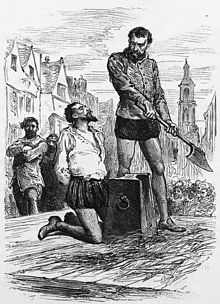
Iceland has enforced this article in the past.  On both occasions, it was to prosecute Icelanders who mocked the Third Reich in some capacity.  In 1934, Þórbergur Þórðarson was charged under the law for an article he wrote about Germany at the time, wherein he called Adolf Hitler “the sadist in the German chancellor’s seat.”  Further, Icelandic poet Steinn Steinarr was charged under the same law, when he and a group of others who torn down a Nazi flag flown by the German consulate in Siglufjörður.

So why – you might ask – would one country prosecute its citizens for insulting the leader of a foreign country?  The answer?  International relations.

As noted in The Guardian [on] Böhmermann, the only way to “make sense of this prosecution is to set it in the context that the law’s 19th-century drafters probably envisaged:

In the specific case of Germany’s section 103, about slighting foreign states, the government must expressly approve the prosecution, presumably because the whole original purpose was to deploy the criminal law as an instrument of foreign policy.

And incidentally, this business of punishing your own citizens for insulting a foreign leader is nothing new.  One notable example from history is Sir Walter Raleigh.

“Sir Walter” was a court favorite of Queen Elizabeth I.  (She knighted him in 1585.)  But then came a change of regime, in the form of Elizabeth’s successor, King James I.  (The guy who created the King James Version of the Bible, but was “not favourably disposed” toward Raleigh.)   And Raleigh pushed his luck too far.
Between bouts in prison, Raleigh was famous for establishing colonies in the New World and “also well known for popularising tobacco in England.”  But in doing all that he made the Spanish king very angry.  (Mainly because he stole lots of gold from Spanish ships.)

Things went well as long as his forays produced some income.  But finally, his luck – and King James’ patience – ran out.   In 1618, “to appease the Spanish,”  he was arrested and executed.

The good news from all this is that Jan Böhmermann won’t be hung or beheaded.  (Like Raleigh, above left.)  In fact, the “archaic law” now seems so ridiculous – “in the light of day” – that it’s on the path to extinction.  See Germany to Scrap Law [against] Insulting Foreign Leaders.

But the point I’m trying to make – in case it’s too subtle – is the marked contrast between those laws that punish citizens for insulting foreign leaders, and Exodus 22:28.  Whatever else you can say about the 12 countries [that] punish you for insulting their heads of state, they’re at least “following the Bible.”  I noted another marked contrast – between that Biblical commandment as practiced and as preached” – in On dissin’ the Prez.  (In my other blog.)

Another aside:  The Apostle Paul was reminded of Exodus 22:28 in Acts 23.  He was on trial – for “preaching” – before the Sanhedrin.  (The “Hebrew Supreme Court.”)  High priest Ananais told a guard to “strike him on the mouth,” and Paul responded as shown in the image below:

Those standing nearby said, ‘Do you dare to insult God’s high priest?’   And Paul said, ‘I did not realize, brothers, that he was high priest; for it is written, “You shall not speak evil of a leader of your people.”’

(Which brought up Conservative Christians who say the Bible must be interpreted literally.)

But getting back to the subject at hand:  In Turkey, over “1,800 people – including schoolchildren – have been prosecuted for comments posted on social media that insult Erdogan:”

In Istanbul, opinions are divided on the move against the comedian…  “The president [Erdogan] has his own rights,” said one man.  “When someone insults the German president they put him into the prison, also the American president. (E.A.)

Oh really?  Apparently that guy hasn’t watched Fox News or listened to American talk radio…


http://upload.wikimedia.org/wikipedia/commons/2/2b/Angelico,_niccolina_02.jpg

“God will strike you, you whitewashed wall!”

*   *   *   *

The upper image is courtesy of not bite your tongue about some world leaders – GlobalPost.  (Cited in the text as “This is how these 12 countries will punish you for insulting their heads of state.”)

Sources used in writing this blog-post include: Turkish President Wants German Satirist JailedGerman Comedian May Face PrisonCORRECTION BACKGROUND German law: When does insulting a foreign leader become a crimeCalls grow to scrap law on insulting foreign leaders [Germany]Germany to Scrap Law that Prohibits Insulting Foreign LeadersJan Böhmermann – Wikipedia, and The Guardian view on the Jan Böhmermann affair.

Re: firestorm.  See “F” Metaphors, including Firestorm.

Re: Raleigh and Spanish gold.  One example:  When his fleet captured an incredibly rich prize— a merchant ship (carrack) named Madre de Deus (Mother of God) off Flores.

The lower image is courtesy of wikipedia/commons/2/2b/Angelico,_niccolina_02.jpg.  The caption: ““Fra Angelico, Dispute before the Sanhedrin (1449).”  The painting is based on “Acts 23.”