* * * *
* * * *
July 28, 2026 – The last post explored our May ’26 driving trip in Ireland from Dunboy Castle – on May 12, “much of it along Bantry Bay” – over to Killarney. (In County Kerry, southwest Ireland.) On that long day, and the days before that, we kept checking the weather forecast for Portmagee on May 13. There in Killarney, late on May 12, we finally got the bad news: The winds next day would be way too choppy. (“Sustained winds over 28 mph, gusts above 41 mph.”)
That is, way too choppy for me to take the tiny-boat-ride I’d reserved, seven miles out from Portmagee into the stormy Atlantic. There – if the winds had been under 20 miles per hour – I could have climbed gingerly down from the boat onto the tiny dock at Skellig Michael. Once ashore I would then have tried to climb the rugged path up to the top; “not a place for people with mobility difficulties, or kids; ‘It’s just too easy to fall off the path.’” That was the bad news.
The good news? We didn’t have to get up at the crack of dawn to make the 10:00 a.m. boat. (Though actually I had to be at the dock at something like 9:30.) But we did go down to Portmagee, later in the day, and there we visited The Skellig Experience Visitor Centre. (Where we learned that the rugged island is where they filmed some scenes in Star Wars VII. As Wikipedia noted: “On July 28, 2014, filming took place over three days at Skellig Michael.”)
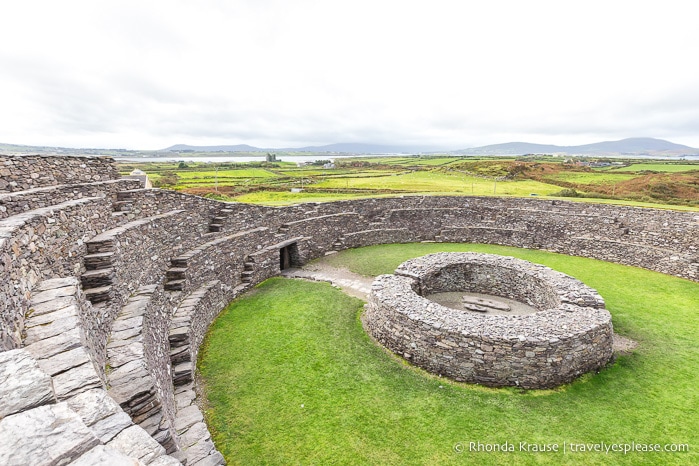
Because we didn’t have to make the 10:00 a.m. boat we took our time heading down. On the way we stopped at the Cahergall stone ring fort (“cashel” in Irish), 40 miles west-southwest of Killarney and 11 miles shy of Portmagee. The ring fort was built around 600 AD and is said to be one of the best examples of an early medieval stone fort on the Ring of Kerry. You can see lots of good picture at Visiting Cahergall and Leacanabuaile- Irish Stone Ringforts, but here’s one man’s take: “The fort was so much bigger than I anticipated, its dry stone wall approximately 6 metres high and 3 metres thick. I felt so tiny when I stood beside it!” Other thoughts:
Another interesting feature of the fort was the flights of steps and terraces all around the inner face of the wall. I wasn’t expecting to be able to climb up and walk the circumference of the fort… The 360-degree view from the top of Cahergall stone fort was wonderful! I could see Ballycarbery Castle and the harbor off in the distance, farmhouses with sheep roaming the fields, and the surrounding green and brown hills.
In plain words, exploring the fort was not for the faint of heart, nor those with bum knees, so I explored the place – wearing 10 pounds of ankle weights to bun off some beer calories – while my partner waited back near the gate. (It was a very steep and rocky climb up to the fort.)
I took my time coming back down, after getting a good workout clambering about those walls; the path itself was made of jagged more-or-less flat-but-slippery rocks. Once back down, “at the gate to the stone fort, a local guy approached us and made conversation, then asked if we wanted to hold the lamb. Of course we did!” That’s what my partner wrote, about how we got the memory of a cute photo of her holding the fuzzy, well-behaved and adorable lamb as I stand to the left, leaning in. And in that photo I’m wearing multiple layers, much of what I’d packed.
Leaving the stone fort we took the Castlequin road to a body of water west of where the River Ferta widens (considerably), then crossed the bridge to Cahersiveen, still nine miles short of Portmagee. There we stopped for brunch at Bari Café Kerry. We split a quiche, very substantial actually, that included some kind of rhubarb compote; very tasty.
And I had a large steaming-hot cup of coffee.
Then came The Skellig Experience, in Portmagee. It featured “the magic and mystery of these famous rocks to you through graphics, film presentation, models, exhibition items, reconstruction and the sound of sea birds and lighthouse keeper ship to shore communication.” Over 1400 years ago – on this End of the World – “Skellig Michael became home to a small group of men seeking religious solitude and isolation on one of the most extraordinary locations on earth.”
It was a great place, fascinating exhibits, but not the real thing. (Thus the “wait’ll next year!”)
After the Skelling Experience we drove to the Cliffs of Kerry, or the Kerry Cliffs, which “stand over 1000 ft above the wild Atlantic and were formed in a desert environment 400 million years ago. Out to the west stand the amazing Skellig Rocks,” including Skellig Michael.
The Kerry Cliffs link included lots of dramatic pictures, then added this observation:
Allow a minimum of 1 hour for a visit to the Kerry Cliffs; many visitors spend a few hours relaxing and bird watching for many hours and even return the next day or another day during their vacation. It is recommended to stay overnight in the local village of Portmagee (Ireland’s top tourist town 2012) to make the most of your visit; to enjoy the local culture and traditional Irish music.
Which is another good reason for that “wait’ll next year,” or some time after that. In other words, we now have two good reasons to go back to Ireland at least one more time. For me to take the boat out to Skelling Michael (and climb to the top), and also to spend a night in Portmagee. There – among other things – we could spend a good hour or more enjoying the Cliffs of Kerry. But on that gusty May 13, 2026, the place was cold.
I walked out to the sheer cliffs that plummet a thousand feet down to the rocky shore below, where wind-tossed Atlantic waves crash and tumble. Out near the edge of one cliff I took a video-selfie. It showed the gusting wind whipping the hood of my rain jacket all about my face and neck; the rain jacket I wore for extra warmth, topped by a doo-rag to cover my ears and keep the wind from howling down my collar. (Did I mention that it was cold, mostly because of the wind?) It felt invigorating, for a time anyway, but it was also cold – and gusty.
On the way back to Killarney we stopped again in Caherciveen (different spelling) at Craineens Bar, “5:00 Ireland time, on the way back from the VERY windy Cliffs of Kerry the other side of Portmagee. Tonight, a pub dinner with traditional Irish music?” And so it happened.
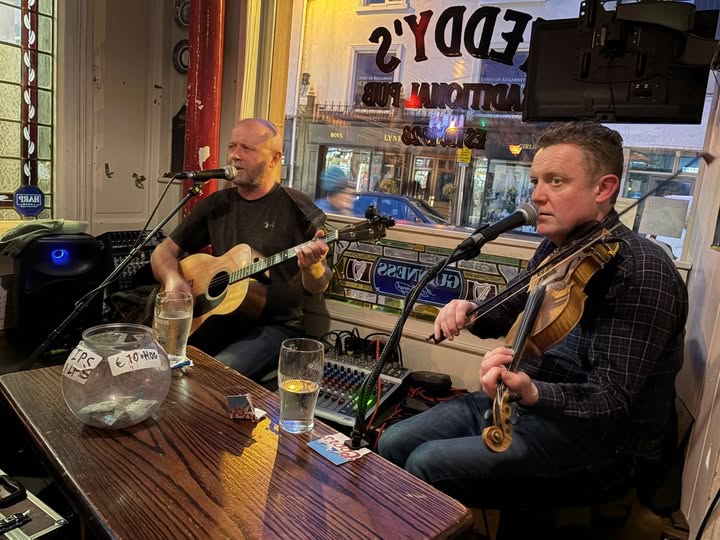
Or as my partner wrote, “To top off the day, traditional Irish music at this place” – O’Connor’s Traditional Irish Pub – “on High Street in Killarney. Introduced ourselves as from Georgia, they played ‘The Devil went down to Georgia.'” Which is being interpreted: When we got there the place was packed, and the only seats were right up front, where the two troubadours shown below sat, their backs to the window out onto High Street. The fiddle player, not two feet away, saw my “LA” hat and asked if I was from California. I said “No, I’m from Georgia.”
From there we played a guessing game; I guessed that the one song they knew about Georgia was “Georgia on my mind,” by Ray Charles. “Wrong!” They knew The Devil went down to Georgia, and proceeded to play that. But I had a bit better luck later, when the duo knew and played The Mountains of Mourne, “a whimsical look at the styles, attitudes and fashions of late nineteenth-century London as seen from the point of view of an emigrant laborer from a village near the Mourne Mountains.” And that’s one of the two main reasons I wanted to come to Ireland: To climb Skellig Michael and also to see “where the dark Mourne sweeps down to the sea.” (From the Don McLean version that always gets me right there at the end.)
The thing is, I remembered the Strand from Don’s version because I was there last year:
You remember young Denny McClaren, of course
But he’s over here working with the rest of the force
I saw him one day as he stood on The Strand
And he stopped all the traffic with a wave of his hand…
Last year I was in London, on August 7, waiting for my brother to fly over and from there we’d start hiking the Canterbury Trail. I wrote of that day that – on my own – and after “hiking down The Strand I headed over to the Thames Path, then west to Waterloo Bridge. Once across the river I took the 77 bus from Waterloo Station down to Nine Elms. Heading home I stopped at The Nott for a pint and nodded to a now-familiar local or two.”
Again, that was last year, but while I stood on The Strand I didn’t stop any traffic, with or without a wave of my hand. (It was more like I was trying to remember that when crossing a street in London, you have to remember that the car or bus that may run your ass over won’t be coming from the left, it’ll be coming from the right.) But back to the Mountains of Mourne, and listening to the two troubadours below singing it, and remembering that it’s such a haunting song that seeing “where the dark Mourne sweeps down to the sea” has been on my Bucket List a long, long time. The last two lines tell of the narrator, standing on the Strand with Denny McLaren (as I remember it), and both longing for home: “But for all his great powers, he’s wishful like me, to be back where the dark Mourne sweeps down to the sea.”
Like I said, those last two lines always get me right there at the end, as they speak of a longing for a time that wasn’t so hectic and troubling, a simpler time when life seemed so much better. And that’s why seeing the Mountains of Mourne was one of the two things I wanted to experience on this trip to Ireland. That “hiking to the top of Skellig Michael” turned out be a bust, but seeing where the dark Mourne sweeps down to the sea is a story for a later post.
In the meantime we enjoyed the authentic Irish music, in a traditional Irish pub, with a pint of authentic Guinness to go with it, all of which made for a cherished-memory Irish evening.
* * * *
* * * *
The upper image is courtesy of Visiting Cahergall and Leacanabuaile- Irish Stone Ringforts.
Re: “Wait’ll next year!” As always, that depends on circumstances, many beyond one’s control. But “we” would definitely like to go back to Ireland at least one more time. But one caveat: To try harder to get that compact car we originally wanted, not the large SUV that kept scraping the many stone walls that lined the narrow roads.
About that stop at Craineens Bar, in Caherciveen, at “5:00 Ireland time.” As I recall I had a celebratory pint there, cold weather be darned. I figured I’d earned it. “It’s Five O’Clock Somewhere…”
See Mountains of Mourne, and also My Mourne Mountains Guide: Walks, History + More.
Re: Me on the Strand in London. See In London – August 7 and 8, 2025.
My partner informs me that she took the lower photo.
* * * *


