Monthly Archives: April 2026

Back to the Preview of Ireland…

*   *   *   *

From Guinness, in Dublin, “one of the most unique collections of advertising in the world…”

*   *   *   *

Welcome to the “Georgia Wasp…”

This blog is modeled on the Carolina Israelite. That was an old-time newspaper – more like a personal newsletter – written and published by Harry Golden. Back in the 1950s, people called Harry a “voice of sanity amid the braying of jackals.” (For his work on the Israelite.)

That’s now my goal as well. To be a “voice of sanity amid the braying of jackals.”

For more on the blog-name connection, see the notes below.

In the meantime:

April 30, 2026 – My last post talked about an upcoming adventure-trip to Ireland in May. (The future of which seemed in doubt because of a last-Thursday visit to the emergency room, caused by a meniscus tear that turned out to be not as serious as we first thought. And a side note: My meniscus – plural, “menisci?” – is fine.) So, back to that Preview of Ireland – 2026:

My travel partner and I will fly into Dublin, then travel by car in a great circle route that will head over to the west coast, then up and over to Belfast and back down to Dublin. This post will cover what figures to be a highlight, weather permitting and the creek don’t rise: My clambering to the top of Skellig Michael, “a rocky island off the coast of County Kerry, Ireland, with a Gaelic monastery and a World Heritage Site.”

But even before that ER visit there was a last-minute change. The night before I clamber atop Skellig Michael – weather permitting – we will now be staying at Haven Suites, on Monsignor O’Flaherty Road in Killarney. We originally planned to stay in Dingle, but that would mean a lot of excessive driving. (Mass transit away from Dublin – out in the Irish boonies – is not as good as in England last year, so we rented a car. That in turn will require getting used to driving on the “wrong side of the road.”) So anyway, the point being: That change will reduce driving time from Cork to Killarney from 5.5 to 4.5 hours, and – after we leave Killarney – reduce the driving time from Cork to Galway from an estimated six hours to four hours and 15 minutes.

But before all that, three days in Dublin. We’ll visit places like the Jameson Distillery, Trinity College (with its Book of Kells), and the Guinness Storehouse Tour. That Guinness tour will include a floor featuring 80 years of ground-breaking marketing campaigns, with “one of the most unique collections of advertising in the world from tiny Guinness buttons to giant Guinness posters and statues.” (As shown in the top image.) Then end at “the real best floor of the tour because it’s where you get your free pint of Guinness … at the Gravity Bar,” one of the highest points in the city with “360° panoramic views across all of Dublin.” (And a note: We won’t be driving that rental car until the day we leave town; in town we’ll rely on Dublin mass transit.)

Leaving Dublin we’ll rent a car and drive to Kilkenny, built on both banks of the River Nore, with a population of 27,184. (According to the 2022 census.) There we’ll visit Kilkenny Castle, built in 1260 to control a fording-point of the River Nore and as “a symbol of Norman occupation.” After that we’ll visit the Smithwick’s Experience: “In Dublin, it’s all about Guinness. In Cork, make it a Murphy’s. And Kilkenny? Well, Smithwick’s is the way to go:”

Brewed in the medieval city since the 18th century, this ale has a rich ruby colour with a pale creamy head, and is served in pubs all over the island of Ireland. But tasting it is one thing, experiencing it is another, and the best way to uncover the history, personalities and place behind the beer is with a visit to Smithwick’s Experience Kilkenny.

And after driving that first 80 miles out of Dublin – “on the wrong side of the ^%$# road!” – I’ll be ready for a tall cool glass of Smithwick’s best. And after that, ready for the next day’s drive to Cork. (And once we’re in Cork I’ll be sure to try a Murphy’s Irish Stout, “brewed to be less heavy and less bitter than its chief competitor Guinness.”) Stay tuned for reviews!

*   *   *   *

Smithwick's logo

*   *   *   *

The upper image is courtesy of “guinness ads through the years” Images.

Re “Boonies.” See Why Do We Call the Country “the Boonies”? – Mental Floss. Unbeknownst to me, the term has a history going back to the American occupation of the Philippines in the early 20th century. It was “adopted into English shortly after the turn of the last century from Tagalog, one of the languages of the Philippines. In Tagalog, bundok means “mountain,” and it seems that word also came to be used more loosely in English in reference to any remote place… The use of boondocks among the U.S. military ultimately endured, and led to the word being taken across to Vietnam, where it was first clipped to boonies in the 1950s.” (And that’s why I love blogging; you learn stuff.)

Also about Murphy’s Irish Stout, from Wikipedia:

Its flavour is evocative of caramel and malt, and is described as “a distant relative of chocolate milk.” The resemblance to milk extends beyond flavour to texture: Murphy’s is free from any hint of carbonation, and is delivered “black as strong cappuccino” with an inch of foam – the head – on top. The water of the River Lee in Cork allegedly gave Murphy’s its quality.

Which sounds interesting. (I wonder if it will give me my preferred “two-beer buzz?”)

The lower image is courtesy of Smithwick’s – Wikipedia.

*   *   *   *

Re:  The Israelite.  Harry Golden grew up in the Jewish ghetto of New York City, but eventually moved to Charlotte, North Carolina.  Thus the “Carolina Israelite.”  I on the other hand am a “classic 74-year-old “WASP” – White Anglo-Saxon Protestant – and live in north Georgia.  Thus the “Georgia Wasp.”    

Anyway, in North Carolina Harry wrote and published the “israelite” from the 1940s through the 1960s.  He was a “cigar-smoking, bourbon-loving raconteur.”  (He told good stories.) That also means if he was around today, the “Israelite would be done as a blog.”  But what made Harry special was his positive outlook on life.  As he got older but didn’t turn sour, like many do today.  He still got a kick out of life.  For more on the blog-name connection, see “Wasp” and/or The blog.

*   *   *   *

“Just to add a bit of drama” – April, 2026

*   *   *   *

A bit of how I felt, leaving the coast in pitch-black night, paddling due south to Half Moon Island

*   *   *   *

Welcome to the “Georgia Wasp…”

This blog is modeled on the Carolina Israelite. That was an old-time newspaper – more like a personal newsletter – written and published by Harry Golden. Back in the 1950s, people called Harry a “voice of sanity amid the braying of jackals.” (For his work on the Israelite.)

That’s now my goal as well. To be a “voice of sanity amid the braying of jackals.”

For more on the blog-name connection, see the notes below.

In the meantime:

April 26, 2026 – The last post mentioned “a new adventure coming up in May, 2026. A two-week trip to Ireland that will lead to another series of posts.” A highlight of that trip? My clambering to the top of Skellig Michael, “a rocky island off the coast of County Kerry, Ireland, with a Gaelic monastery and a World Heritage Site.” But now that new adventure is in doubt.

My travel partner and I spent last Thursday night in the ER, for what turned out to be a likely Meniscus Tear. And for future reference, I note what one site said What to Do and Not to Do:

Regardless of how your meniscus injury started, you need to go easy on your knee to let it heal. Once it’s injured, you may feel pain during everyday activities that never bothered your knee before… If you feel pain during an activity, that means your actions are likely tearing the meniscus further, and you should stop right away. Never drive through the pain of a meniscus injury.

Which means no more comments like, “walk it off, Nancy,” or “just rub some dirt on it.” Like we Boomers used to hear when we were kids? (Or at least what we like to tell young folk that’s what we heard when we were kids.) And it’s certainly good advice now, advice that “we” intend to follow in the next couple weeks. In the meantime, since last Thursday we’ve been waffling back on forth on whether to cancel the trip. Things looked bleak Thursday night, April 23, but after the follow-up work on Friday came the thought: “Maybe we can still make a go of it?”

Thus the “bit of drama” in the title of this post. So in the meantime, until things get sorted out – and to fill in the blank space in the interim – I offer this short review of a past travel adventure: My brother and I canoeing 12 miles off the coast of Mississippi back in 2014. Which brings up the question: “Why in the hell would anyone in his right mind want to do that?”

Why would two old geezers – in 2014, 63 and 69 respectively – paddle far out into the realm of sharks and drownings? For one answer see John Steinbeck. He began Part Two of Travels with Charley by noting most men his age were told, “slow down.” (He was 60 at the time. “Oh, to see 60 again!”) And so, back then doctors advised men that age to “pack their lives in cotton wool, smother their impulses, hood their passions, and gradually retire from their manhood.” (To “trade their violence for a small increase in life span.”) But that wasn’t Steinbeck’s way:

I did not want to surrender fierceness for a small gain in yardage…  If this projected journey should prove too much then it was time to go anyway. I see too many men delay their exits with a sickly, slow reluctance to leave the stage. It’s bad theater as well as bad living.

And I certainly don’t want to be accused of Bad Theater. Which brings up what Robert Louis Stevenson said in a similar vein in his 1879 book, Travels with a Donkey in the Cévennes.

Early on in his Travels, he found himself groping in the dark for a campsite. (A site “black as a pit.”) He settled in for the night, then ate a crude dinner; a tin of bologna and some cake, washed down with brandy. “The wind among the trees was my lullaby.” Then woke in the morning “surprised to find how easy and pleasant it had been,” out in the open, “even in this tempestuous weather.” He then waxed poetic: “I had been after an adventure all my life, a pure dispassionate adventure, such as befell early and heroic voyagers; and thus to be found by morning in a random nook in Gevaudan – not knowing north from south, as strange to my surroundings as the first man upon the earth.” In other words, he experienced what the less adventurous have no idea they’re missing. Something of the feelings that “the explorers back in the olden days had.” (Those “early and heroic voyagers…”) On page 64 of my copy he expanded that thought:

Alas, as we get up in life, and are more preoccupied with our affairs, even a holiday is a thing that must be worked for. To hold a pack upon a pack-saddle against a gale out of the freezing north is no high industry, but it is one that serves to occupy and compose the mind.  And when the present is so exacting, who can annoy himself about the future?

And by the way, I myself have hiked the Robert Louis Stevenson Trail in France, back in 2023. (To see multiple posts on the hike type “Cevennes” in the search engine above right.)

In the same way – as I also experienced on that November 2014 primitive-camp canoe trip – “who can annoy himself about the future” when he’s immersed in the exacting task of paddling for hours on end. When he’s 12 miles offshore, at the mercy of the elements. When day’s end promises naught but a lukewarm meal on a soggy beach, or salt marsh. (Which actually turned out to be quite rewarding. The wealth of bull rushes growing out of the sloshing water on that salt marsh gave the softest bed of the journey.) Plus, as Tom prepared our dinner – likely hot dogs and baked beans – some playful dolphins frolicked not ten yards away in the Gulf.

All that and a few swallows of O-be-joyful made a very pleasant evening, 12 miles off the coast of Mississippi. But as it turns out, that’s the nature of pilgrimage: “A person who makes such a journey is called a pilgrim. As a common human experience, pilgrimage has been proposed as a Jungian archetype. . . Some research has shown that people who engage in pilgrimage walks enjoy biological, psychological, social, and spiritual therapeutic benefits.”

Which brings up the image at the top of the page. It had to do with the nagging feeling I got in the back of my mind early on during that 2014 canoe trip. We had determined to break camp in the dark and get most of our paddling done before the afternoon sun started roiling the waters. (Which can be unsettling in a canoe out in the Gulf of Mexico.) The first few days we paddled along the coast, but then came the early morning we had to leave the coast and set off due south to Half Moon Island, three miles out into the Gulf of Mexico. We were leaving the civilized world and heading out in the pitch-black darkness, away from all those helpful navigation lights. “What ‘nagged me’ was the feeling, as we set off into the utter darkness on the morning of November 8, that we would either fall off the edge of the earth, or ‘there be dragons.'”

But we encountered no dragons and didn’t fall off the edge of the world. In other words, I paddled through the fear, or and Nelson Mandela said, “The brave man is not he who does not feel afraid, but he who conquers that fear.” And that’s why I enjoy my pilgrim adventures:

My brother and I did eight days and 80 miles worth of canoe-paddling on our own. We’d also camped in and on a salt marsh, and seen nature at her majestic best (and worst). We’d seen dolphins capering, once just off our salt-marsh camp, and other times just off our bows. I learned to live on a breakfast ration of one and a half granola bars and tepid instant coffee. I learned to pitch a tent on a salt marsh, with water sloshing around my feet, only to find that the abundant bullrushes provided a most comfortable bed. 

Does that make me a Jungian archetype, like Rick Blaine in the film Casablanca? I’d like to think so, but for now I’d just be happy getting on that Delta flight to Dublin in a week or two, then enjoy climbing to the top of Skellig Michael and visiting the Guiness and Jameson breweries.

Stay tuned for updates!

*   *   *   *

undefined
 “Rick Blaine has been seen through Jungian analysis as a classic hero…”

*   *   *   *

The upper image is courtesy of “leviathan in the bible” images. See also Here be dragons – Wikipedia.

Re: “Walk it off, Nancy.” The AI Summary indicates that the idiom “suggests dealing with minor injuries or discomfort by continuing to move,” and is often used to encourage resilience and toughness, or can be “seen as dismissive of someone’s pain or discomfort,” but mostly originates “from a culture that values stoicism and endurance.” And to clarify, my meniscus is fine…

For this post I reviewed On canoeing 12 miles offshore, from May 2015, and Canoeing 12 miles off the coast of Mississippi, from July 2017.

Re: “O-be-joyful.” That’s a code-word for ardent spirits. We brothers – originally four – started packing samples in past canoe trips, like down the Missouri River from Fort Benton, MT. That was a way of following in the footsteps of Lewis and Clark, and other American pioneersYou see, back in the old days of our country, whiskey – for example – was used instead of hard currency:

One of the first media of exchange in the United States was classic whiskey.  For men and women of the day, the alcohol did more than put “song in their hearts and laughter on their lips.”  Whiskey was currency.  Most forms of money were extremely scarce in our country after the Revolutionary War, making monetary innovation the key to success.

In other words, we were following in the footsteps of Lewis, Clark and other pioneers. See also Why Whiskey Was Money, and Bitcoins Might Be. Another note: I wrote about this subject in the March 2023 post, The Okefenokee – “Haven of Serenity” or Deadly Swamp? (About canoeing into – bisecting – the Deadly Swamp from east to west.)

A Jungian archetype “refers to a universal, inherited idea, pattern of thought, or image that is present in the collective unconscious of all human beings,” and also “thought to be the basis of many of the common themes and symbols that appear in stories, myths, and dreams across different cultures and societies.” The Wikipedia article – quite detailed – included the lower image, with the caption: “Casablanca co-protagonist Rick Blaine has been seen through Jungian analysis as a classic hero, the character being in one of the most memorable love triangles in film.” (Who knew? But that’s why I love blogging. You learn about stuff like “Jungian archetypes.”)

*   *   *   *

Re:  The Israelite.  Harry Golden grew up in the Jewish ghetto of New York City, but eventually moved to Charlotte, North Carolina.  Thus the “Carolina Israelite.”  I on the other hand am a “classic 74-year-old “WASP” – White Anglo-Saxon Protestant – and live in north Georgia.  Thus the “Georgia Wasp.”    

Anyway, in North Carolina Harry wrote and published the “israelite” from the 1940s through the 1960s.  He was a “cigar-smoking, bourbon-loving raconteur.”  (He told good stories.) That also means if he was around today, the “Israelite would be done as a blog.”  But what made Harry special was his positive outlook on life.  As he got older but didn’t turn sour, like many do today.  He still got a kick out of life.  For more on the blog-name connection, see “Wasp” and/or The blog.

*   *   *   *

A preview of Ireland – 2026

*   *   *   *

undefined
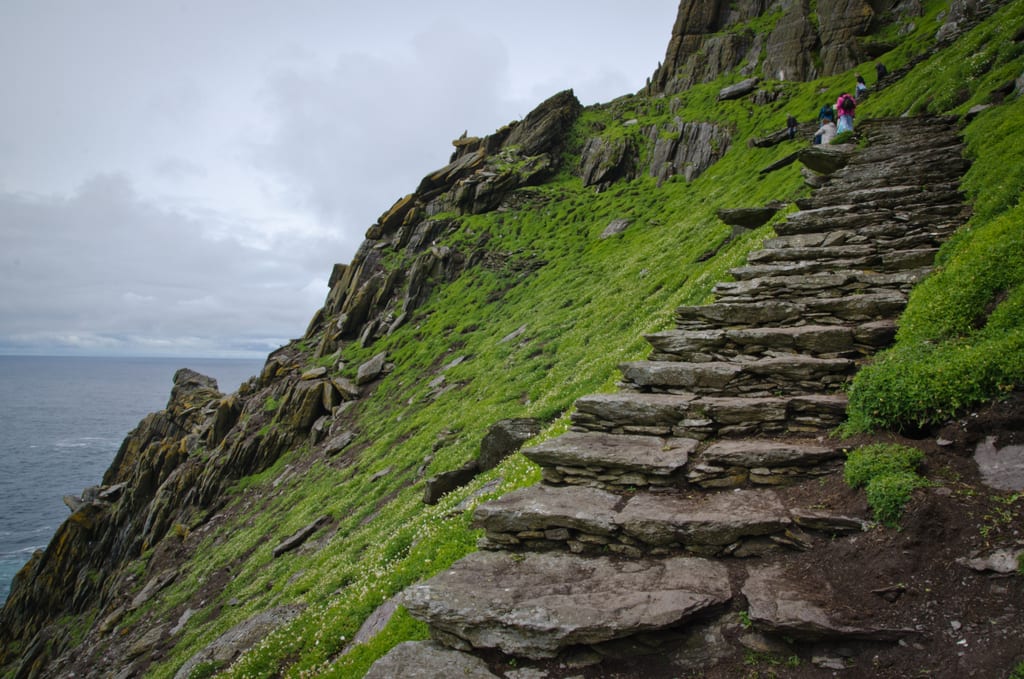
One view of Skellig Michael, a path I’ll be clambering this May – “weather permitting,” etc.

*   *   *   *

Welcome to the “Georgia Wasp…”

This blog is modeled on the Carolina Israelite. That was an old-time newspaper – more like a personal newsletter – written and published by Harry Golden. Back in the 1950s, people called Harry a “voice of sanity amid the braying of jackals.” (For his work on the Israelite.)

That’s now my goal as well. To be a “voice of sanity amid the braying of jackals.”

For more on the blog-name connection, see the notes below.

In the meantime:

April 14, 2026 – My last post – Canterbury – At last! – finished a series that started back in July 2025. A Canterbury hike preview – and some posts that followed – talked about a two-week visit to England last May. I did that Mid-May “Recon” to prepare for another visit to England, to hike the Pilgrims’ Way in August 2025. (It’s also known as the Canterbury Trail.)

That led to another series of posts about the actual hike, starting chronologically with On to Winchester – August 11 (2025), from last October. But I actually started that series at the end, with my September 9 (’25) post, On my last day in London – 2025. Which is actually a great story-telling technique. See What is the literary term for a book that begins at the end?

The literary term for a book that begins at the end is often referred to as a “frame story.” This narrative technique starts at the ending and then flashes back to explain how the story reached that point… This means that the story is beginning with a prolepsis, or a “flash-forward” in time. This kind of style operates as a postmodern narrative device and has come to be fairly popular in contemporary literature. 

But now it’s time to talk about a new adventure coming up in May, 2026. A two-week trip to Ireland, which will lead to another series of posts. (Though I’ll follow that up with a separate – a hiking – adventure in August, 150 miles or so on the GR 5, short for the Grand Randonnée Five. It starts at the Hook of Holland and we’ll end up in Maastricht, a story for a later time.)

But back to that trip in May to Ireland. My travel partner and I will fly into Dublin. then travel by car in a great circle route that will head over to the west coast, then up and over to Belfast and back down to Dublin. This post will cover what figures to be a highlight, weather permitting and the creek don’t rise: My clambering to the top of Skellig Michael, “a rocky island off the coast of County Kerry, Ireland, with a Gaelic monastery and a World Heritage Site.”

The island is named after the archangel Michael, and “Skellig” is derived from the Irish language word sceilig, meaning a splinter of stone. The island consists of 54 acres of rock. Its highest point, 714 ft above sea level, is defined “by twin peaks and a central valley called Christ’s Saddle.” All told, “a steep and inhospitable landscape.” (Emphasizing “inhospitable.”)

Which brings up the 1969 BBC documentary Civilisation: A Personal View by Kenneth Clark. In the first episode Clark described the island’s buildings and pathways as “an extraordinary achievement of courage and tenacity”. He observed that “looking back from the great civilizations of twelfth-century France or seventeenth-century Rome, it is hard to believe, that for quite a long time – almost a hundred years – western Christianity survived by clinging to places like Skellig Michael, a pinnacle of rock eighteen miles from the Irish coast.” And not surprisingly, by the 16th century Skellig Michael had become a place of religious pilgrimage.

And so it may be for me on what may be a cold, wet and windy day in May.

I’ll describe what I actually experience in a later post – weather permitting – but for now, here are some nuggets from a guy who’s already done it. First off, “600 steps to climb, most of them jagged slabs of rock.” This guy proceeded “at a snail’s pace, keeping my eye on every step.” And places to stop and rest were few and far between: “At times there was literally nowhere to stop but the steps themselves, as you’d pitch over the side of a cliff.”

It’s not a place for people with mobility difficulties, or kids; “It’s just too easy to fall off the path.” (There is a helicopter pad on the island, “just in case.”) You bring your own food and plenty of water. And there are no toilets on the island, so take care of that on the boat ride out?

Skellig Michael was not only remote and inhospitable, but it was “the end of the world” as far as the Irish knew. The monks may have chosen that destination to be closer to God, or closer to Satan, so they could defend the rest of the world.

As for the weather, getting off the island seemed to be harder than getting on. “I saw first-hand how this had almost been a no-go day. The boat rose and fell next to the steps and even though it seemed safe every 10 seconds or so, Eoin wouldn’t let me step on for a full minute, until a particularly boisterous wave gave him the signal to pull me on board.” Which led him to wonder: “How on Earth did the monks land here?” And not something I look forward to, getting off or back on to a heaving, pitching boat. Which is something I’ll contemplate on our first day in Dublin. We’re scheduled to arrive at 8:45 a.m. After settling in and resting up a bit, we’ll do the Jameson Dublin – The World’s Leading Distillery Tour at 4:30 that afternoon.

There, and in the days that follow I’ll contemplate climbing up those “jagged slabs of rock.”

*   *   *   *

“600 steps to climb, most of them jagged slabs of rock…

*   *   *   *

The upper image is courtesy of Skellig Michael – Wikipedia. Caption: “Path to Christ’s Saddle.”

See also What Is Prolepsis? Rhetoric, Grammar & Literature: “Prolepsis is a technique of treating something future as if it has already happened or is already true. The word comes from the Greek prolēpsis, derived from prolambanein, meaning “to take beforehand.” First recorded in English in 1578, it appears in three distinct fields: rhetoric, literature, and philosophy. In each case, the core idea is the same: pulling the future into the present.

Also, from What is the literary term for a book that begins at the end: “There are many novelists which apply the technique of beginning the text at the end of the story. Mary Shelley uses it in ‘Frankenstein;’ Daphne du Maurier uses it in ‘Rebecca;’ Edith Wharton uses it in ‘Ethan Frome.'”

See also Skellig Michael | History, Description, & Facts | Britannica.

The lower image is courtesy of Skellig Michael – Image Results. It came with a page, Skellig Michael: Ireland’s Most Striking Destination. I‘ve included my full notes from the page below.

*   *   *   *

Re:  The Israelite.  Harry Golden grew up in the Jewish ghetto of New York City, but eventually moved to Charlotte, North Carolina.  Thus the “Carolina Israelite.”  I on the other hand am a “classic 74-year-old “WASP” – White Anglo-Saxon Protestant – and live in north Georgia.  Thus the “Georgia Wasp.”    

Anyway, in North Carolina Harry wrote and published the “israelite” from the 1940s through the 1960s.  He was a “cigar-smoking, bourbon-loving raconteur.”  (He told good stories.) That also means if he was around today, the “Israelite would be done as a blog.”  But what made Harry special was his positive outlook on life.  As he got older but didn’t turn sour, like many do today.  He still got a kick out of life.  For more on the blog-name connection, see “Wasp” and/or The blog.

*   *   *   *

The full notes from Skellig Michael: Ireland’s Most Striking Destination:

I started slowly and continued at a snail’s pace, keeping my eye on every step. Speed doesn’t help you here. When I needed a break, I simply stopped — at times there was literally nowhere to stop but the steps themselves, as you’d pitch over the side of a cliff.

As you can tell by the photos, Skellig Michael is an exceptionally difficult place for people with mobility difficulties.

I also don’t think it’s a place for kids. It’s just too easy to fall off the path. I personally wouldn’t bring kids under the age of 12 — and even then, only well-behaved 12-year-olds who will understand the dangers and listen to you, do exactly as you say, and not go off on their own.

It’s good to know that there’s a helicopter pad on the island, just in case.

Soon I had reached a big grassy clearing with plenty of space to sit down and enjoy the sandwich that I had purchased on the mainland. There is nowhere to buy food on Skellig Michael — nor are there even toilets on the island!

At the time, Skellig Michael was not only remote and inhospitable, but it was “the end of the world” as far as the Irish knew. The monks may have chosen that destination to be closer to God, or closer to Satan, so they could defend the rest of the world.

After descending from the monastery to the big grassy area, I had my sandwich and wished I could get a particular photo I had seen — a photo of the staircase leading to the monastery with Small Skellig in the background.

By this point, very few people were left on this part of the island, making it an ideal time to take the picture. I scrambled up the path on the other peak and edged out to the side until Small Skellig appeared perfectly in the background:

Was it worth it?

Yes. It was SO worth it.

(Though please don’t do this unless you’re comfortable climbing! This part of the island is just a rough path, rather than a staircase, and climbing down is much more difficult than climbing up!)

And soon enough, it was almost time to meet Eoin at the boat. I climbed down the 600 steps as carefully as I climbed up them.

I saw first-hand how this had almost been a no-go day. The boat rose and fell next to the steps and even though it seemed safe every 10 seconds or so, Eoin wouldn’t let me step on for a full minute, until a particularly boisterous wave gave him the signal to pull me on board.

How on Earth did the monks land here?! I thought, a sentiment shared by my three companions from County Cork. It was so difficult to land in modern times — how did they land on the rock in the middle of the stormy Atlantic with only ancient technology!

*   *   *   *